Facts
The deceased, T. Ramu, was travelling in his Maruti 800 car on 13 July 1996 when an unidentified lorry struck the car from behind, causing injuries that resulted in his death.
Source reference: para. 27His legal representatives filed a compensation claim under the Motor Vehicles Act, 1988, alleging that he was the sole breadwinner and earned approximately ₹1,00,000 per annum.
Source reference: para. 28The Motor Accident Claims Tribunal rejected the claim on the ground that no additional premium had been paid to cover the personal risk of the vehicle owner.
Source reference: para. 29The Telangana High Court reversed that decision and awarded ₹10,00,500 with interest at 7.5% per annum, holding that the comprehensive/package policy covered the deceased as an occupant of the vehicle.
Source reference: paras. 30–31The insurance company appealed to the Supreme Court.
Source reference: para. 32During the appeal, the Court expanded its examination to systemic issues concerning uninsured vehicles and the structure of motor-vehicle insurance policies, after impleading insurance companies, IRDAI, the Ministry of Road Transport and Highways, and the General Insurance Council.
Source reference: paras. 2–4Issues
Whether the statutory mandate under Section 146 of the Motor Vehicles Act, 1988, requiring compulsory third-party insurance for vehicles, was being effectively complied with and what enforcement measures were necessary to address uninsured vehicles.
Source reference: paras. 1–4, 16–23Whether there should be a uniform motor-vehicle insurance-policy structure covering occupants of a vehicle, in addition to the statutorily mandated third-party-risk cover.
Source reference: paras. 1–4, 13–14, 23.4–23.6Whether, under a comprehensive/package insurance policy, the insurer was liable to compensate an occupant or owner travelling in the insured vehicle despite the absence of a separately paid premium for personal-risk coverage.
Source reference: paras. 26–34Law Applied
Section 146 of the Motor Vehicles Act, 1988 (“MVA”) makes third-party motor-vehicle insurance compulsory; Section 147 prescribes the requirements and limits of such policies; Section 149 imposes a duty on insurers to satisfy third-party awards; and Sections 196 and 207 provide penal and enforcement mechanisms against uninsured vehicles.
Source reference: para. 8Under the Insurance Regulatory and Development Authority Act, 1999, IRDAI is responsible for protecting policyholders and regulating insurance contracts, including their terms and conditions under Sections 14(2)(b) and 26.
Source reference: paras. 5–6The Court relied on the IRDAI circular dated 16 November 2009, under which a comprehensive/package policy covers occupants of the insured vehicle.
Source reference: para. 34It also relied on S. Rajaseekaran v. Union of India, (2018) 8 SCC 447, concerning mandatory long-term third-party insurance for new cars and two-wheelers.
Source reference: paras. 14, 23.7The Court relied on General Insurance Council v. State of Andhra Pradesh, (2007) 12 SCC 354, Jai Prakash v. National Insurance Co., (2010) 2 SCC 607, and M.R. Krishna Murthi v. New India Assurance Co. Ltd., (2020) 15 SCC 493, concerning the filing of accident information reports and expeditious disposal of motor-accident claims.
Source reference: para. 15The Court further applied the principle that motor-accident claims should not be approached hyper-technically, as recognised in Surekha v. Santosh, (2021) 16 SCC 467.
Source reference: para. 34Reasoning
The Court found that the statutory requirement of compulsory third-party insurance was substantially undermined by the large number of uninsured vehicles—approximately 56% of vehicles, or 16.54 crore out of 30.48 crore vehicles.
Source reference: para. 17Since uninsured vehicles deprive accident victims of timely and effective compensation and frequently lead to prolonged litigation, the Court considered technology-based enforcement necessary to give practical effect to Sections 146, 196 and 207 of the MVA.
Source reference: paras. 16–22It therefore accepted and institutionalised measures involving integration of ANPR cameras, the Insurance Information Bureau and the VAHAN portal, together with handheld applications for State Police.
Source reference: paras. 23.1–23.3To improve consumer understanding and standardise policy choices without making all occupant or own-damage coverage compulsory, the Court adopted a four-layer insurance structure: mandatory third-party-only cover; optional occupant/pillion-rider liability cover; optional personal-accident cover; and optional own-damage cover.
Source reference: paras. 23.4–23.6In the individual claim, the Court held that the policy was a comprehensive/package policy and that the IRDAI circular of 16 November 2009 required coverage of occupants; consequently, the insurer could not avoid liability merely because a separate premium for the deceased’s personal risk had not been shown.
Source reference: para. 34Holding
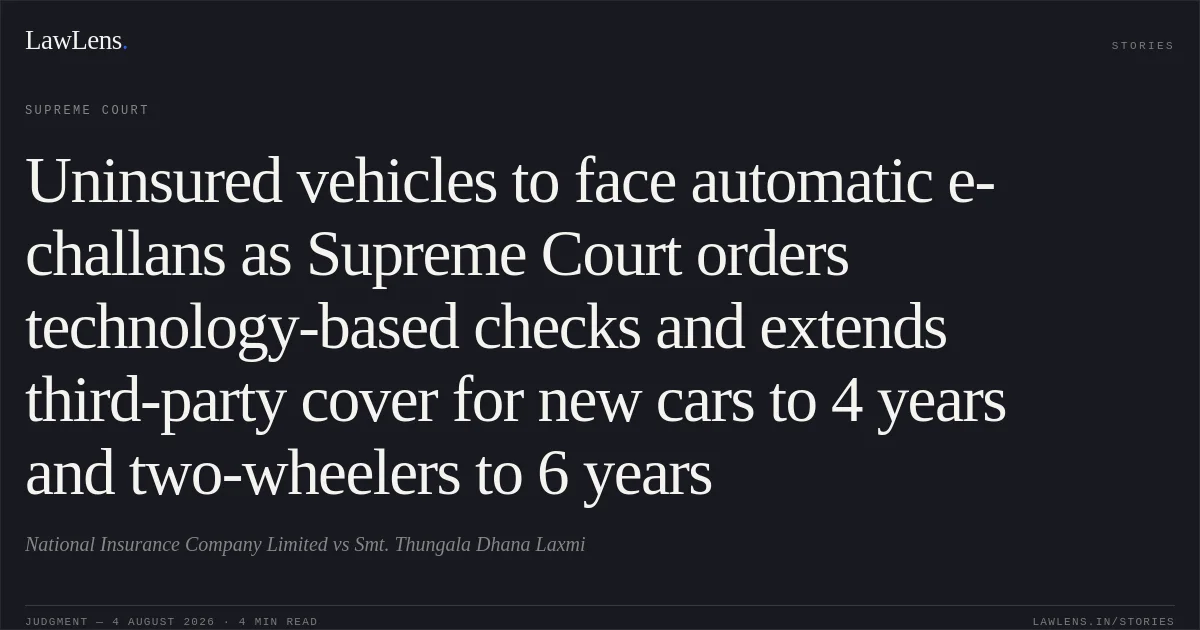
The Supreme Court dismissed the insurance company’s appeal and upheld the High Court’s award of ₹10,00,500 with 7.5% interest, holding that the comprehensive/package policy covered the deceased occupant of the vehicle.
In the public interest, the Court directed MoRTH and IRDAI to integrate ANPR, VAHAN and Insurance Information Bureau data for automatic e-challans; provide State Police with real-time insurance-verification tools; implement a uniform four-layer motor-insurance structure and customer-option form; formulate uniform wordings for optional covers; provide consumer-friendly information sheets; and require four-year third-party insurance for new cars and six-year third-party insurance for new two-wheelers.
Source reference: paras. 23.1–23.7It further directed insurance companies to display the benefits of comprehensive policies, contemplated pilot projects for public verification of insurance status and linking fuel access with valid insurance, and directed State Police to file Detailed Accident Reports and assist with service in pre-31 March 2022 pending claims.
Source reference: paras. 23.8–24.2Stakeholders were directed to file compliance responses by 14 August 2026, with the matter listed for review on 18 August 2026.
Source reference: para. 35Original Court PDF
National Insurance Company LimitedvsSmt. Thungala Dhana Laxmi
Click to open original judgment
Original judgment, available to read, download and summarize on LawLens.in