Facts
Reena Devi died after suffering extensive burn injuries.
Source reference: no citationIn a fardbeyan recorded at hospital, she alleged that her husband, Dhananjay Yadav, poured kerosene on her and set her alight after she objected to his drinking; she did not allege dowry demand in that statement.
Source reference: paras. 3, 21; pp. 2–3, 8–9The appellant was charged under Sections 304B, 302, 307 and 498A IPC and convicted under Section 304B IPC, receiving a sentence of life imprisonment.
Source reference: paras. 4–6, 10–12; pp. 3–6In appeal, he challenged the reliability of the fardbeyan and the evidence of dowry demand, and maintained that the deceased had set herself on fire.
Source reference: paras. 13–17; pp. 6–7Issues
1. Whether the prosecution proved the ingredients of dowry death under Section 304B IPC, including dowry-related cruelty or harassment soon before the death.
Source reference: paras. 23–29; pp. 9–132. Whether the fardbeyan could safely be relied on as the deceased’s dying declaration, given the circumstances of its recording and the non-examination of the recording officer.
Source reference: paras. 24, 29, 33; pp. 10, 13, 153. Whether the conviction and sentence under Section 304B IPC should be set aside or altered.
Source reference: paras. 33–35; pp. 15–16Law Applied
Section 304B IPC governs dowry death and requires proof of a woman’s death otherwise than under normal circumstances within seven years of marriage, together with cruelty or harassment by her husband or his relative for, or in connection with, a dowry demand soon before her death; the trial court had treated these ingredients as established.
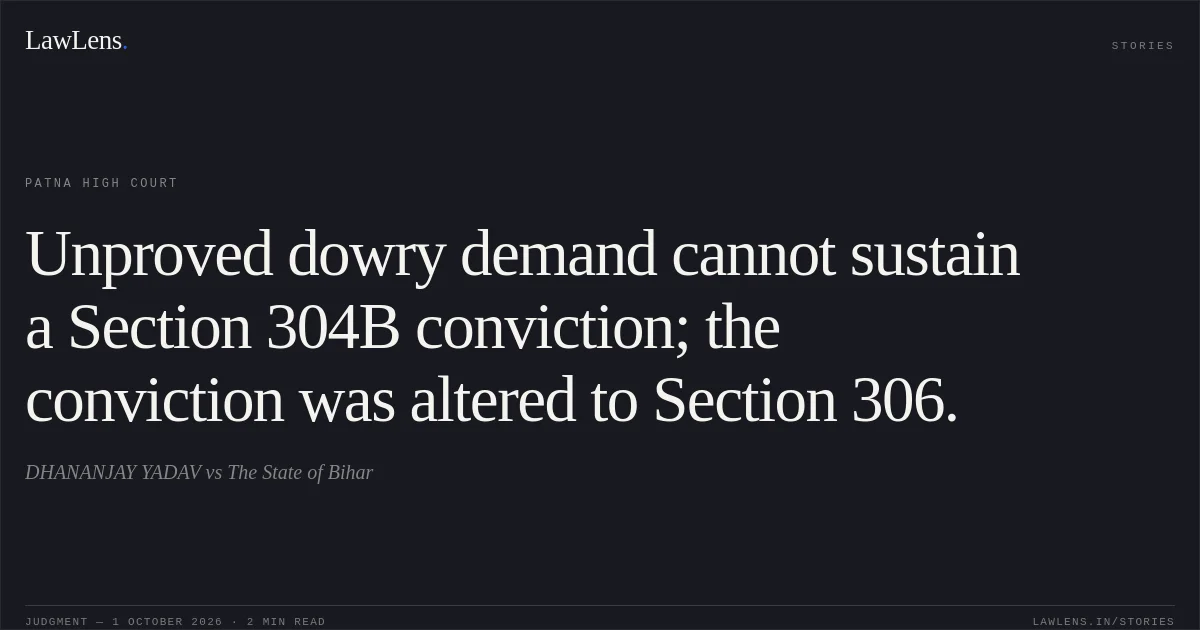
Source reference: paras. 10, 23; pp. 5, 9The Court also altered the conviction to Section 306 IPC, which concerns abetment of suicide, and modified the sentence accordingly.
Source reference: para. 34; p. 15The judgment cited no precedent and did not set out a separate test for assessing a dying declaration; it considered whether the circumstances in which the fardbeyan was recorded had been adequately proved.
Source reference: paras. 24, 33; pp. 10, 15Reasoning
The Court found that the deceased’s fardbeyan contained no dowry allegation and attributed the immediate dispute to her husband’s drinking. The brother and father introduced dowry demands at trial, with differing amounts, and their evidence was not corroborated by the fardbeyan; the Court considered this a later development in the prosecution case.
Source reference: paras. 23, 25–27; pp. 9–12The recording officer was not examined, no doctor was present when the statement was recorded, and the conditions of recording were therefore not duly established. The post-mortem evidence confirmed extensive burns but disclosed no sign of struggle or other injury establishing forceful burning.
Source reference: paras. 24, 29–31; pp. 10, 13–14The Court also considered the appellant’s account that the deceased had self-immolated and that he was burned while trying to save her, noting that this account was consistent with parts of the evidence.
Source reference: paras. 25, 32–33; pp. 11, 14–15In those circumstances, it held that the fardbeyan was not safe to accept as a dying declaration and that the prosecution had not proved the dowry-related basis for a Section 304B conviction.
Source reference: paras. 26, 33; pp. 11–12, 15Holding
The appeal was allowed in part.
The Court altered the appellant’s conviction from Section 304B to Section 306 IPC and reduced the sentence to the period already undergone, with a fine of ₹20,000; in default of payment, he must serve three months’ simple imprisonment.
Source reference: paras. 34–35; p. 16Acts & Sections Cited
6 provisions across 2 statutes referred to in this judgment. Each provision opens on LawLens.
Indian Penal Code, 18605
Code of Criminal Procedure, 19731
Original Court PDF
DHANANJAY YADAVvsThe State of Bihar
Click to open original judgment
Original judgment, available to read, download and summarize on LawLens.in