Facts
The appellant challenged his conviction by the Special Additional Sessions Judge, Dantewada, in Special Sessions Case No. 17/2015, under Section 376 IPC, Section 323 IPC, and Sections 3 and 4 of the POCSO Act. He was sentenced to seven years’ rigorous imprisonment and fine under Section 376 IPC, fine under Section 323 IPC, and seven years’ rigorous imprisonment and fine under the POCSO Act.
Source reference: para. 2The prosecution alleged that the appellant had taken the victim to his house, maintained a physical relationship with her, and subsequently assaulted her after consuming alcohol. The victim had lived with the appellant for several months and later returned to her parental home, where the appellant also resided with her as her husband.
Source reference: paras. 3, 21The prosecution relied principally on the victim’s school records showing her date of birth as 3 April 1998 to establish that she was below 18 years of age.
Source reference: paras. 11–14The medical examination recorded scratches on the victim’s cheek, lip, ear and mandible, but no internal or external injuries to her private parts; the FSL report detected no semen or spermatozoa on the vaginal slides or underwear.
Source reference: para. 3The trial court acquitted co-accused Harish Mahanand but convicted the appellant.
Source reference: para. 6Issues
Whether the prosecution proved beyond reasonable doubt that the victim was below 18 years of age on the date of the alleged incident, so as to attract the POCSO provisions.
Source reference: paras. 10–19Whether the appellant had kidnapped or taken the victim from the keeping of her lawful guardian so as to establish the alleged kidnapping-related offence.
Source reference: paras. 20–24Whether the prosecution proved that the sexual relationship constituted rape under Section 376 IPC and penetrative sexual assault under the POCSO Act, notwithstanding the victim’s conduct and testimony.
Source reference: paras. 20–26Whether the evidence established the appellant’s guilt under Section 323 IPC for voluntarily causing hurt to the victim.
Source reference: para. 27Law Applied
The Court applied Section 374 CrPC governing criminal appeals, Section 376 IPC relating to rape, Section 323 IPC relating to voluntarily causing hurt, and the relevant provisions of the POCSO Act concerning penetrative sexual assault.
Source reference: no citationFor proof of age, it applied Section 35 of the Evidence Act and relied on Alamelu v. State, 2011 (2) SCC 385, Birad Mal Singhvi v. Anand Purohit, and Narbada Devi Gupta v. Birendra Kumar Jaiswal, holding that a school record may be admissible but has little or no probative value unless the person who made the entry or supplied the underlying information is examined.
Source reference: para. 15It also relied on Rishipal Singh Solanki v. State of Uttar Pradesh, 2022 (8) SCC 602, and P. Yuvaprakash v. State, 2023 SCC OnLine SC 846, concerning the hierarchy and evidentiary assessment of age records.
Source reference: paras. 16–17On kidnapping, the Court applied S. Varadarajan v. State of Madras, AIR 1965 SC 942, holding that voluntarily accompanying the accused does not amount to “taking” unless inducement, persuasion, or active participation in leaving the guardian is proved.
Source reference: para. 23The Court also referred to Tilku alias Tilak Singh v. State of Uttarakhand, 2025 INSC 226, regarding the significance of a victim aged between 16 and 18 voluntarily accompanying the accused.
Source reference: para. 24Reasoning
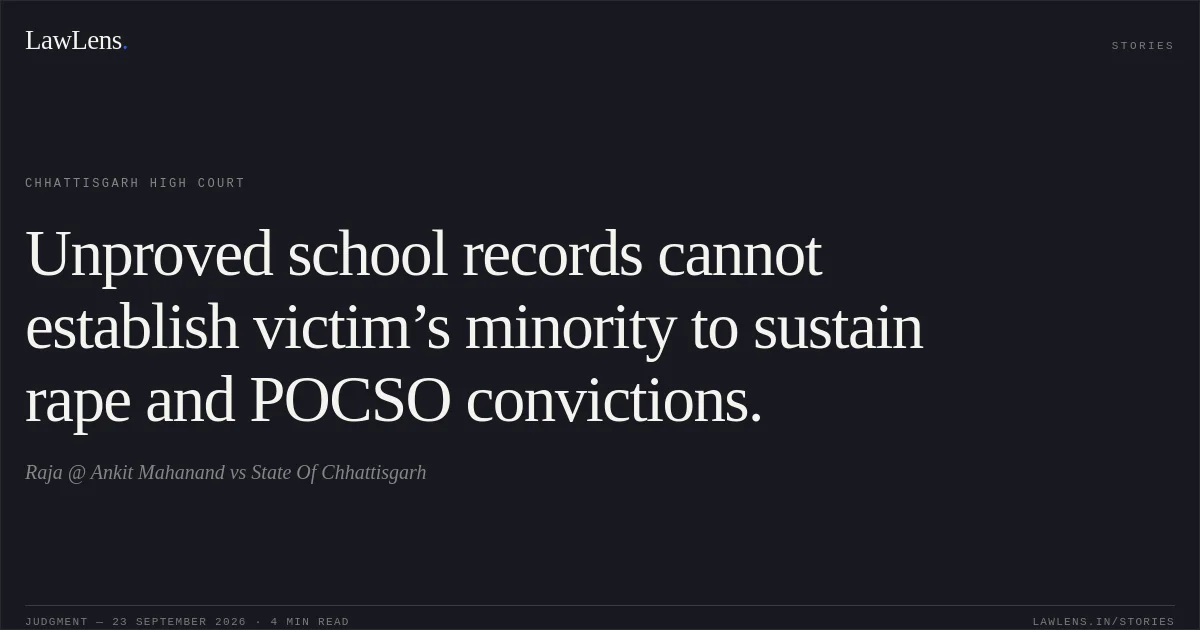
The Court held that the prosecution failed to reliably establish the victim’s age. Although the school register recorded her date of birth as 3 April 1998, the Headmaster and teacher were neither the authors of the relevant entry nor able to state the basis on which it had been made; the victim and her mother also did not know her date of birth or who had admitted her to school.
Source reference: paras. 12–14, 18–19Consequently, the entry could not conclusively establish that she was a minor. The victim’s own evidence further showed that she had voluntarily accompanied the appellant, lived with him for several months, returned to her parents’ house of her own accord, and again resided with him as husband and wife.
Source reference: paras. 18–19, 21–22She denied that the appellant had forcibly taken her, threatened her, or compelled her to have sexual relations, and stated that the FIR followed a domestic quarrel arising from the appellant’s drinking habit.
Source reference: paras. 21–22Applying Varadarajan, the Court found no proof of inducement, coercion, or active taking from lawful guardianship.
Source reference: para. 23In the absence of reliable proof of minority and coercion, and considering the victim’s evidence regarding the consensual nature of the relationship, the ingredients of rape and the POCSO offence were not established beyond reasonable doubt.
Source reference: paras. 25–26However, the medical evidence corroborated the victim’s allegation of assault, and the injuries on her cheek and other parts of the head remained unrebutted; therefore, the offence under Section 323 IPC was proved.
Source reference: para. 27Holding
The appeal was partly allowed. The Court set aside the appellant’s convictions and sentences under Section 376 IPC and Sections 3 and 4 of the POCSO Act, and acquitted him of those offences.
The conviction and sentence under Section 323 IPC were affirmed.
Source reference: para. 29As the appellant was on bail, his bail bond was directed to continue for six months under Section 481 BNSS, 2023, and the trial court record was ordered to be returned for compliance.
Source reference: paras. 30–32Acts & Sections Cited
22 provisions across 5 statutes referred to in this judgment. Each provision opens on LawLens.
Code of Criminal Procedure, 19734
Indian Penal Code, 18607
Protection of Children from Sexual Offences Act, 20128
Juvenile Justice (Care and Protection of Children) Act, 2015.2
Bharatiya Nagarik Suraksha Sanhita, 20231
Original Court PDF
Raja @ Ankit MahanandvsState Of Chhattisgarh
Click to open original judgment
Original judgment, available to read, download and summarize on LawLens.in