Facts
The victim went to the appellant’s house for treatment by exorcism.
Source reference: para. 1–6She testified that, during the process, the appellant held her hand and attempted to kiss it; she withdrew her hand, left, and later reported the incident.
Source reference: para. 1–6The Trial Court convicted the appellant under Section 354-A(1) of the IPC and Section 3(1)(xi) of the SC/ST Act, although the charge under the Act had been framed under Section 3(1)(w)(i). The appellant appealed under Section 374(2) CrPC.
Source reference: para. 1–6The High Court considered the victim’s evidence, the testimony of other witnesses, and a complaint the appellant had made to police before the victim lodged her report.
Source reference: para. 11–18Issues
Whether the prosecution proved beyond reasonable doubt the ingredients of Section 354-A(1) IPC, including the alleged unwelcome sexual conduct and the requisite intention.
Source reference: para. 17, 19Whether the appellant’s conviction under Section 3(1)(xi) of the SC/ST Act could be sustained, particularly where he had been charged under Section 3(1)(w)(i) and the alleged act and requisite intention were not proved.
Source reference: para. 18–19Law Applied
Section 354-A(1) IPC was relevant to whether the alleged conduct amounted to the charged sexual offence; the Court considered whether the evidence established the requisite physical contact, unwelcome and explicit sexual overture, and intention.
Source reference: para. 7, 17, 19The Court also considered Sections 3(1)(w)(i) and 3(1)(xi) of the SC/ST Act, holding that the relevant act and intention must be proved and that the victim’s Scheduled Tribe status alone could not sustain the conviction.
Source reference: para. 18–19Applying the benefit-of-doubt principle, the Court relied on Digambar Vaishnav v. State of Chhattisgarh, 2019 (4) SCC 522: where the evidence permits two reasonable views, the view favourable to the accused should be adopted.
Source reference: para. 20Reasoning
The victim’s account established that the appellant held her hand during an exorcism session, but the Court found that the prosecution had not shown that this contact was unrelated to the process or proved the necessary sexual overture and intention.
Source reference: para. 12–19The victim had gone to the appellant for treatment, and the evidence did not establish the nature of the exorcism being performed.
Source reference: para. 12–19The grandmother did not support the prosecution’s account of a disclosure immediately after the incident; the uncle’s evidence was hearsay, and the appellant’s earlier police complaint and defence evidence supported a probable alternative account.
Source reference: para. 12–19In these circumstances, the Court found the prosecution evidence insufficient to prove the IPC offence beyond reasonable doubt.
Source reference: para. 12–19It also held that the SC/ST Act conviction could not stand in the absence of proof of the requisite act and intention, noting the difference between the provision charged and the provision of conviction.
Source reference: para. 12–19Holding
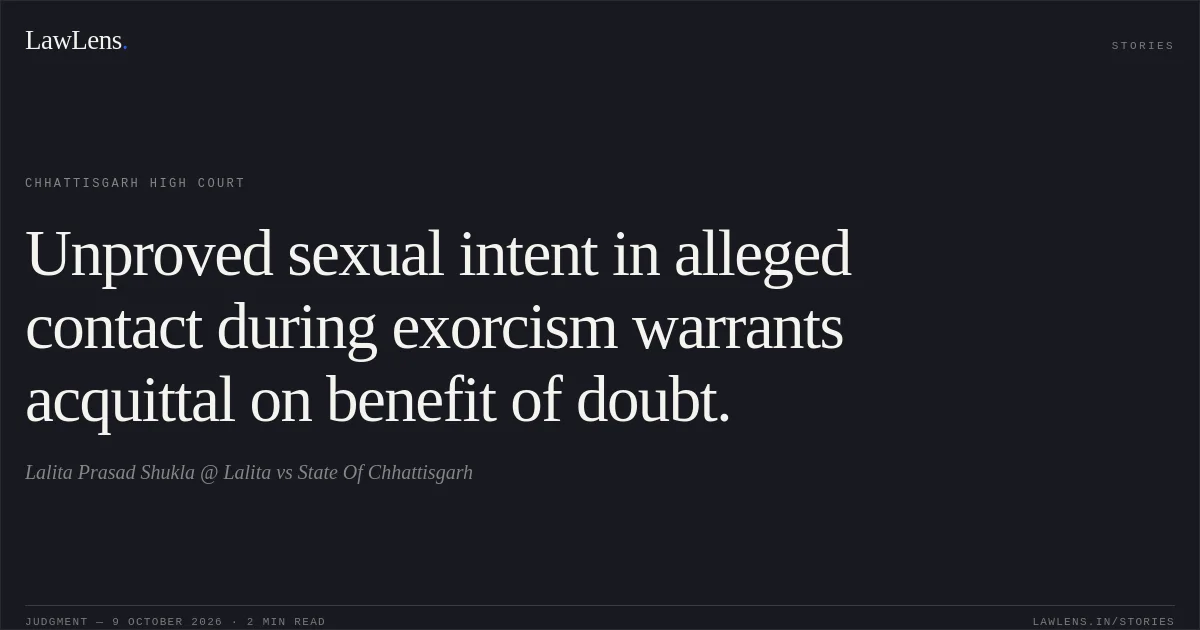
The High Court allowed the appeal, set aside the conviction and sentences under Section 354-A(1) IPC and Section 3(1)(xi) of the SC/ST Act, and acquitted the appellant on the benefit of doubt.
As the appellant was on bail, his bail bond was directed to continue for six months under Section 481 BNSS, 2023.
Source reference: para. 23Acts & Sections Cited
6 provisions across 3 statutes referred to in this judgment. Each provision opens on LawLens.
Code of Criminal Procedure, 19734
Scheduled Castes and the Scheduled Tribes (Prevention of Atrocities) Act, 19891
Bharatiya Nagarik Suraksha Sanhita, 20231
Original Court PDF
Lalita Prasad Shukla @ LalitavsState Of Chhattisgarh
Click to open original judgment
Original judgment, available to read, download and summarize on LawLens.in