Facts
The Respondent (Original Plaintiff) held a gas distributorship and entered into a notarized Memorandum of Understanding (MOU) dated 01.07.2010 to sell the agency and its assets to the Appellants (Original Defendants) for Rs. 80,00,000
Source reference: para 2The Appellants paid an initial Rs. 16,00,000 and took possession of the properties, including vehicles and a godown
Source reference: para 2, 10.1However, they defaulted on the remaining installments.
Source reference: no citationCheques issued toward the balance were dishonored, leading to a criminal conviction under Section 138 of the Negotiable Instruments Act
Source reference: para 2, 9.2The Plaintiff filed Special Civil Suit No. 141 of 2012 for the recovery of Rs. 64,00,000 and a permanent injunction
Source reference: para 2.1The Trial Court decreed the suit in favor of the Plaintiff
Source reference: para 3The Appellants challenged the decree, arguing the suit was based on an unregistered MOU, which is inadmissible under Section 49 of the Registration Act
Source reference: para 5Issues
1. Whether the Plaintiff proved the execution of the Distributorship Transfer Agreement and the subsequent default by the Defendants?
Source reference: para 32. Whether the court is justified in decreeing a suit for recovery based on an unregistered Memorandum of Understanding?
Source reference: para 7Law Applied
The Court primarily applied Section 96 of the Code of Civil Procedure for the exercise of appellate jurisdiction
Source reference: para 1Regarding the admissibility of documents, it applied Sections 17 and 49 of the Registration Act, 1908, which govern the compulsory registration of documents and the consequences of non-registration
Source reference: para 5, 12The Court specifically utilized the proviso to Section 49, which allows an unregistered document to be received as evidence of a contract in a suit for specific performance or as evidence of any "collateral transaction"
Source reference: para 12It further relied on the precedent in S. Kaladevi v. V.R. Somasundaram (2010) 5 SCC 401, which clarifies that an unregistered document can be admitted to prove an agreement between parties or the character of possession, even if it cannot affect the title of the immovable property
Source reference: para 12Reasoning
The Court noted that the Appellants, in their depositions, admitted to the execution of the MOU, the total consideration of Rs. 80,00,000, and the fact that they remained in possession of the business while paying only Rs. 16,00,000
Source reference: para 10, 10.1Since these material facts were admitted, the Court held they required no further proof
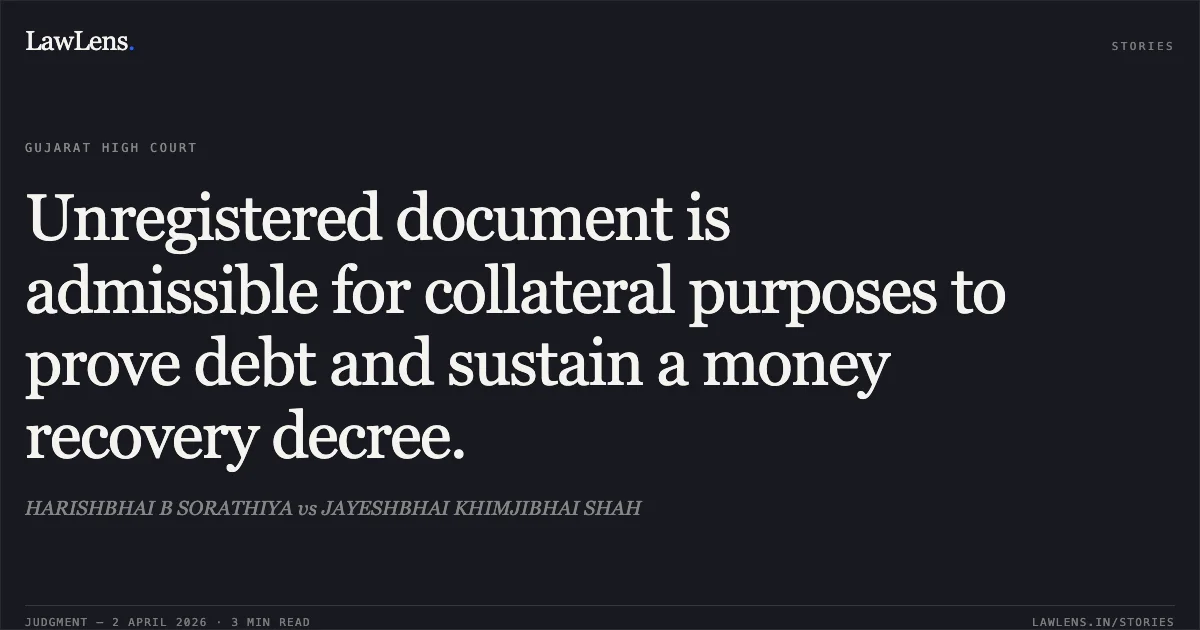
Source reference: para 12Addressing the technical objection of non-registration, the Court reasoned that while the MOU could not legally "transfer" title to the immovable property without registration under Section 17, it was entirely admissible for "collateral purposes"—specifically to prove the existence of the debt and the terms of the agreement in a suit for a money decree
Source reference: para 12The Court found that the Plaintiff sought recovery of the agreed consideration, not just the perfection of title, making the MOU a valid evidentiary tool under the Section 49 proviso
Source reference: para 12The Court concluded that the Appellants could not retain the benefits of the contract (possession and profit) while repudiating the obligation to pay based on a registration technicality
Source reference: para 10.1, 13Holding
The High Court dismissed the First Appeal and confirmed the Trial Court’s judgment and decree dated 21.04.2025
The Court held that the Plaintiff was entitled to recover the outstanding Rs. 64,00,000 with interest, as the debt was clearly established through admissions and the MOU
Source reference: para 12, 14The Court vacated all interim relief and refused the Appellants' request for a stay on the judgment
Source reference: para 14, 15Acts & Sections Cited
5 provisions across 3 statutes referred to in this judgment. Each provision opens on LawLens.
Code of Civil Procedure, 19081
Negotiable Instruments Act, 18811
Registration Act, 19083
Original Court PDF
HARISHBHAI B SORATHIYAvsJAYESHBHAI KHIMJIBHAI SHAH
Click to open original judgment
Original judgment, available to read, download and summarize on LawLens.in