Facts
The plaintiffs (Respondents 1 and 2) filed a suit for declaration of title and permanent injunction regarding the suit property.
Source reference: para. 4They claimed ownership based on an unregistered sale deed dated 15.04.1964 (Ex. P/1) executed by Mohd. Rafique for ₹150/-.
Source reference: para. 4They alternatively pleaded perfection of title by adverse possession, asserting continuous and hostile possession since 1964.
Source reference: para. 4The defendants 1 to 3 later sold the same property to the appellants (Defendants 6 and 7) via a registered sale deed dated 19.09.2000.
Source reference: para. 4The Trial Court and First Appellate Court decreed the suit in favor of the plaintiffs.
Source reference: para. 6Issues
1. Whether the Courts below committed an error of law in holding that the unregistered sale-deed (Ex. P/1) confers any title upon the plaintiff?
Source reference: para. 22. Whether the correct test in relation to perfection of title by way of adverse possession was applied or if the finding is perverse?
Source reference: para. 2Law Applied
Section 17(1)(b) of the Registration Act, 1908, which mandates registration for non-testamentary instruments transferring right or title in immovable property valued at ₹100 or more.
Source reference: para. 24Section 49 of the Registration Act prohibits such unregistered documents from being received as evidence of the transaction, except for "collateral purposes".
Source reference: para. 26Section 54 of the Transfer of Property Act, 1882, which defines "sale" and mandates that tangible immovable property of value above ₹100 can only be transferred by a registered instrument.
Source reference: para. 25The doctrine of nec vi, nec clam, nec precario (without force, secrecy, or permission) and precedents like Achal Reddy v. Ramakrishna Reddiar, which establish that possession under an executory contract is permissive and not adverse.
Source reference: para. 19-22Reasoning
The High Court found that since the sale consideration in Ex. P/1 was ₹150/-, registration was mandatory under the Registration Act; therefore, the document conferred no legal title and was inadmissible to prove the sale.
Source reference: para. 25, 27Regarding adverse possession, the Court noted that the plaintiffs' claim was "self-destructive" because they claimed both a lawful title (via the deed) and adverse possession simultaneously.
Source reference: para. 18Following Ram Nagina Rai v. Deo Kumar Rai, the Court held that since the plaintiffs entered possession under a purported transaction, their stay was "permissive" in nature and lacked the requisite "hostile animus" against the true owner.
Source reference: para. 20, 23The High Court observed that the registered sale deed of 2000 in favor of the appellants carried a presumption of genuineness which the plaintiffs failed to specifically challenge or rebut.
Source reference: para. 31Holding
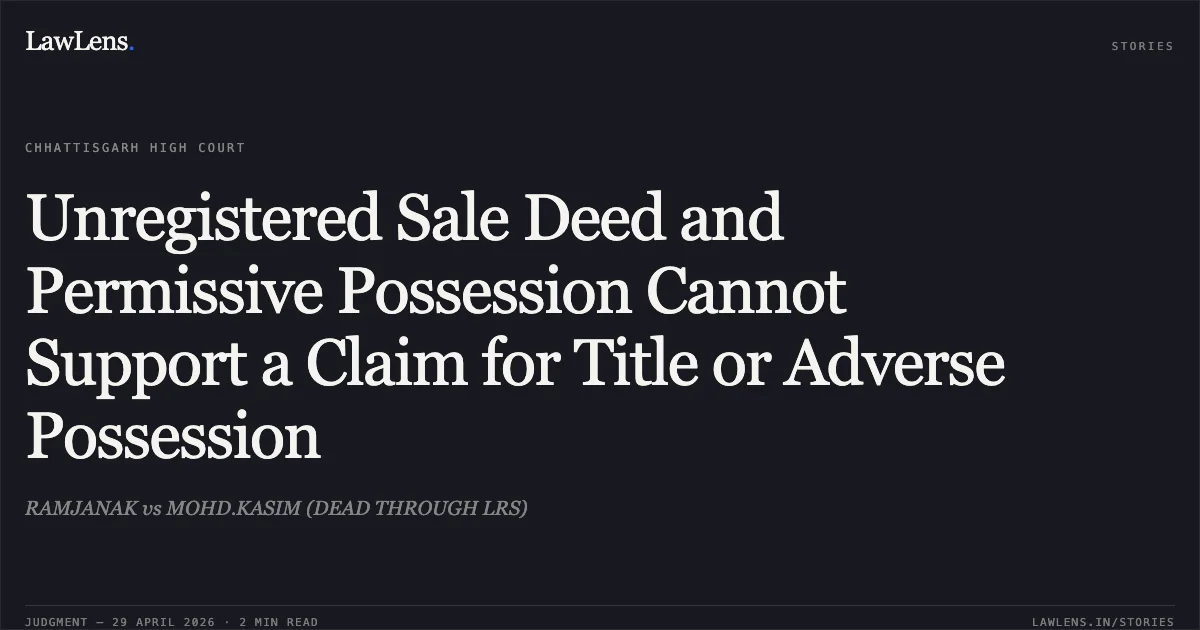
The High Court answered both substantial questions of law in the affirmative in favor of the appellants. It held that the unregistered sale deed (Ex. P/1) did not confer title and the plaintiffs failed to prove the essentials of adverse possession.
The Court set aside the judgments of the Trial Court and First Appellate Court and dismissed the plaintiffs' suit.
Source reference: para. 32-33Acts & Sections Cited
7 provisions across 3 statutes referred to in this judgment. Each provision opens on LawLens.
Code of Civil Procedure, 19082
Registration Act, 19082
Transfer of Property Act, 18823
Original Court PDF
RAMJANAKvsMOHD.KASIM (DEAD THROUGH LRS)
Click to open original judgment
Original judgment, available to read, download and summarize on LawLens.in