Facts
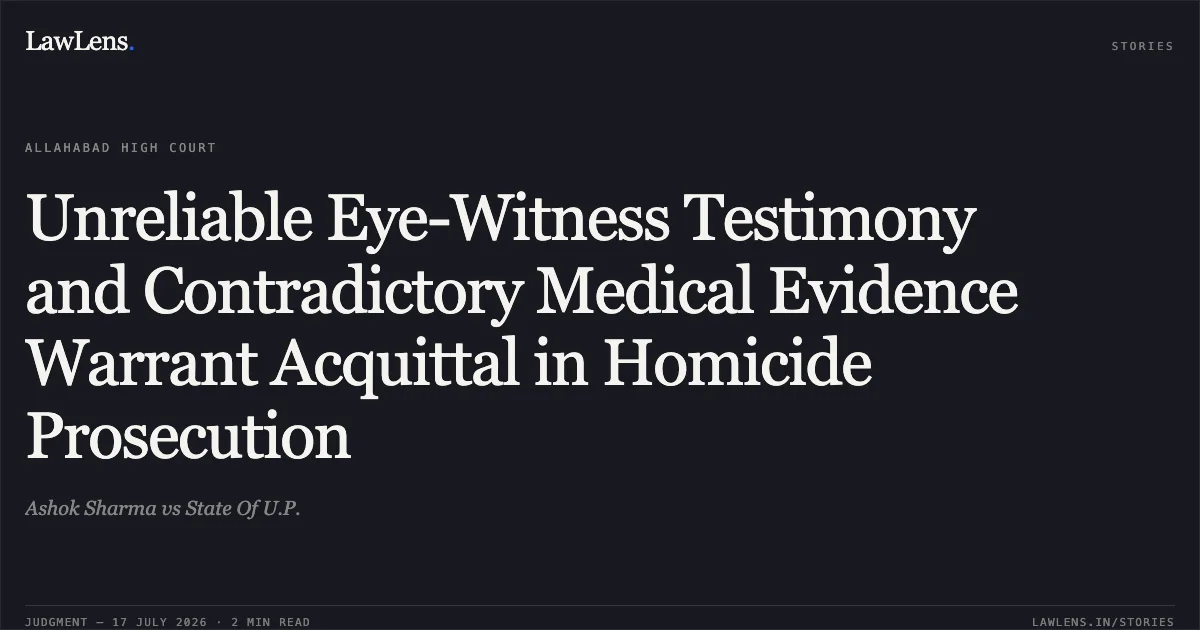
The Appellant was convicted under Sections 302 and 201 of the IPC by the Sessions Court for the alleged murder and subsequent burning of Sunita Sharma and her three-year-old daughter, Jhalak.
Source reference: para 1The prosecution alleged that the Appellant had an illicit relationship with Sunita’s mother-in-law (Geeta Devi) and murdered the victims because Sunita objected to the affair.
Source reference: para 2The case rested primarily on the oral testimonies of P.W. 2 (Reeta Devi) and P.W. 4 (Sunil Sharma), who claimed to be eye-witnesses.
Source reference: paras 28, 33The trial court sentenced the Appellant to death.
Source reference: para 1The Appellant challenged the conviction, asserting that the eye-witnesses were unreliable and their conduct was unnatural.
Source reference: para 38Issues
1. Whether the testimonies of P.W. 2 and P.W. 4 are reliable enough to sustain a conviction for murder.
Source reference: para 422. Whether the medical evidence corroborates the ocular version of the incident provided by the alleged eye-witnesses.
Source reference: para 613. Whether the prosecution proved the presence of the Appellant at the crime scene beyond reasonable doubt.
Source reference: para 65Law Applied
The Court applied Section 302 (Punishment for murder) and Section 201 (Causing disappearance of evidence) of the Indian Penal Code.
Source reference: para 1It relied on the evidentiary principle that for an eye-witness to be credible, their conduct must be natural and their testimony must be consistent with medical evidence.
Source reference: paras 44, 61The Court also adhered to the "beyond reasonable doubt" standard required in criminal trials and referenced the "rarest of rare" doctrine regarding the imposition of the death penalty.
Source reference: para 38(IX)Reasoning
The Court found the conduct of the alleged eye-witnesses, P.W. 2 and P.W. 4, to be "wholly unnatural" as they neither raised an alarm during the crime nor informed the police or family members despite being present during the inquest.
Source reference: paras 44, 54P.W. 2 admitted during cross-examination that she only learned of the incident in the morning, contradicting her claim of witnessing the murder.
Source reference: para 49Furthermore, the ocular testimony—claiming the victims were strangulated with a saree—was flatly contradicted by the medical post-mortem report, which concluded the cause of death was "ante-mortem throttling" (manual strangulation) and noted the absence of ligature marks.
Source reference: para 61The Court noted that even the Investigating Officer (P.W. 5) had recorded that P.W. 4 was not an eye-witness.
Source reference: para 59Consequently, the Court held that the prosecution failed to establish the Appellant's presence or culpability through any credible evidence.
Source reference: para 66Holding
The Court answered the issues in the negative, holding that the eye-witnesses were "wholly unreliable" and their testimonies "not worthy of belief".
The High Court set aside the judgment dated 16.09.2021, acquitted Ashok Sharma of all charges, and ordered his immediate release. The Capital Appeal was allowed.
Source reference: paras 68-71Acts & Sections Cited
3 provisions across 2 statutes referred to in this judgment. Each provision opens on LawLens.
Indian Penal Code, 18602
Code of Criminal Procedure, 19731
Original Court PDF
Ashok SharmavsState Of U.P.
Click to open original judgment
Original judgment, available to read, download and summarize on LawLens.in