Facts
The Appellant (Decree Holder) sought to execute an ex-parte arbitral award dated 22.10.2022, which awarded Rs. 10,00,000 against the Respondent.
Source reference: para. 5The arbitral proceedings were initiated based on a "receipt-cum-acknowledgment" letter dated 16.09.2020 containing an arbitration clause.
Source reference: para. 1While the Respondent had signed the document, the Appellant had not.
Source reference: para. 7The Respondent filed objections to the execution, arguing that no valid arbitration agreement existed.
Source reference: para. 6The Executing Court (District Judge) dismissed the execution petition on 01.04.2024, holding the award to be a nullity due to the lack of a valid written agreement under Section 7 of the Arbitration and Conciliation (A&C) Act, 1996.
Source reference: para. 9Issues
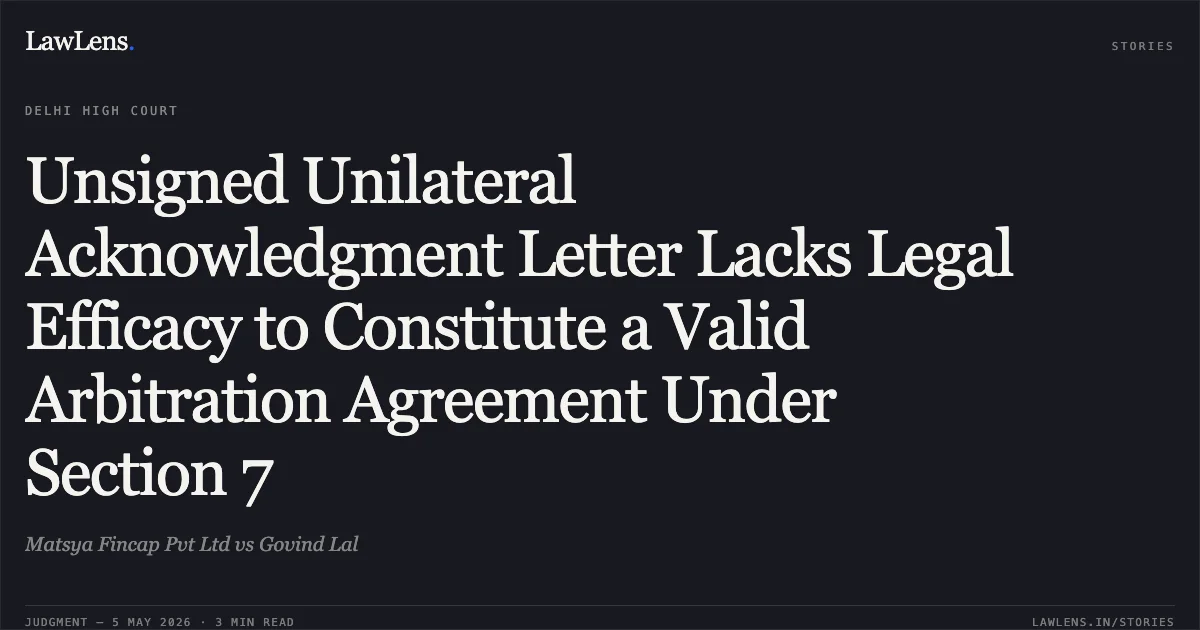
1. Whether an acknowledgment letter signed by only one party constitutes a valid arbitration agreement within the meaning of Section 7 of the A&C Act.
Source reference: para. 32. Whether an Executing Court can entertain an objection regarding the non-existence of an arbitration agreement under Section 47 of the CPC.
Source reference: para. 9(iv)3. Whether the unilateral appointment of a pre-named arbitrator in multiple proceedings by one party affects the validity of the arbitral process.
Source reference: paras. 33, 43Law Applied
The Court applied Section 7 of the Arbitration and Conciliation Act, 1996, which mandates that an arbitration agreement must be in writing and reflects the consensus ad idem of both parties.
Source reference: paras. 15-18It relied on Section 7(4), which specifies that an agreement is "in writing" if it is signed by the parties or recorded through an exchange of communications.
Source reference: para. 15The Court referred to Section 47 of the Code of Civil Procedure (CPC), 1908, and the Supreme Court's ruling in Dhurandhar Prasad Singh v. Jai Prakash University, which permits an Executing Court to refuse enforcement if a decree is a nullity due to an inherent lack of jurisdiction.
Source reference: para. 29Additionally, it applied the principle from Bhadra International (India) Pvt. Ltd. v. Airport Authority of India that party autonomy cannot allow one party to unilaterally dominate the constitution of an arbitral tribunal.
Source reference: para. 42Reasoning
The Court observed that the acknowledgment letter failed to satisfy Section 7(4)(a) because it was not signed by the Appellant.
Source reference: para. 20Since no other correspondence was produced to prove mutual assent, Section 7(4)(b) was also inapplicable.
Source reference: para. 21The Court found that the Arbitrator's assumption that both parties had signed the document was factually incorrect.
Source reference: para. 25Regarding the execution, the Court reasoned that while an Executing Court cannot generally go behind a decree, a defect in the very existence of an arbitration agreement constitutes an "inherent lack of jurisdiction," rendering the resulting award a nullity and thus reviewable under Section 47 of the CPC.
Source reference: paras. 26, 30Furthermore, the Court noted that the Appellant’s repeated appointment of the same arbitrator for various borrowers—based on a disputed and unsigned document—amounted to a unilateral constitution of the tribunal, violating the principles of neutrality and independence essential to the arbitral process.
Source reference: paras. 37, 43-46Holding
The Court held that in the absence of a valid arbitration agreement under Section 7 of the A&C Act, the Arbitrator lacked inherent jurisdiction, making the award a nullity and incapable of execution.
The High Court dismissed the appeal and upheld the Impugned Order dated 01.04.2024.
Source reference: para. 48It affirmed that the Respondent’s objections were correctly entertained by the Executing Court under Section 47 of the CPC.
Source reference: para. 47Acts & Sections Cited
5 provisions across 3 statutes referred to in this judgment. Each provision opens on LawLens.
Arbitration and Conciliation Act, 19963
Code of Civil Procedure, 19081
Code of Criminal Procedure, 19731
Original Court PDF
Matsya Fincap Pvt LtdvsGovind Lal
Click to open original judgment
Original judgment, available to read, download and summarize on LawLens.in