Facts
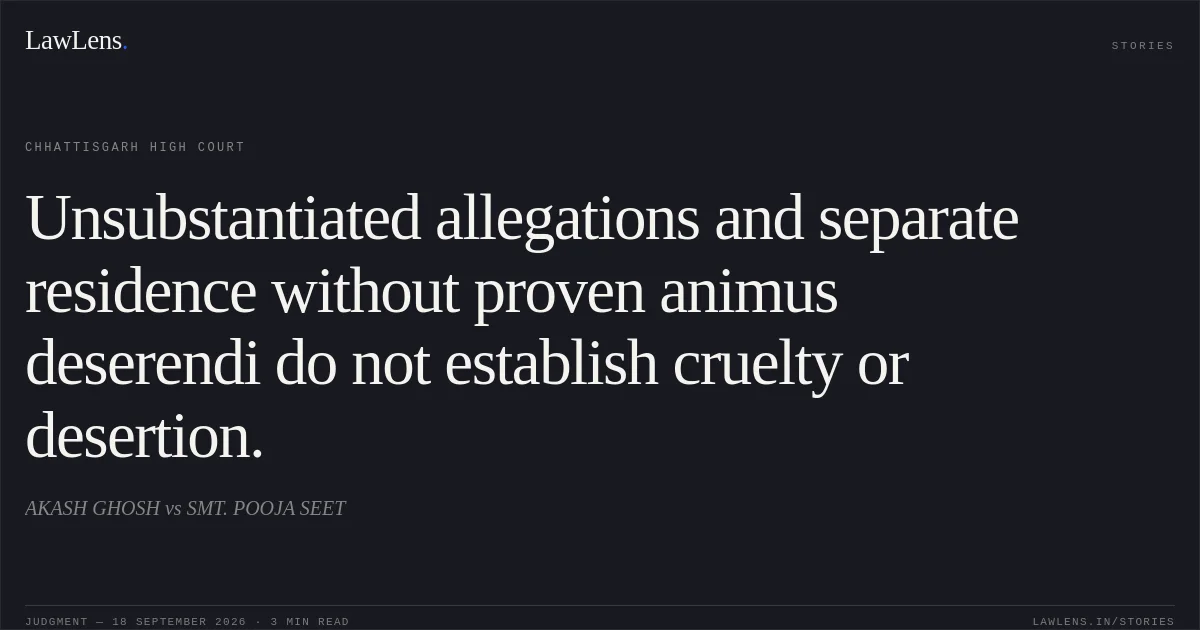
The parties married on 7 March 2019 according to Hindu rites. The wife lived with the husband and his family for approximately two to three months, after which she began residing separately. The husband alleged that she treated him with hostility, threatened to implicate him in false cases, frequently visited her parental home, and refused to resume cohabitation despite his efforts. He therefore sought divorce under Section 13 of the Hindu Marriage Act, 1955, on the grounds of cruelty and desertion.
Source reference: para. 2–3The wife denied the allegations and contended that the husband had an illicit relationship, consumed alcohol, abused her, neglected her during pregnancy, and failed to provide proper medical care. She stated that her mother took her to Raigarh for treatment and that the husband and his family did not take her back. She also initiated proceedings under the Protection of Women from Domestic Violence Act, 2005.
Source reference: para. 4The Family Court, Janjgir, held that the husband had failed to prove cruelty and desertion and dismissed his divorce petition. It allowed the wife’s application under Section 27 of the Hindu Marriage Act and directed the husband to return the articles or gifts listed in Schedule A, described as her stridhan. The husband challenged that judgment in the present appeal under Section 19(1) of the Family Courts Act, 1984.
Source reference: para. 2, 5Issues
Whether the husband proved that the wife had treated him with cruelty so as to entitle him to a decree of divorce under Section 13 of the Hindu Marriage Act, 1955?
Source reference: para. 5, 9–12Whether the husband proved that the wife had deserted him without reasonable cause, including the requisite intention to permanently terminate cohabitation?
Source reference: para. 5, 10, 12Whether the Family Court’s direction under Section 27 of the Hindu Marriage Act requiring the husband to return the wife’s stridhan was liable to be interfered with in appeal?
Source reference: para. 2, 6, 12Law Applied
The Court applied Section 13 of the Hindu Marriage Act, 1955, under which cruelty and desertion constitute grounds for divorce; the party asserting these matrimonial offences must establish the requisite factual ingredients through cogent evidence. Desertion requires both separation and the intention to bring cohabitation permanently to an end, commonly described as animus deserendi.
Source reference: para. 12The Court also applied the principles governing mental cruelty stated by the Supreme Court in Samar Ghosh v. Jaya Ghosh, (2007) 4 SCC 511, which recognised that the determination of mental cruelty is fact-specific and that the illustrative instances identified therein are not exhaustive.
Source reference: para. 11Section 27 of the Hindu Marriage Act permits the court to make appropriate orders concerning property presented at or about the time of marriage and belonging jointly to the husband and wife. The appeal was governed by Section 19(1) of the Family Courts Act, 1984.
Source reference: para. 2Reasoning
The High Court found that the husband’s allegations—including hostility, threats, refusal to return, and insulting references to his complexion and body—were not supported by cogent and clinching evidence and did not, in the circumstances, amount to mental cruelty under the principles in Samar Ghosh.
Source reference: para. 10–12The wife’s evidence indicated that she had gone to Rajasthan with the husband and family members, later became ill, and was taken for medical treatment; her mother’s evidence further suggested that the husband’s family sent the wife to her parental home after her miscarriage.
Source reference: para. 9–10The Court also held that the husband failed to prove that the wife was living separately without reasonable cause or that she possessed the necessary intention to permanently abandon the matrimonial relationship. His assertion that he had made efforts to bring her back was not accepted as sufficient proof of the wife’s desertion.
Source reference: para. 10, 12Since the husband failed to establish either statutory ground for divorce, and no sufficient basis was shown to disturb the Section 27 direction concerning the wife’s stridhan, the Family Court’s decision warranted no appellate interference.
Source reference: para. 12Holding
The High Court answered the issues against the husband. It held that cruelty and desertion under Section 13 of the Hindu Marriage Act had not been proved and upheld the dismissal of the divorce petition.
The direction requiring the husband to return the wife’s stridhan under Section 27 was also left undisturbed. Accordingly, the appeal was dismissed without costs, and the decree was directed to be drawn accordingly.
Source reference: para. 12Acts & Sections Cited
3 provisions across 2 statutes referred to in this judgment. Each provision opens on LawLens.
Family Courts Act, 19841
Hindu Marriage Act, 19552
Original Court PDF
AKASH GHOSHvsSMT. POOJA SEET
Click to open original judgment
Original judgment, available to read, download and summarize on LawLens.in