Facts
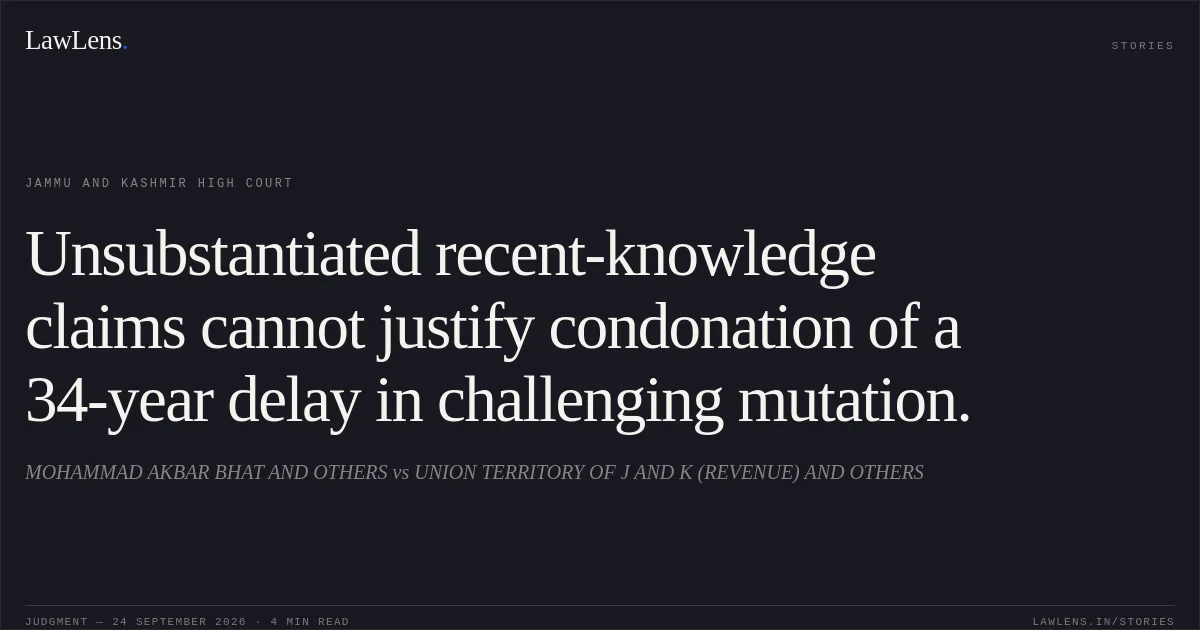
The petitioners claimed cultivating tenancy rights, through their predecessors-in-interest, over 3 Kanals in Khasra No. 336 and 4 Kanals in Khasra No. 339, aggregating 7 Kanals, situated at Village Utressoo, District Anantnag.
Source reference: paras. 2–4Their predecessors’ cultivating possession had allegedly been recorded in the Kharif 1971 Khasra Girdawari and affirmed under Section 4 of the J&K Agrarian Reforms Act, 1976 through Mutation No. 1657, attested on 25 April 1981.
Source reference: paras. 2–4Mutation No. 1888 was subsequently attested under Section 8 of the Act on 11 October 1986, conferring proprietary rights upon the predecessors of the private respondents over specified portions of the land; the petitioners alleged that their claimed 7 Kanals were omitted without any order of resumption, surrender, or spot inquiry.
Source reference: para. 5An endorsement dated 18 April 1987 recorded an interim stay of Mutation No. 1888, but the petitioners claimed that they acquired knowledge of the mutation only in November 2021 when revenue officials allegedly attempted to interfere with their possession.
Source reference: paras. 6–7They filed an appeal with an application for condonation of delay on 27 November 2021.
Source reference: paras. 8–9; pp. 2–4The Additional Deputy Commissioner, exercising powers of Commissioner Agrarian Reforms, rejected the condonation application and consequently dismissed the appeal as time-barred on 28 September 2023.
Source reference: paras. 8–9; pp. 2–4The petitioners’ review petition was dismissed on 15 January 2026.
Source reference: paras. 8–9; pp. 2–4They thereafter invoked Article 226 seeking quashing of both orders and restoration of their appeal.
Source reference: paras. 8–9; pp. 2–4Issues
1. Whether the petitioners had shown sufficient cause under Section 5 of the Limitation Act for condoning the delay of more than 34 years in challenging Mutation No. 1888.
Source reference: paras. 11–13, 222. Whether the statutory appeal was rightly dismissed as barred by limitation under Section 12 of the Land Revenue Act, which prescribes a 60-day limitation period for the relevant appeal.
Source reference: para. 123. Whether the order dated 15 January 2026 dismissing the review petition disclosed any error apparent on the face of the record or other ground warranting review.
Source reference: paras. 14–154. Whether the impugned orders suffered from any legal infirmity warranting interference under Article 226 of the Constitution.
Source reference: paras. 16, 23–24Law Applied
The Court applied Section 12 of the Land Revenue Act, under which the relevant appeal was subject to a 60-day limitation period, read with the Limitation Act provisions applicable to appeals, revisions, and reviews.
Source reference: para. 12Under Section 5 of the Limitation Act, delay may be condoned only where sufficient cause is established; the length of delay is not by itself decisive, but the explanation must be genuine, cogent, and acceptable.
Source reference: paras. 18–19Relying on Sheo Raj Singh v. Union of India, AIR 2023 SC 5109, the Court reiterated that courts must distinguish a satisfactory explanation from a mere excuse and must assess each case on its facts.
Source reference: paras. 18–19Relying on Basawaraj v. Special Land Acquisition Officer, (2013) 14 SCC 81, the Court held that statutory limitation must be applied with full rigor and cannot be extended merely on equitable grounds or hardship.
Source reference: paras. 20–22The Court also relied on the principle that limitation provisions prescribe a definite lifespan for legal remedies and prevent uncertainty and endless litigation.
Source reference: paras. 17, 21Review jurisdiction is limited and cannot be used to reargue the matter or obtain a rehearing; review requires an error apparent on the face of the record, a clerical or arithmetical error, or another recognized ground for review.
Source reference: paras. 14–15Reasoning
The Court held that the challenge to Mutation No. 1888 was instituted more than 34 years after its attestation, whereas the applicable statutory limitation was 60 days.
Source reference: paras. 11–12The petitioners’ assertion that they first acquired knowledge of the mutation in November 2021 was unsupported by documentary material and did not explain the entire intervening period.
Source reference: paras. 11, 19, 22A bare plea of subsequent knowledge was therefore insufficient to constitute “sufficient cause” under Section 5 of the Limitation Act, particularly in view of the extraordinary delay.
Source reference: paras. 11, 19, 22Applying the principles in Sheo Raj Singh and Basawaraj, the Court concluded that equitable considerations could not override the statutory limitation period.
Source reference: paras. 20–22It further found that the review petition merely sought reconsideration of the condonation decision and did not identify any patent error, clerical mistake, or other permissible ground for review.
Source reference: paras. 14–15Consequently, the orders of the revenue authorities did not disclose any jurisdictional or legal infirmity warranting interference under Article 226.
Source reference: paras. 16, 23Holding
The Court answered the issues against the petitioners.
It held that the delay of more than 34 years was not satisfactorily explained, that the statutory appeal was rightly dismissed as time-barred, and that the review petition disclosed no error apparent on the face of the record.
Source reference: paras. 22–24The writ petition and connected application were dismissed in limine; the orders dated 28 September 2023 and 15 January 2026 were upheld, with no order as to costs.
Source reference: para. 24Acts & Sections Cited
1 provisions across 1 statute referred to in this judgment. Each provision opens on LawLens.
Limitation Act, 19631
Original Court PDF
MOHAMMAD AKBAR BHAT AND OTHERSvsUNION TERRITORY OF J AND K (REVENUE) AND OTHERS
Click to open original judgment
Original judgment, available to read, download and summarize on LawLens.in