Facts
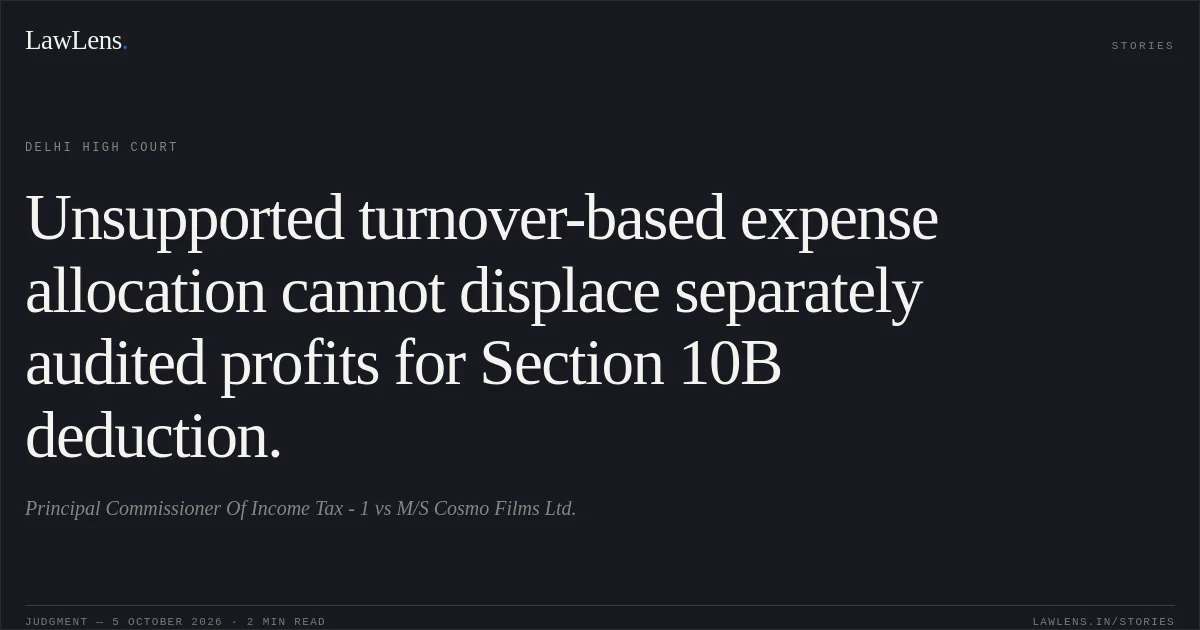
For Assessment Year 2007–08, Cosmo Films Ltd. claimed a deduction of ₹20,83,01,011 under Section 10B of the Income Tax Act, 1961, in respect of its export-oriented unit (EOU).
Source reference: p. 2The Assessing Officer disputed the allocation of expenses between the EOU and non-EOU units and reduced the deduction.
Source reference: pp. 3–7The CIT(A) set aside that adjustment, noting, among other things, that the units maintained separate accounts and had different products and manufacturing processes; it also considered that the assessee had allocated senior management salary by turnover in the year under appeal.
Source reference: pp. 3–7The ITAT upheld the CIT(A)’s conclusion and dismissed the Department’s challenge.
Source reference: pp. 7–8The Department appealed under Section 260A, raising questions concerning the expense allocation, the treatment of the preceding assessment year, and whether the ITAT’s decision was perverse.
Source reference: pp. 1–2Issues
1. Whether the ITAT erred in its consideration of the Assessing Officer’s adverse inference in Assessment Year 2006–07 and its relevance to the deduction claimed for Assessment Year 2007–08.
Source reference: p. 1; paras. 2, 82. Whether the ITAT erred in considering the Assessing Officer’s verification and allocation of expenses between the EOU and non-EOU units.
Source reference: pp. 1–2; paras. 2, 7–83. Whether the ITAT’s order was perverse or otherwise unsustainable, giving rise to a question of law under Section 260A.
Source reference: p. 2; paras. 2, 9Law Applied
Section 10B of the Income Tax Act provides for a deduction in respect of the profits of an eligible export-oriented undertaking.
Source reference: pp. 3–5Section 80-IA(10), concerning arrangements between an eligible business and another person that produce more than ordinary profits, was considered by the CIT(A), which held it inapplicable because no such transaction was shown in this case.
Source reference: pp. 3–5The CIT(A) also relied on the principle of consistency, observing that although res judicata does not strictly apply to income-tax proceedings, consistency may be relevant where the material circumstances are comparable.
Source reference: p. 6Under Section 260A, the High Court’s appellate jurisdiction is engaged where the appeal raises a question of law; the Court concluded that no such question arose on the facts before it.
Source reference: p. 8; para. 9Reasoning
The CIT(A) found that the Assessing Officer’s turnover-based apportionment did not account for the units’ separate audited accounts, different product mixes, manufacturing processes, asset bases and actual expenses, and that the Assessing Officer had not identified a specific discrepancy in the assessee’s allocation.
Source reference: pp. 3–5The ITAT additionally noted that the EOU’s profit percentage was broadly similar to the preceding year and that, for the year under appeal, the assessee had allocated senior management salary by turnover, addressing the concern raised in the earlier assessment year.
Source reference: pp. 7–8The High Court did not undertake a fresh determination of the expense allocation; it held that the Department’s appeal disclosed no question of law warranting interference under Section 260A.
Source reference: p. 8; para. 9Holding
The High Court held that no question of law arose for consideration in the Department’s Section 260A appeal.
The High Court dismissed the appeal, together with any pending applications.
Source reference: p. 8; paras. 9–10Acts & Sections Cited
4 provisions across 1 statute referred to in this judgment. Linked provisions open on LawLens.
Income Tax Act, 19614
Original Court PDF
Principal Commissioner Of Income Tax - 1vsM/S Cosmo Films Ltd.
Click to open original judgment
Original judgment, available to read, download and summarize on LawLens.in