Facts
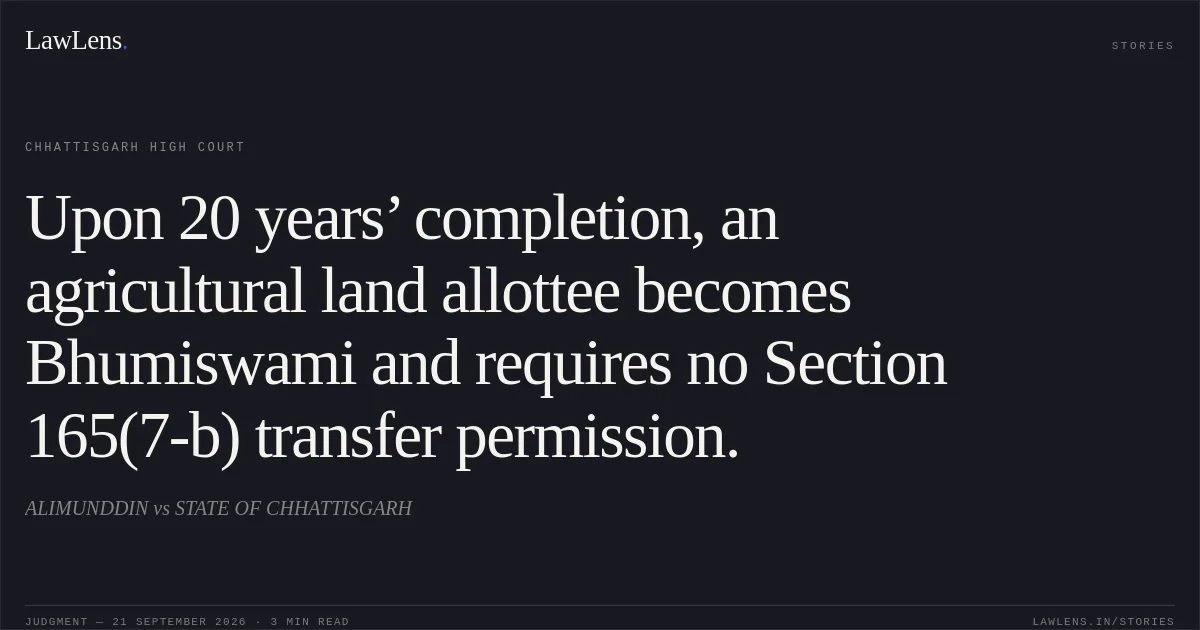
The appellant, Alimunddin, and respondent No. 5, Vikesh Gupta, complained to the Collector alleging that Dwarika Gupta had sold land allotted to him by the State in 1987 to respondent No. 6, Vishal Gupta, through a registered sale deed dated 20 May 2019, without obtaining the Collector’s prior permission under Section 165(7-b) of the Chhattisgarh Land Revenue Code, 1959 (“the Code”).
Source reference: para. 4The Collector set aside the sale.
Source reference: para. 4Respondent No. 6 challenged that order in revision under Section 50 of the Code.
Source reference: para. 4The Commissioner, Surguja Division, held that Dwarika Gupta had acquired Bhumiswami rights after twenty years under Section 158(4) of the Code and that the transfer therefore did not require prior permission.
Source reference: para. 4The appellant challenged the Commissioner’s order through a writ petition under Article 226 of the Constitution.
Source reference: paras. 2–3The learned Single Judge dismissed the writ petition, holding that the appellant lacked locus standi because he was not a person aggrieved.
Source reference: paras. 2–3Issues
Whether the appellant, who was neither the owner nor a person claiming any legal interest in the land, had locus standi to maintain a writ petition under Article 226 of the Constitution challenging the sale and the revisional order?
Source reference: paras. 3, 7, 11Whether, after completion of twenty years from the allotment of agricultural land, the allottee acquired deemed Bhumiswami rights under Section 158(4) of the Code, thereby making prior permission under Section 165(7-b) unnecessary for transfer?
Source reference: paras. 5, 9–11Whether Section 158(4), inserted on 7 October 2022, could govern the legal status and transfer rights arising from an allotment made in 1987 and a sale executed in 2019?
Source reference: paras. 5, 10–11Law Applied
Section 158(1) of the Code confers Bhumiswami status and the corresponding rights and liabilities under the Code.
Source reference: para. 9Section 158(4) provides that a person holding agricultural land under a lease granted by the State Government, Collector, or Allotment Officer is deemed to become a Bhumiswami upon completion of twenty years from the date of allotment.
Source reference: paras. 9–10Section 165(7-b), read with its proviso, does not require prior permission for transfer by a Bhumiswami or legal heir holding Bhumiswami rights under Section 158(4) or freehold rights under Section 158(5).
Source reference: para. 10A person who is not directly affected in his legal rights or interests is not a “person aggrieved” and lacks locus standi to invoke Article 226.
Source reference: paras. 3, 7, 11Reasoning
The Court held that Dwarika Gupta, having been allotted the land in 1987, completed twenty years of holding well before the 2019 sale and consequently acquired deemed Bhumiswami status under Section 158(4).
Source reference: paras. 9–11The Court treated the statutory consequence of Section 158(4) as determining the allottee’s status upon completion of twenty years, notwithstanding that the provision was inserted in 2022.
Source reference: paras. 9–11Once Dwarika Gupta became a Bhumiswami, the proviso to Section 165(7-b) dispensed with the requirement of prior Collector permission for the transfer.
Source reference: para. 10Accordingly, the sale deed executed in favour of respondent No. 6 did not suffer from the alleged absence of permission.
Source reference: paras. 10–11Independently, the appellant had no ownership, possessory, or other legally enforceable interest in the land and was therefore not a person aggrieved entitled to challenge the revisional order under Article 226.
Source reference: para. 11The Commissioner and the Single Judge were consequently found to have committed no error.
Source reference: para. 11Holding
The High Court answered the issues against the appellant.
It held that Dwarika Gupta had acquired Bhumiswami rights after completion of twenty years from the 1987 allotment, that the 2019 sale did not require prior permission under Section 165(7-b) of the Code, and that the appellant lacked locus standi as he was not a person aggrieved.
Source reference: paras. 10–11The writ appeal was dismissed as devoid of merit, and the order of the learned Single Judge was affirmed.
Source reference: para. 12Acts & Sections Cited
5 provisions across 3 statutes referred to in this judgment. Linked provisions open on LawLens.
Chhattisgarh Land Revenue Code, 19593
Madhya Pradesh Land Revenue Code, 19541
Rewa State Land Revenue and Tenancy Code, 19351
Original Court PDF
ALIMUNDDINvsSTATE OF CHHATTISGARH
Click to open original judgment
Original judgment, available to read, download and summarize on LawLens.in