01Facts
The plaintiff instituted an SCC suit seeking eviction, arrears of rent and mesne profits, alleging that the defendant occupied the premises as a tenant at ₹50,000 per month and that the tenancy had been terminated by notice dated 10 September 2024.
¶ 2–3The suit was filed on 2 December 2024.
¶ 2–3The defendant applied under Order VII Rule 11 CPC, arguing that the Uttarakhand Tenancy Act, 2021 barred the civil court’s jurisdiction and required the matter to be brought before the Rent Court.
¶ 3–4The District Judge dismissed that application, prompting this revision.
¶ 3–4The High Court noted that the trial court’s statement that proceedings pre-dated the Act was incorrect; the judgment’s reference to the suit having been filed in “2014” appears inconsistent with the stated filing date of 2 December 2024.
¶ 1502Issues
i.Whether the suit was barred before the civil court by the Uttarakhand Tenancy Act, 2021, where no written tenancy agreement or information to the Rent Authority was shown
¶ 14–19ii.Whether the District Judge correctly rejected the defendant’s application under Order VII Rule 11 CPC
¶ 19–2203Law Applied
Section 4(1)–(2) of the Uttarakhand Tenancy Act, 2021 requires a tenancy created after commencement of the Act to be recorded in a written agreement and the agreement’s execution to be informed to the Rent Authority; under Section 4(6), in the absence of the required information, landlord and tenant are not entitled to relief under the Act.
¶ 15–16The court adopted the principle that the Act’s denial of relief for non-compliance does not, by itself, oust the jurisdiction of the general civil courts; it relied on the reasoning in Sunil Kumar Kapoor v. Shivendra Narain Saklani and the principle attributed there to Nutan Kumar v. 2nd Additional District Judge.
¶ 20–21Section 40 was invoked by the defendant as the provision barring civil-court jurisdiction, but the court held that the statutory scheme did not bar the present civil suit in the circumstances.
¶ 8, 21Provisions in the judgment · 4 · Linked ones open on LawLens
Code of Civil Procedure, 1908 Section 151Section 7
Provincial Small Cause Courts Act, 1887 Section 25Section 15
04Reasoning
The court accepted that the suit was instituted after commencement of the 2021 Act, but found no written tenancy agreement or evidence that the agreement had been reported to the Rent Authority.
¶ 15, 18–19It reasoned that Section 4(6) therefore denied the parties relief under the Act, rather than making the civil court unavailable.
¶ 20–21Applying the coordinate-bench approach in Sunil Kumar Kapoor, the court concluded that non-compliance with Section 4 did not automatically oust the general civil court’s jurisdiction.
¶ 20–21The defendant’s jurisdictional objection consequently did not establish that the plaint was barred by law for purposes of Order VII Rule 11 CPC.
¶ 20–21The court did not decide whether the earlier consent order could have been recalled, observing that the recall order had become final because it was not challenged.
¶ 1305Holding
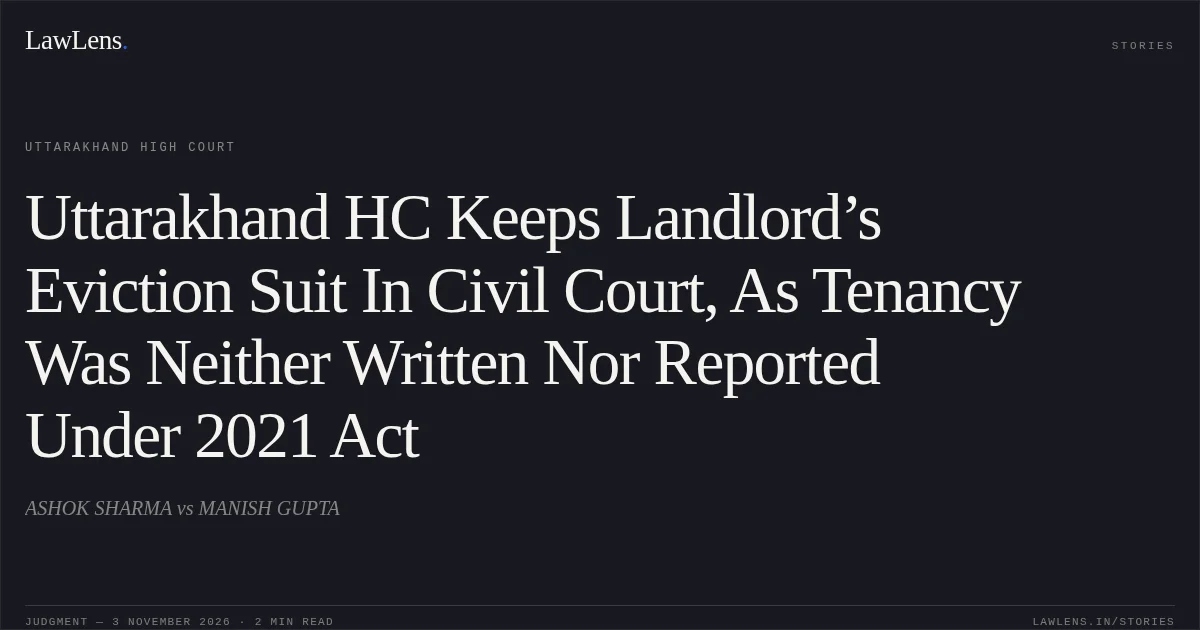
The High Court held that, in the absence of compliance with Section 4 of the Uttarakhand Tenancy Act, 2021, the parties could not claim relief under that Act, but the civil court’s jurisdiction was not thereby ousted.
¶ 21–22The trial court had therefore correctly rejected the defendant’s Order VII Rule 11 CPC application.
¶ 21–22The civil revision was dismissed.
¶ 21–22Original Court PDF
ASHOK SHARMAvsMANISH GUPTA
Click to open original judgment
Original judgment, available to read, download and summarize on LawLens.in