01Facts
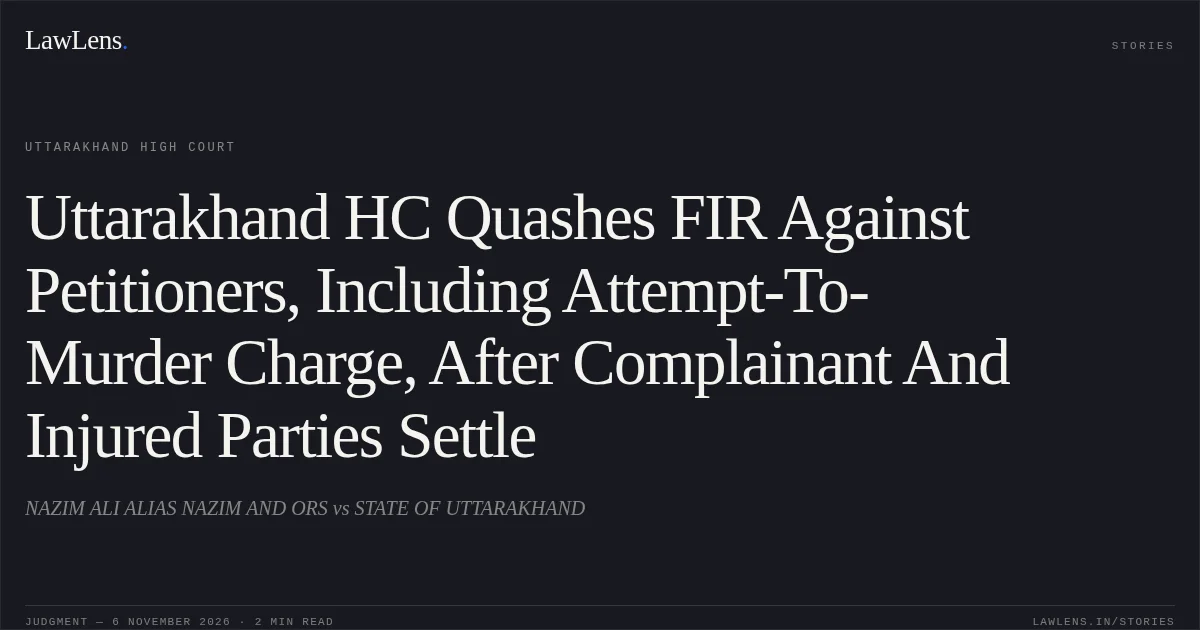
The petitioners challenged FIR No. 289 of 2026, registered at Police Station Gadarpur, District Udham Singh Nagar, for offences under Sections 109(1), 115(2), 191(1), 117(2), 309(4), 324(2), 351(3) and 352 of the Bharatiya Nyaya Sanhita, 2023.
¶ 2They sought quashing on the basis of a compromise with respondent No. 3, the informant. The parties filed a joint compounding application supported by affidavits; the informant and injured persons stated that they wished to resolve the dispute and not pursue the prosecution.
¶ 2–6The State objected that the offences were non-compoundable.
¶ 702Issues
i.1. Whether the High Court could quash proceedings for non-compoundable offences on the basis of a compromise between the parties.
¶ 7–10ii.2. Whether the compromise and circumstances of this case justified quashing the FIR and consequential proceedings against the petitioners.
¶ 1103Law Applied
Section 320 of the Code of Criminal Procedure governs compounding, and non-compoundable offences cannot be compounded under that provision.
¶ 8–10However, under the inherent power recognised by Section 482 of the Code, the High Court may quash criminal proceedings in an appropriate case where the parties have settled their dispute.
¶ 8–10As stated in Yogendra Yadav v. State of Jharkhand, (2014) 9 SCC 653, and reiterated in Jaiveer Malik & Another v. State of Delhi, Criminal Appeal Nos. 864–866 of 2024, quashing may be appropriate where the offences are personal in nature, do not affect public peace or tranquillity, and quashing would secure the ends of justice; offences of grave societal concern, such as murder or rape, ordinarily cannot be effaced by compromise.
¶ 8–10Provisions in the judgment · 12 · Linked ones open on LawLens
Bharatiya Nyaya Sanhita, 2023 Section 109Section 115Section 191Section 117Section 309Section 324Section 351Section 352
Indian Penal Code, 1860 Section 307Section 326
Code of Criminal Procedure, 1973 Section 320Section 482
04Reasoning
The Court considered the parties’ settlement, the informant’s no-objection, and affidavits from the injured persons—including those lodged in jail—stating that they did not wish to continue the prosecution.
¶ 5–6Applying the principles in Yogendra Yadav and Jaiveer Malik, it concluded that the settlement left only a remote or bleak possibility of conviction and that continuing the proceedings would be unfair or contrary to the interests of justice.
¶ 1105Holding
The Court allowed the compounding application and accepted the compromise.
¶ 12–14It quashed FIR No. 289 of 2026 and all subsequent proceedings arising from it qua the petitioners, allowed the criminal writ petition, and disposed of any pending applications.
¶ 12–14Original Court PDF
NAZIM ALI ALIAS NAZIM AND ORSvsSTATE OF UTTARAKHAND
Click to open original judgment
Original judgment, available to read, download and summarize on LawLens.in