01Facts
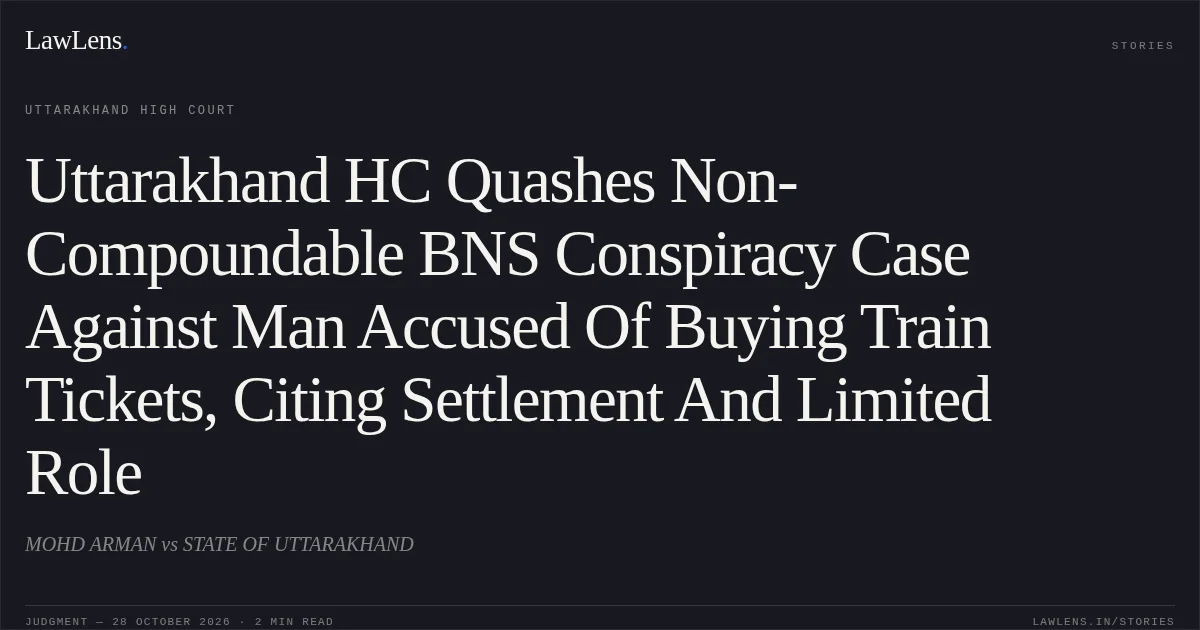
The applicant sought quashing under Section 528 of the Bharatiya Nagarik Suraksha Sanhita, 2023, of the charge-sheet, the cognizance/summoning order dated 15 April 2026, and the consequential proceedings arising from FIR No. 207 of 2019.
¶ 4–9The case arose from a personal altercation between parties who lodged cross-FIRs and sustained injuries, described as grievous but not dangerous to life.
¶ 4–9The parties later entered into a voluntary settlement; the respondents confirmed that they did not wish to pursue the proceedings.
¶ 4–9The State opposed quashing on the ground that some alleged offences were non-compoundable.
¶ 4–902Issues
i.Whether the High Court could exercise its inherent jurisdiction under Section 528 BNSS to quash proceedings involving non-compoundable offences after the parties settled a personal dispute.
¶ 8–11ii.Whether, in light of the settlement and circumstances of the incident, continuation of the criminal proceedings would serve any useful purpose.
¶ 9, 1303Law Applied
Section 320 of the Code of Criminal Procedure, 1973 governs statutory compounding and identifies offences that are non-compoundable; however, the High Court’s inherent jurisdiction under Section 528 BNSS is distinct from that power and may be exercised to secure the ends of justice, having regard to the nature and gravity of the allegations, the circumstances of the incident, and the genuineness of the settlement.
¶ 10Relying on Gian Singh v. State of Punjab, (2012) 10 SCC 303, Narinder Singh v. State of Punjab, (2014) 6 SCC 466, and State of Madhya Pradesh v. Laxmi Narayan, (2019) 5 SCC 688, the Court stated that proceedings arising from essentially private disputes may be quashed following an amicable settlement where continuation would amount to an abuse of process.
¶ 11–12Provisions in the judgment · 3 · Linked ones open on LawLens
Bharatiya Nagarik Suraksha Sanhita, 2023 Section 528
Code of Criminal Procedure, 1973 Section 320Section 482
04Reasoning
The Court treated the dispute as predominantly personal, noting the cross-FIRs, injuries on both sides, and the parties’ voluntary settlement.
¶ 9–13Although some alleged offences were non-compoundable, the Court considered its inherent jurisdiction separately from statutory compounding.
¶ 9–13The respondents’ unequivocal confirmation that they did not wish to pursue the case, together with the circumstances of the altercation, led the Court to conclude that continuing the proceedings would serve no useful purpose.
¶ 9–1305Holding
The Court allowed the compounding application and the Section 528 BNSS application.
¶ 14It quashed the charge-sheet, the cognizance/summoning order dated 15 April 2026, and the consequential proceedings in Sessions Trial No. 106 of 2026, qua the applicant, in terms of the parties’ compromise.
¶ 14Pending applications were disposed of accordingly.
¶ 15Original Court PDF
MUZAMMIL HASANvsSTATE OF UTTARAKHAND
Click to open original judgment
Original judgment, available to read, download and summarize on LawLens.in