01Facts
The Rural Works Department invited bids for construction of a Circuit House at Pithoragarh.
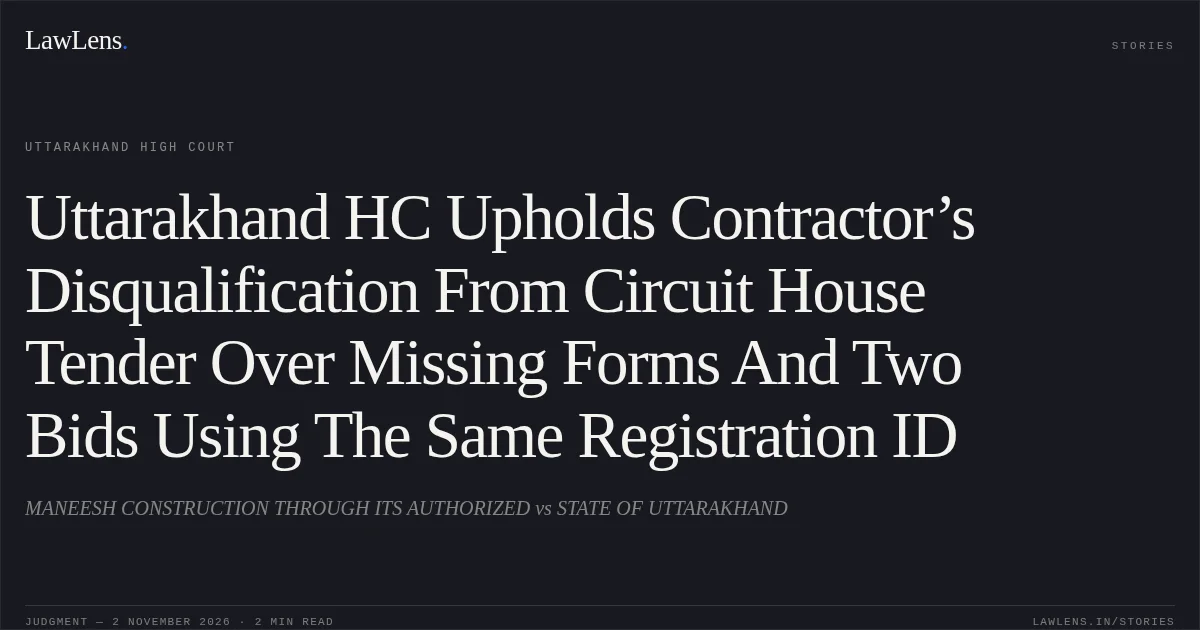
¶ 1The petitioner’s technical bid was declared non-responsive for not submitting the prescribed LIT-1 form on pending litigation and PER-2 personnel resumes, and for allegedly submitting two bids using the same registration ID as another bidder, contrary to the tender conditions.
¶ 1–3The petitioner challenged the rejection and the opening of respondent no. 2’s financial bid, contending that the required information had been provided and that the other bidder had wrongly used his email ID.
¶ 1, 4The Court found that the litigation information and personnel resumes were not submitted in the prescribed forms; it also noted that a writ petition filed by the petitioner was pending when he submitted his bid.
¶ 8, 1002Issues
i.Whether the Department was justified in declaring the petitioner’s technical bid non-responsive for failure to submit mandatory information and forms in the prescribed manner.
¶ 3, 8, 10ii.Whether the alleged use of the same registration ID in bids submitted by the petitioner and respondent no. 2 warranted rejection of the petitioner’s bid as a violation of the tender conditions.
¶ 3, 5, 9–10iii.Whether the Court should interfere under Article 226 with the tender evaluation and rejection of the petitioner’s bid.
¶ 12–1903Law Applied
Under the tender’s Standard Bidding Document and Instructions to Bidders, bidders were required to submit the prescribed LIT-1 and PER-2 forms, and the relevant conflict-of-interest provisions prohibited multiple bids by the same entity or its affiliates.
¶ 2–3, 5Judicial review of tender decisions is limited: courts do not substitute their assessment for that of the employer unless the decision-making process is mala fide, arbitrary, irrational, perverse, or intended to favour someone. The employer is ordinarily best placed to interpret its tender documents (Central Coalfields Ltd. v. SLL-SML (Joint Venture Consortium); Afcons Infrastructure Ltd. v. Nagpur Metro Rail Corporation Ltd.).
¶ 12–14Courts should also weigh public interest and avoid unnecessary interference that may delay or increase the cost of public projects (Raunaq International Ltd. v. I.V.R. Construction Ltd.; Air India Ltd. v. Cochin International Airport Ltd.; M/s N.G. Projects Ltd. v. Vinod Kumar Jain; Tata Motors Ltd. v. BEST).
¶ 15–1804Reasoning
The Court examined the bid documents and found that the petitioner had not supplied the pending-litigation information in the prescribed LIT-1 form and had not submitted the personnel resumes in the required PER-2 format.
¶ 8It further considered the shared registration ID, the alleged connection between the bids, and the fact that the petitioner’s pending writ petition was not disclosed as required; these matters supported the Department’s decision to reject the bid and the Court’s concern about possible cartelization.
¶ 9–10Applying the deferential standard of review in tender matters, the Court found no basis to conclude that the Department’s decision was mala fide, arbitrary, or otherwise unlawful.
¶ 12–1805Holding
The Court held that the petitioner’s bid failed to satisfy the Standard Bidding Document and that the employer was justified in rejecting it.
¶ 10, 19–21Finding no ground for judicial interference, it dismissed the writ petition, vacated the interim order dated 2 April 2025, and directed the employer to proceed in accordance with law.
¶ 19–21Original Court PDF
MANEESH CONSTRUCTION THROUGH ITS AUTHORIZEDvsSTATE OF UTTARAKHAND
Click to open original judgment
Original judgment, available to read, download and summarize on LawLens.in