Facts
The petitioners intended to contest student-union elections at colleges affiliated with Kumaun University: three sought the post of Treasurer and one sought Joint Secretary.
Source reference: paras. 2–4, 6–8After the University announced the election schedule, the State issued a communication proposing 50% representation for female students, and the University issued an order reserving certain posts—including Treasurer and Joint Secretary—for female students.
Source reference: paras. 2–4, 6–8The petitioners challenged the State communication and/or the University order, arguing, among other things, that the prescribed amendment procedure had not been followed and that the State lacked authority to direct the reservation.
Source reference: paras. 2–4, 6–8The University stated that its Executive Council had approved implementation of the reservation on 18 September 2026.
Source reference: paras. 9–11, 19By the time the petitions were considered, nominations had closed and the elections were imminent.
Source reference: paras. 9–11, 19Issues
1. Whether the State’s direction and the University’s order reserving student-union posts for female students were legally invalid because the relevant amendment procedure had not been followed or the State lacked authority to issue the direction.
Source reference: paras. 6–8, 202. Whether the circumstances disclosed a legal violation warranting the High Court’s intervention after nominations had closed and elections were imminent.
Source reference: paras. 19–20Law Applied
Article 162 of the Constitution permits the State executive to act within the State’s executive sphere; Article 15(3) authorises special provisions for women, including affirmative action or reservation (Government of A.P. v. P.B. Vijayakumar, (1994) 4 SCC 520).
Source reference: paras. 12–14, 21The Court also relied on the principle that the right to contest an election is not a fundamental or common-law right, but a statutory right subject to the governing rules and qualifications (Javed v. State of Haryana, (2003) 8 SCC 369; Vishwanath Pratap Singh v. Election Commission of India, 2022 SCC OnLine SCC 2213).
Source reference: para. 16Under Section 21(1)(xvii) of the Uttarakhand State Universities Act, 1973, the University Executive Council may regulate matters concerning the University and its affiliated colleges in accordance with the Act, Statutes and Ordinances.
Source reference: para. 10The Court further considered Article 19 of the student-union Constitution, finding that its specified amendment process concerned amendments proposed by student unions and did not preclude action by the Executive Council.
Source reference: para. 23Reasoning
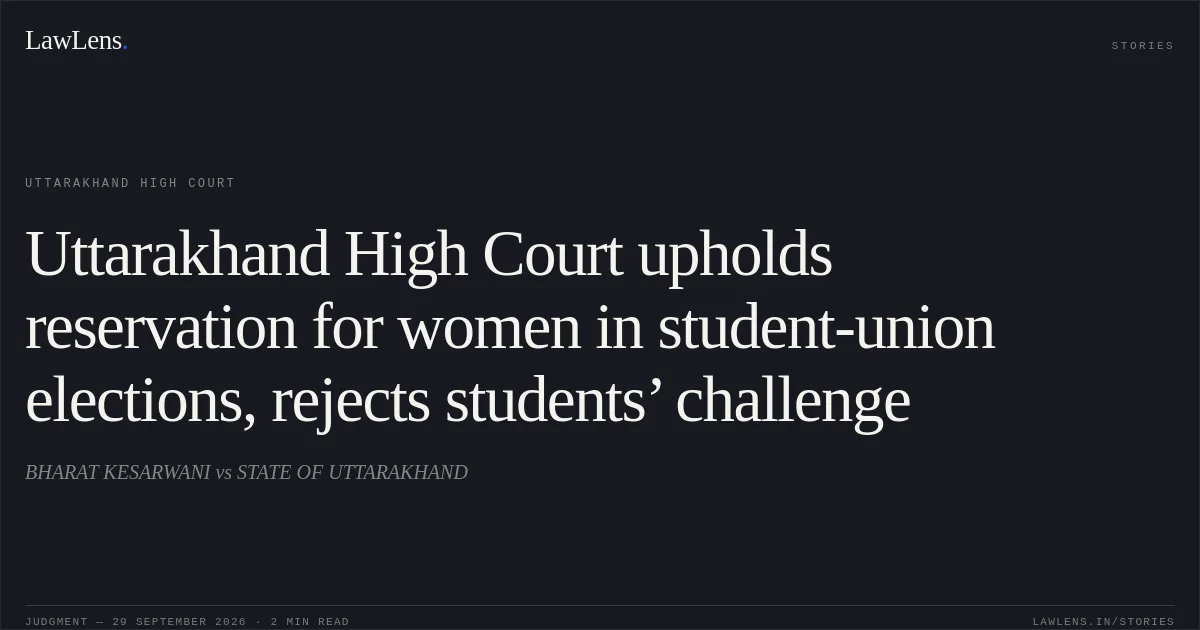
The Court accepted that the State’s direction was issued to promote female students’ representation and treated it as a permissible special measure under Article 15(3), exercised through the State’s executive power under Article 162.
Source reference: paras. 12–14, 21It found that the University’s Executive Council had approved the measure and held that the absence of a formal amendment to the student-union Constitution did not invalidate the University’s order, since Article 19 did not govern amendments initiated by the Executive Council.
Source reference: paras. 22–23The Court also noted that the petitioners had not been barred from contesting altogether, and that nominations had closed; it found no gross violation justifying intervention at that stage.
Source reference: paras. 19–20Holding
The Court held that the petitions lacked merit and that no ground for intervention had been established.
All four writ petitions were dismissed in limine.
Source reference: paras. 24–25Acts & Sections Cited
4 provisions across 1 statute referred to in this judgment. Linked provisions open on LawLens.
Uttarakhand State University Act, 19734
Original Court PDF
BHARAT KESARWANIvsSTATE OF UTTARAKHAND
Click to open original judgment
Original judgment, available to read, download and summarize on LawLens.in