Facts
Respondent No. 2, an accounts manager of VAPS Knowledge Services Pvt. Ltd., complained that the petitioner, a director of Ivorysense Pvt. Ltd., supplied used and substandard lighting materials under a work order dated 20 May 2019, despite receiving the agreed payment.
Source reference: p. 3–4A private complaint alleging several offences was referred to the police, which registered Crime No. 145/2020 and, after investigation, filed a charge sheet against the petitioner under Section 406 IPC.
Source reference: p. 3–4The Magistrate took cognizance, and the petitioner sought to quash the proceedings under Section 482 CrPC.
Source reference: p. 3–4The petitioner relied on the work order’s civil-dispute clause and the availability of contractual remedies; the prosecution opposed quashing, relying on witness statements alleging that substandard materials were supplied after payment of Rs. 48 lakhs.
Source reference: p. 4–5Issues
1. Whether the charge-sheet material disclosed the ingredients of criminal breach of trust under Section 406 IPC, including entrustment and dishonest misappropriation or conversion
Source reference: p. 6–82. Whether, in the circumstances, continuation of the criminal proceedings would amount to an abuse of process warranting exercise of the High Court’s inherent jurisdiction under Section 482 CrPC
Source reference: p. 7–11Law Applied
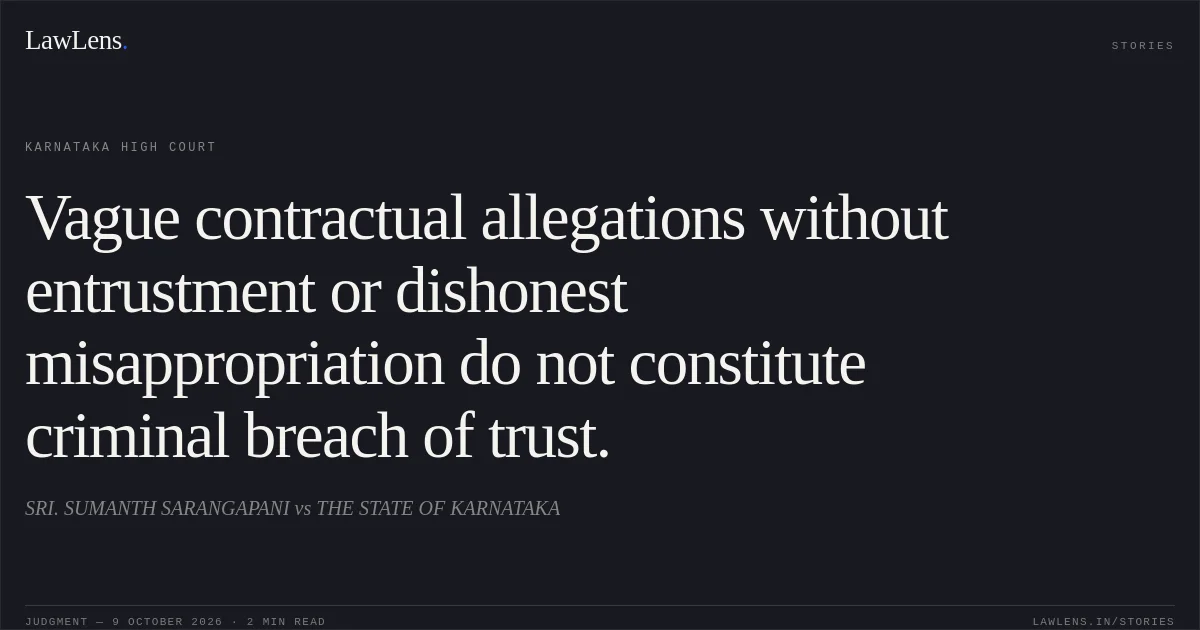
Section 482 CrPC empowers the High Court to quash criminal proceedings where allowing them to continue would amount to an abuse of process. Sections 405 and 406 IPC require, for criminal breach of trust, entrustment of property and its dishonest misappropriation, conversion, use, or disposal in violation of law or a legal contract; a contractual breach alone does not establish the offence
Source reference: p. 7–9Relying on Arshad Neyaz Khan v. State of Jharkhand, 2025 SCC OnLine SC 2058, the Court reiterated that a breach of trust does not become a penal offence without material showing dishonest misappropriation of entrusted property, and that criminal proceedings should not be used to pursue a civil dispute where the ingredients of an offence are absent
Source reference: p. 8–10Reasoning
The Court found that the work order specified the materials and provided for civil remedies, while the charge sheet made only a general allegation that the petitioner supplied substandard materials.
Source reference: p. 6–8It identified no particular material that was substandard, no specific departure from the agreed specifications, and no material showing entrustment followed by dishonest misappropriation or conversion.
Source reference: p. 6–8In those circumstances, the allegation did not disclose the essential ingredients of Section 406 IPC; the contractual remedies and civil-dispute clause reinforced the Court’s conclusion that the criminal case could not continue on the material presented.
Source reference: p. 7–11Holding
The Court held that no prima facie offence under Section 406 IPC was made out and that continuing the prosecution would amount to an abuse of process.
It allowed the petition and quashed the proceedings in C.C. No. 5967/2022, arising from Crime No. 145/2020, pending before the IV ACMM, Bengaluru.
Source reference: p. 11Acts & Sections Cited
7 provisions across 2 statutes referred to in this judgment. Each provision opens on LawLens.
Code of Criminal Procedure, 19732
Indian Penal Code, 18605
Original Court PDF
SRI. SUMANTH SARANGAPANIvsTHE STATE OF KARNATAKA
Click to open original judgment
Original judgment, available to read, download and summarize on LawLens.in