Facts
The petitioners, Jakir Hossain and Jahir Abbash, were respectively the husband and brother-in-law of the opposite party no. 2/de facto complainant
Source reference: p.1–2The complainant alleged that she married petitioner no. 1 on 18 June 2018 according to Muslim rites and customs and was thereafter subjected to physical and mental cruelty by her husband and in-laws for dowry
Source reference: p.2She further alleged that approximately two and a half years before lodging the complaint, she was assaulted and driven out of the matrimonial home, following which she resided at her parental home.
Source reference: p.2She subsequently learnt that her husband had married another woman on 6 March 2022 and, upon visiting the matrimonial home, was again assaulted by her husband and in-laws
Source reference: p.2On the basis of the complaint, Chanchal Police Station Case No. 221 of 2022 dated 7 March 2022 was registered under Sections 498A, 323, 325, 308 and 494 of the Indian Penal Code, 1860, read with Sections 3 and 4 of the Dowry Prohibition Act, 1961.
Source reference: p.1The proceedings were pending as G.R. Case No. 479 of 2022 before the Additional Chief Judicial Magistrate, Malda, Chanchal
Source reference: p.1The petitioners sought quashing of the proceedings.
Source reference: p.1The State produced the case diary and memo of evidence before the High Court
Source reference: p.2Issues
Whether the allegations in the complaint and the materials in the case diary disclosed the essential ingredients of the offences alleged against the petitioners under Sections 498A, 323, 325, 308 and 494 IPC and Sections 3 and 4 of the Dowry Prohibition Act?
Source reference: p.6–7Whether continuation of the criminal proceedings against the petitioners would amount to an abuse of the process of law warranting exercise of the High Court’s inherent jurisdiction to quash the proceedings?
Source reference: p.6–7Law Applied
The Court applied Section 498A IPC, including its Explanation defining cruelty as wilful conduct likely to drive a woman to suicide or cause grave injury or danger to her life, limb or health, and harassment intended to coerce fulfilment of an unlawful demand for property or valuable security
Source reference: p.3It considered Sections 3 and 4 of the Dowry Prohibition Act, concerning giving, taking or abetting dowry and demanding dowry, respectively
Source reference: p.3The Court relied on Dara Lakshmi Narayana v. State of Telangana, which held that vague and omnibus allegations without specific particulars of time, place, manner or individual involvement cannot sustain criminal prosecution, particularly against relatives of the husband
Source reference: p.3–6It also relied on G.V. Rao v. L.H.V. Prasad, (2000) 3 SCC 693, and Preeti Gupta v. State of Jharkhand, (2010) 7 SCC 667, emphasising judicial caution and scrutiny in matrimonial prosecutions to prevent misuse of Section 498A IPC
Source reference: p.5–6Applying the principles governing quashing of proceedings under Section 482 CrPC, including category 7 of State of Haryana v. Bhajan Lal, the Court held that proceedings may be quashed where the allegations do not disclose a prima facie offence or continuation would constitute abuse of process
Source reference: p.6Reasoning
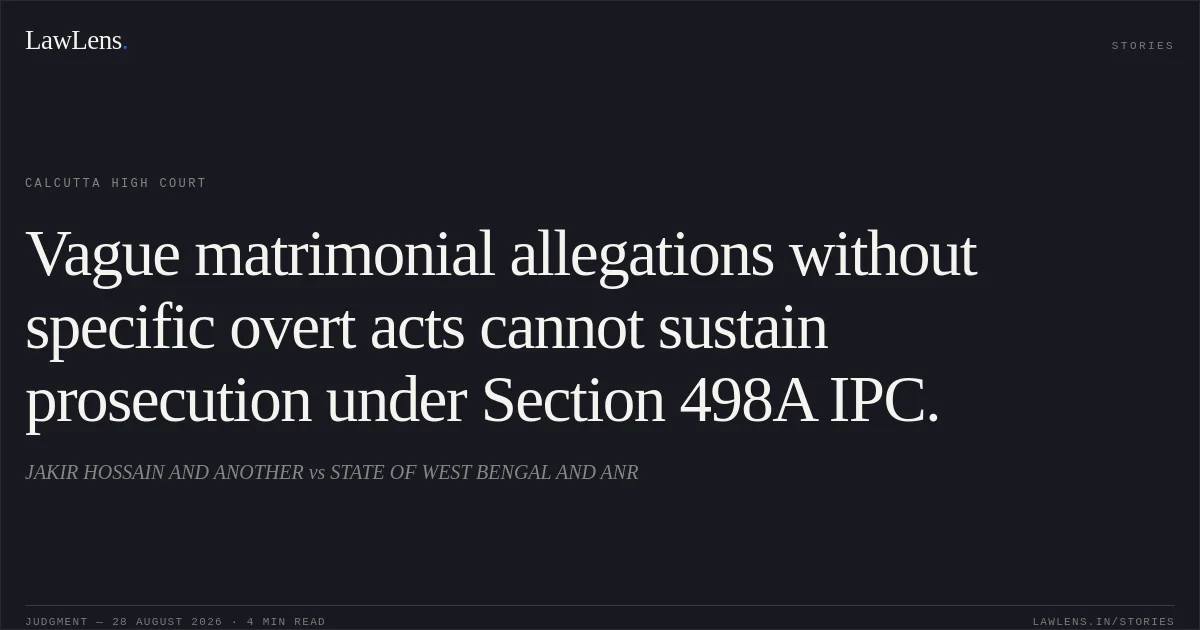
The Court found that the allegations against the petitioners were general and omnibus and did not contain concrete particulars establishing the individual participation of either petitioner in the alleged acts of cruelty, assault, dowry demand or the other offences charged
Source reference: p.6–7Although the complaint referred broadly to physical and mental torture, expulsion from the matrimonial home, the husband’s subsequent marriage and a later assault, the materials did not demonstrate the essential ingredients of the offences alleged against the petitioners with sufficient specificity
Source reference: p.2, p.6–7In light of the principles in Dara Lakshmi Narayana, G.V. Rao and Preeti Gupta, the Court held that permitting the prosecution to continue on the basis of such unparticularised allegations would amount to misuse of the criminal process.
Source reference: p.6The Court therefore treated the case as falling within the abuse-of-process category identified in Bhajan Lal
Source reference: p.6–7Holding
The High Court answered the issues in favour of the petitioners and held that the allegations and case-diary materials did not disclose the necessary ingredients of the offences against them and that continuation of the proceedings would constitute an abuse of the process of law
CRR 4100 of 2024 was allowed, and the proceedings in G.R. Case No. 479 of 2022 arising from Chanchal Police Station Case No. 221 of 2022 were quashed insofar as they related to Jakir Hossain and Jahir Abbash
Source reference: p.7All connected applications were disposed of, any interim order was vacated, and a copy of the judgment was directed to be sent to the trial court for necessary compliance
Source reference: p.7Acts & Sections Cited
7 provisions across 3 statutes referred to in this judgment. Each provision opens on LawLens.
Indian Penal Code, 18604
Code of Criminal Procedure, 19731
Original Court PDF
JAKIR HOSSAIN AND ANOTHERvsSTATE OF WEST BENGAL AND ANR
Click to open original judgment
Original judgment, available to read, download and summarize on LawLens.in
![Courts will not interfere with transfers absent mala fides or violation of statutory rules.. M Ramya vs EMPLOYEES STATE INSURANCE CORPORATION (ESIC). CAT - ['Chennai']. LawLens](/stories/thumbnails/courts-will-not-interfere-with-transfers-absent-mala-fides-or-violation-of-statutory-rules-a6845e9ca6f548fca284c51c8351957f.webp)
![Courts cannot direct one-time recruitment age relaxation absent authority in the governing rules or advertisement.. UT OF PUDUCHERRY vs M ANDAL. CAT - ['Chennai']. LawLens](/stories/thumbnails/courts-cannot-direct-one-time-recruitment-age-relaxation-absent-authority-in-the-governing-895d78fde47143e2a8ed0207c4b6a44f.webp)
![A review cannot correct an allegedly erroneous decision absent an error apparent on the record.. Ajit Kumar Jha vs RAILWAY BOARD. CAT - ['Delhi']. LawLens](/stories/thumbnails/a-review-cannot-correct-an-allegedly-erroneous-decision-absent-an-error-apparent-on-the-re-8ac952fd4eba470c92f7da20af72a220.webp)