01Facts
The FIR, C.R. No. I-8 of 2016 registered at Anandnagar Police Station, Ahmedabad, alleged offences under Sections 498-A, 306 and 114 of the IPC and Sections 3 and 7 of the Dowry Prohibition Act.
¶ 2–3.15, 16–17The deceased married Krunal Ishwarbhai Desai on 24 November 2015 and died by suicide on 21 January 2016, within two months of the marriage.
¶ 2–3.15, 16–17The complainant alleged that the husband demanded ₹25 lakh for purchase of property, physically and mentally harassed the deceased, demanded money, objected to her employment, and taunted her regarding her previous marriage.
¶ 2–3.15, 16–17As against the surviving applicant, Pushpaben Desai, the deceased’s mother-in-law, the allegations were principally that she failed to restrain or condemn her son’s conduct and told the deceased that, since she too had suffered as a woman, the deceased should also suffer.
¶ 2–3.15, 16–17Applicant No. 1 was reported to have died on 13 July 2022, and the proceedings were recorded as abated against him; the husband had also been acquitted by the Sessions Court on 29 April 2026.
¶ 1, 10, 15The surviving applicant invoked Section 482 of the Code of Criminal Procedure seeking quashing of the FIR and consequential proceedings.
¶ 202Issues
i.1. Whether the allegations against the surviving applicant, considered at their face value, disclosed the ingredients of offences under Sections 498-A or 306 of the IPC and Sections 3 or 7 of the Dowry Prohibition Act.
¶ 5–8, 16–18ii.2. Whether the general allegation that the mother-in-law failed to restrain her son and stated that the deceased should also suffer constituted instigation, intentional aid, or conduct sufficiently proximate to attract Section 306 read with Section 107 of the IPC.
¶ 6–7, 16–18iii.3. Whether the FIR and consequential proceedings should be quashed under the High Court’s inherent jurisdiction under Section 482 CrPC, particularly when the allegations lacked specific particulars and the husband had been acquitted.
¶ 15–2003Law Applied
The Court applied Section 482 CrPC, which empowers the High Court to quash criminal proceedings to prevent abuse of process and secure the ends of justice.
¶ 2, 20Section 498-A IPC requires cruelty by the husband or his relative, including wilful conduct likely to drive the woman to suicide or harassment connected with an unlawful demand for property or valuable security.
¶ 5, 7, 16–18Section 306 IPC, read with Section 107 IPC, requires abetment of suicide through instigation, conspiracy, or intentional aid; a mere omission to intervene or a vague allegation, without a positive and proximate act, is insufficient.
¶ 6–7Sections 3 and 7 of the Dowry Prohibition Act require allegations connecting the accused with giving, taking, or demanding dowry.
¶ 5, 7, 17–18The Court also considered the submission concerning Section 113-A of the Indian Evidence Act, observing that the presumption relating to abetment of suicide by a married woman presupposes foundational facts showing cruelty by the accused.
¶ 8Relying on Dara Lakshmi Narayana v. State of Telangana, 2024 SCC OnLine SC 3682, and Archin Gupta v. State of Haryana, (2025) 3 SCC 756, the Court reiterated that vague and omnibus allegations against matrimonial relatives, without specific acts demonstrating active involvement, may constitute abuse of process warranting quashing.
¶ 19–19.1Provisions in the judgment · 7 · Linked ones open on LawLens
Code of Criminal Procedure, 1973 Section 482
Indian Penal Code, 1860 Section 306Section 114Section 107
04Reasoning
The Court found that the FIR and charge-sheet contained no specific date, time, place, or concrete incident showing that Pushpaben demanded dowry, physically or mentally assaulted the deceased, or actively participated in the alleged harassment.
¶ 16–18The allegation that she did not restrain her son was treated as insufficient to establish cruelty or abetment.
¶ 17–18Her alleged statement that the deceased should also suffer, although objectionable, was considered vague and unsupported by any specific overt act, instigation, or intentional aid proximate to the suicide.
¶ 17–18The Court further regarded the husband’s acquittal on benefit of doubt as a significant circumstance, particularly since the case against the mother-in-law was based on a substantially weaker and generalised attribution.
¶ 10, 15, 18On the principles in Dara Lakshmi Narayana and Archin Gupta, continuing the prosecution in the absence of concrete allegations of active involvement would amount to abuse of the criminal process.
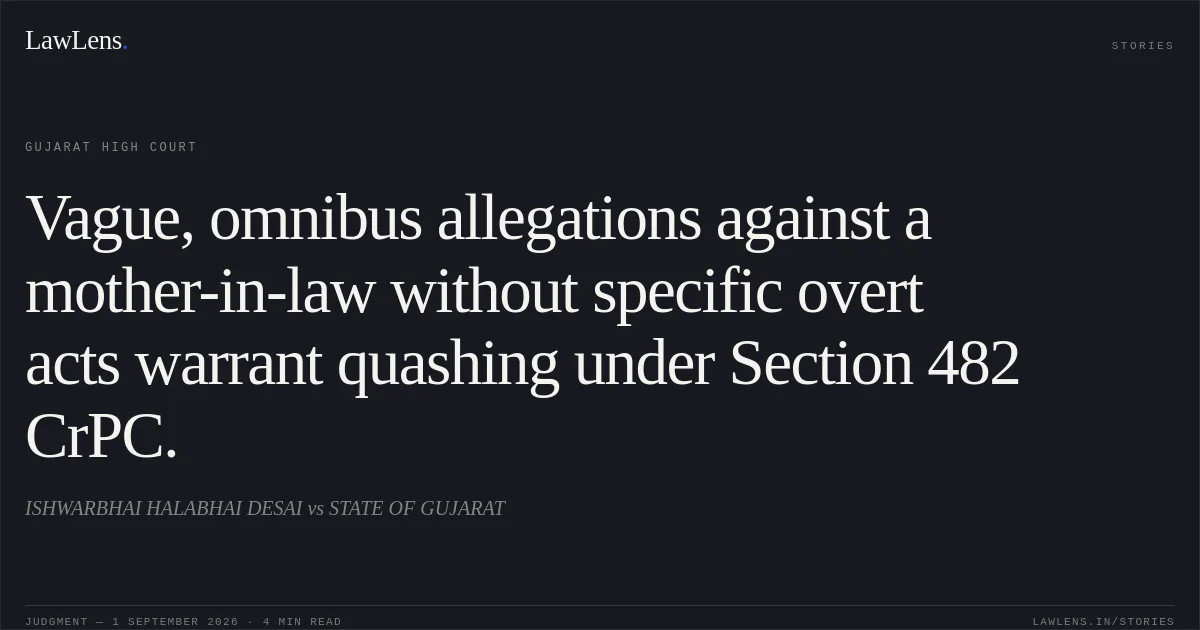
¶ 19–19.1The Court therefore held that the statutory ingredients of Sections 498-A and 306 IPC and Sections 3 and 7 of the Dowry Prohibition Act were not prima facie made out against the surviving applicant.
¶ 1805Holding
The Court allowed the application under Section 482 CrPC and quashed FIR C.R. No. I-8 of 2016 registered with Anandnagar Police Station, Ahmedabad, together with all consequential proceedings.
¶ 20The proceedings were already treated as abated against the deceased applicant, and the relief effectively terminated the prosecution against the surviving applicant, Pushpaben Desai.
¶ 1, 15, 20Rule was made absolute, and direct service was permitted.
¶ 1, 15, 20Original Court PDF
ISHWARBHAI HALABHAI DESAIvsSTATE OF GUJARAT
Click to open original judgment
Original judgment, available to read, download and summarize on LawLens.in