01Facts
The petitioner, sister-in-law of the complainant, sought quashing of FIR in Crime No. 43/2021 under Sections 498A, 323, 504, 506, 342 r/w 34 IPC and Section 4 of the Dowry Prohibition Act, registered on the complainant's complaint dated 27.11.2021.
¶ 2 · ¶ 3The complainant married on 14.06.2017 and gave birth on 28.01.2019. She alleged taunting and neglect by her husband, mother-in-law and sister-in-law, and left the matrimonial home on 06.02.2021.
¶ 3On 03.09.2021, the petitioner, her husband and one Prabhu allegedly came to bring her back, promising a fresh start.
¶ 3 · ¶ 11On 03.10.2021, the complainant alleged that her mother-in-law did not cooperate with a family meeting, that she was confined in a room, and that the room's latches were removed before she was taken to her parental home.
¶ 3In her Section 164 CrPC statement, the complainant stated that the petitioner and her husband are both doctors practising in Bengaluru and that they visited on weekends.
¶ 4 · ¶ 11The petitioner contended that the allegations were omnibus.
¶ 4The complainant contended that the complaint specifically pleaded the 03.09.2021 visit and subsequent assault and confinement, requiring investigation.
¶ 6The State supported the FIR.
¶ 902Issues
i.1. Whether the FIR may be quashed under Section 482 CrPC against the sister-in-law where the complaint makes only omnibus allegations and does not specify the date or particular act attributable to her.
¶ 10 · ¶ 11 · ¶ 12ii.2. Whether mere separate residence of the accused relative is, by itself, a ground for quashing the proceedings.
¶ 6 · ¶ 8 · ¶ 1203Law Applied
The Court's power to quash under Section 482 CrPC is governed by the contents of the complaint. Where the complaint discloses the ingredients of the offence, quashing is impermissible, as held in Dineshbhai Chandubhai Patel v. State of Gujarat (2018) 3 SCC 104.
¶ 10Allegations must be assessed at face value, and the principles of State of Haryana v. Bhajan Lal (1992 Supp (1) SCC 335) and Kahkashan Kausar v. State of Bihar (2022) 6 SCC 599 apply to determine whether the ingredients of Section 498A IPC are disclosed.
¶ 5Under Prabha Devi v. State of Bihar (SLP (Crl.) No. 3845/2026, dated 08.09.2026), collective allegations of taunting, opposition to marriage and harassment do not disclose the particular conduct or wilful cruelty required by Section 498A, and an unlawful demand must be attributed to the accused.
¶ 5 · ¶ 12Bhaskar Lal Sharma v. Monica (2014) 3 SCC 383 holds that at the quashing stage, the averments must be accepted as they appear, without a summary appreciation of evidence.
¶ 7Shaik Mukthar v. State of Andhra Pradesh (2020) 19 SCC 178 holds that separate residence does not by itself exonerate relatives where specific evidence shows they harassed the wife.
¶ 8 · ¶ 12Provisions in the judgment · 8 · Linked ones open on LawLens
Code of Criminal Procedure, 1973 Section 482Section 164
Indian Penal Code, 1860 Section 323Section 504Section 506Section 342Section 34
Dowry Prohibition Act, 1961 Section 4
04Reasoning
The Court read the complaint in its entirety. The complaint did not state the date on which the petitioner allegedly assaulted the complainant, and it attributed the specific assault and confinement to the mother-in-law.
¶ 10 · ¶ 11The only particularised allegation against the petitioner was that she joined in the 03.09.2021 visit to bring the complainant back, which is not cruelty. The Court held that the allegation against the petitioner was an omnibus implication, following the observation that roping in all family members has become a habit.
¶ 3 · ¶ 11The complainant's own Section 164 statement that the petitioner was a practising doctor in Bengaluru, and visited only on weekends, weakened any claim of continuous cohabitation-based cruelty.
¶ 4 · ¶ 11Applying Prabha Devi, the Court found that the collective allegations did not disclose wilful conduct under Section 498A. The Court distinguished Shaik Mukthar, where specific evidence of harassment by separately residing relatives existed.
¶ 12On the second issue, the Court rejected the argument that separate residence is a ground for quashing in itself. However, it held that since the complaint did not disclose the offence against this petitioner, separate residence was relevant only as part of the overall lack of specific allegations.
¶ 1205Holding
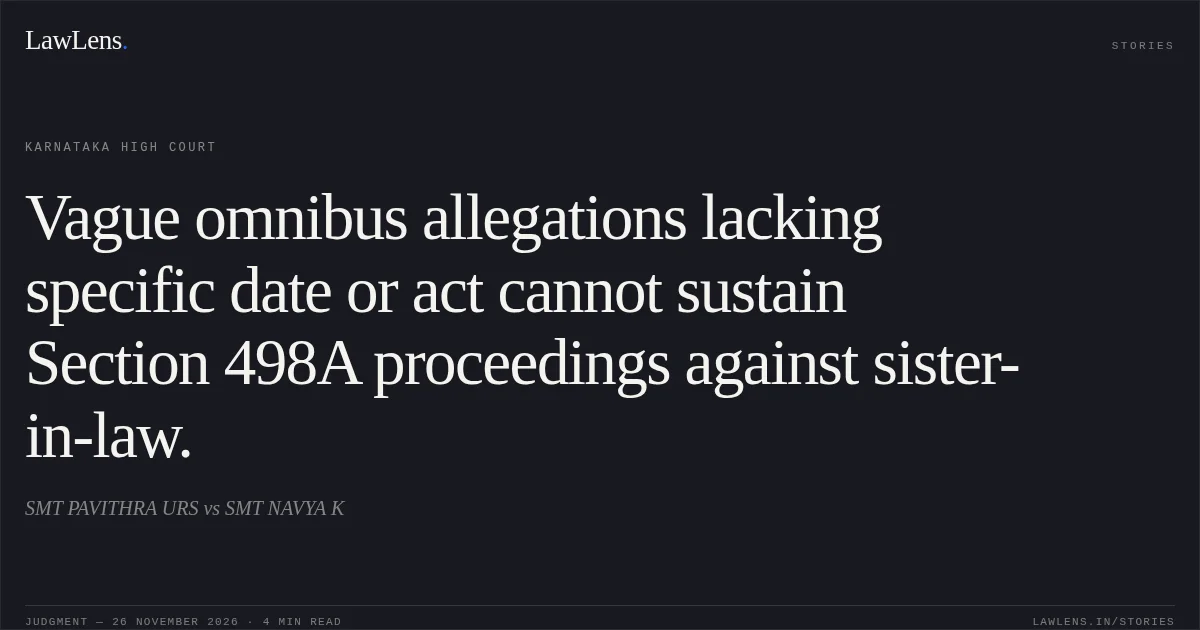
The Court answered Issue 1 in the affirmative: the complaint contains only omnibus allegations against the petitioner, with no specified date or particular act, and does not disclose the ingredients of the offences alleged.
¶ 11 · ¶ 12On Issue 2, separate residence is not by itself a ground for quashing, but it does not preclude quashing where the complaint discloses no offence against the particular accused.
¶ 12The petition is allowed, and the proceedings against the petitioner (accused No. 3) in Crime No. 43/2021 are quashed.
¶ 12 · ¶ 13The proceedings against the other accused are not affected by this order.
Original Court PDF
SMT PAVITHRA URSvsSMT NAVYA K
Click to open original judgment
Original judgment, available to read, download and summarize on LawLens.in