Facts
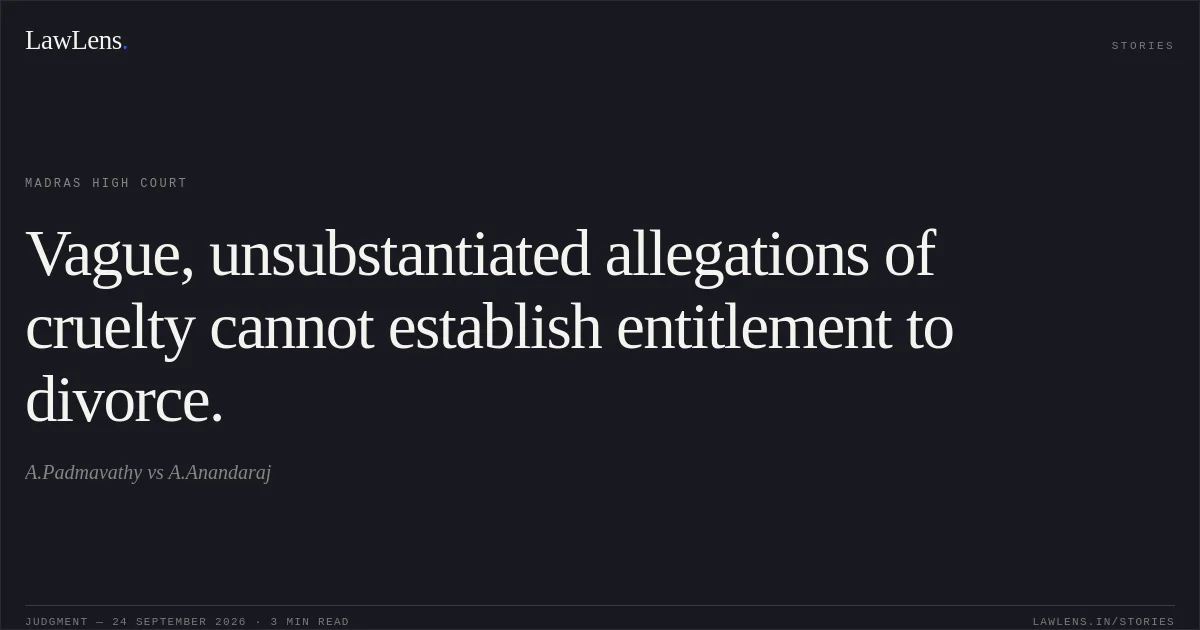
The appellant-wife challenged the dismissal of her petition in H.M.O.P. No. 622 of 2007, by which she had sought dissolution of marriage on the ground of cruelty.
Source reference: p. 2The parties married on 16 June 1999 according to Hindu rites and had two children.
Source reference: p. 2The wife alleged that the husband was alcoholic, used abusive language, physically assaulted her with a cane and nylon rope, demanded money for purchasing property, suspected her fidelity, and compelled her to leave the matrimonial home in April 2006 when her parents did not pay the alleged balance amount of ₹2,19,000.
Source reference: pp. 2–3She lodged a police complaint on 9 July 2006, while the husband subsequently filed a petition for restitution of conjugal rights in H.M.O.P. No. 44 of 2007.
Source reference: p. 3The husband denied cruelty and alleged that the wife had an illicit relationship with his step-sister’s husband, had eloped, and had deserted him and their two children.
Source reference: pp. 3–4The Family Court, after recording the evidence of the parties and their witnesses, dismissed the wife’s petition, holding that cruelty was not proved and that she had deserted the husband and children without valid reason.
Source reference: p. 4Issues
1. Whether the wife proved that the husband had subjected her to matrimonial cruelty so as to justify dissolution of the marriage.
Source reference: pp. 2, 52. Whether the Family Court was justified in rejecting the wife’s allegations of cruelty and in treating her departure from the matrimonial home, leaving the minor children behind, as a matrimonial wrong.
Source reference: pp. 4–6Law Applied
The Court applied the statutory matrimonial remedy of divorce on the ground of cruelty under the Hindu Marriage Act, as invoked in H.M.O.P. No. 622 of 2007.
Source reference: pp. 2, 5It applied the principle that allegations of matrimonial cruelty must be pleaded and proved through specific, credible and material particulars; vague allegations, unsupported by dates, circumstances or corroborative evidence, are insufficient.
Source reference: p. 5The Court also considered the evidentiary consequence of the wife’s failure to cross-examine the husband on the alleged acts of cruelty and the circumstances surrounding her departure from the matrimonial home.
Source reference: pp. 5–6Reasoning
The Court found that the wife’s pleadings and chief-examination contained only general assertions that the husband abused and beat her, without identifying the dates, months, years or specific circumstances of the alleged incidents.
Source reference: p. 5Her failure to cross-examine the husband regarding the alleged acts of cruelty further weakened her case and, in the Court’s view, indicated that the allegations were vague and unsupported.
Source reference: pp. 5–6The Court also considered it significant that she had left the matrimonial home while the children were aged approximately five and three years and had thereafter not visited them; it reasoned that, if the husband were an abusive or dangerous person, she would not ordinarily have left the children in his custody.
Source reference: p. 5On the evidence, the Court therefore accepted the Family Court’s conclusion that cruelty by the husband had not been established and that the wife’s conduct in leaving the husband and minor children constituted a matrimonial wrong.
Source reference: pp. 5–6Holding
The High Court answered the issues against the wife, holding that she had failed to prove matrimonial cruelty and that the Family Court’s dismissal of H.M.O.P. No. 622 of 2007 was justified.
The order of the Family Court, Coimbatore, dated 28 May 2013, was affirmed, the civil miscellaneous appeal was dismissed, and no costs were awarded.
Source reference: p. 6Acts & Sections Cited
1 provisions across 1 statute referred to in this judgment. Each provision opens on LawLens.
Family Courts Act, 19841
Original Court PDF
A.PadmavathyvsA.Anandaraj
Click to open original judgment
Original judgment, available to read, download and summarize on LawLens.in