Facts
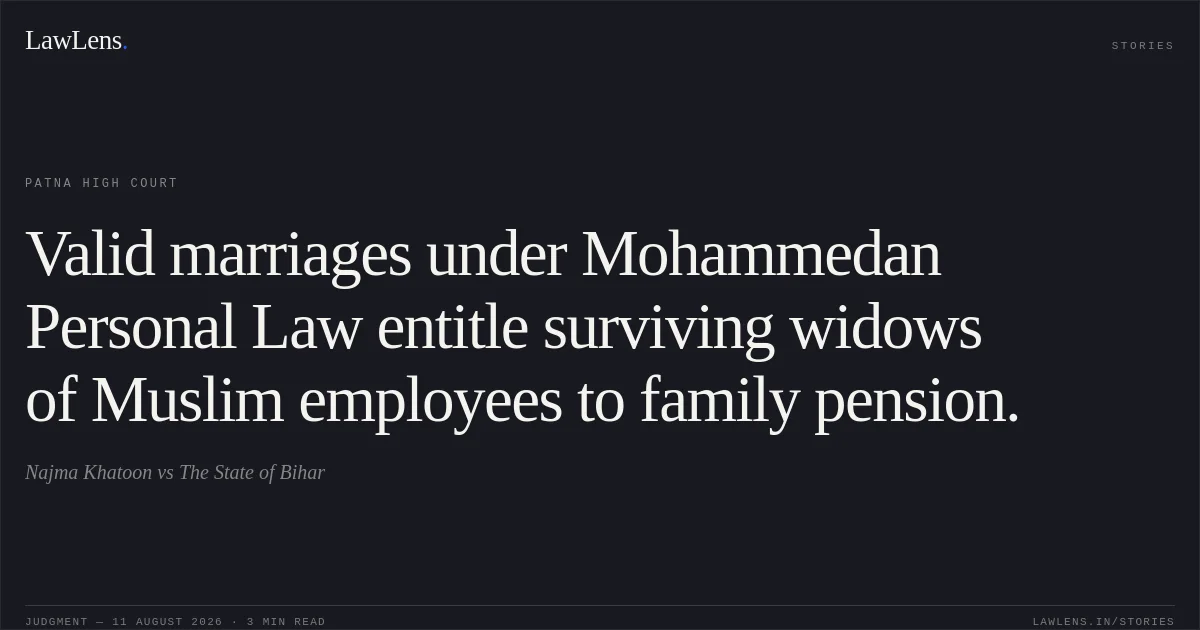
The petitioner, Najma Khatoon, claimed family pension as the second wife of Late Md. Usman, a deceased Government employee who died on 14 October 2024.
Source reference: paras. 2–3; pp. 2–3The deceased’s first wife, Khurshid Jahan, who had been receiving family pension, died on 28 April 2021.
Source reference: paras. 2–3; pp. 2–3The deceased thereafter addressed a letter dated 14 September 2021 requesting that the petitioner’s name be incorporated as the family pensioner and that the name of his son, who had attained the age of 21 years, be removed from the pension records.
Source reference: paras. 2–3; pp. 2–3The Accountant General stated that it could authorise pension only on the basis of sanction by the competent Pension Sanctioning Authority.
Source reference: paras. 7–8; pp. 5–6It further stated that the concerned department had reported that no prior Government permission for the deceased’s second marriage had been produced, and therefore the 2011 Resolution was considered inapplicable.
Source reference: paras. 7–8; pp. 5–6Issues
Whether the petitioner, as the surviving second wife of a Muslim Government employee, was entitled to family pension under Finance Department Memo No. 1549 dated 27 June 2011, notwithstanding the absence of proof of prior departmental permission for the second marriage.
Source reference: paras. 6–8, 11–15; pp. 4–11Whether Rule 23 of the Bihar Government Servants Conduct Rules, 1976 invalidated or otherwise disentitled the petitioner from claiming family pension on the basis of a marriage permissible under Mohammedan Personal Law.
Source reference: paras. 6, 11–13; pp. 4–11Whether the Civil Surgeon and the Accountant General were required to take steps for sanction and authorisation of the petitioner’s family pension.
Source reference: paras. 7–8, 15–17; pp. 5–6, 11–12Law Applied
The Court applied Article 25 of the Constitution, subject to public order, morality, health and other Part III rights, and Article 44, which directs the State to endeavour to secure a Uniform Civil Code; neither provision, by itself, abrogates Muslim personal law.
Source reference: paras. 9–11; pp. 7–9Article 29(1) and Entry 5 of List III were also considered in relation to protection of minority practices and legislative competence over marriage and family law.
Source reference: para. 10; pp. 7–8Rule 23 of the Bihar Government Servants Conduct Rules, 1976 restricts a Government servant from contracting a second marriage during the subsistence of the first, but recognises an exception where the marriage is permissible under the applicable personal law, subject to Government permission.
Source reference: para. 12; p. 9Finance Department Memo No. 1549 dated 27 June 2011 clarifies that Notification dated 6 September 1996 cannot be applied to deny family pension to surviving widows of a deceased Muslim Government employee where the marriage is valid under Mohammedan Personal Law.
Source reference: para. 14; p. 11Relying on Rameshwari Devi v. State of Bihar, AIR 2000 SC 735, the Court held that a Government servant may contract a second marriage where it is permissible under the personal law applicable to him, while departmental authorities may examine the issue for service-law purposes.
Source reference: para. 13; pp. 9–11Reasoning
The Court treated the petitioner’s marriage as governed by Mohammedan Personal Law, under which a Muslim male may contract up to four marriages, subject to applicable statutory or service restrictions.
Source reference: paras. 11–12; pp. 8–9It held that Rule 23 regulated the conduct and service obligations of the deceased employee but did not, in the circumstances of the case, justify denial of family pension to the petitioner where the marriage was not shown to be void under personal law.
Source reference: paras. 11–13; pp. 8–11The Court also noted that the State had not clearly denied the petitioner’s claim or disputed the deceased’s letter dated 14 September 2021 requesting substitution of the petitioner’s name in the pension records.
Source reference: para. 14; p. 11Memo No. 1549 was considered clarificatory, continuing to operate because it had neither been withdrawn nor superseded, and was held to have retrospective effect.
Source reference: para. 14; p. 11Since the Civil Surgeon was the competent authority to facilitate sanction and the Accountant General’s role was limited to authorising pension upon receipt of the requisite sanction and documents, the Court directed both authorities to act accordingly.
Source reference: paras. 7, 15–16; pp. 5–6, 11–12Holding
The writ petition was allowed.
The Court directed the Civil Surgeon, Lakhisarai, to take all necessary steps to facilitate sanction of family pension in favour of the petitioner in light of the Court’s findings.
Source reference: para. 15; p. 11Upon receipt of the required documents, the Accountant General was directed to issue the Pension Payment Order in accordance with law.
Source reference: para. 16; p. 12The Court further granted the petitioner liberty to take legal action if the Civil Surgeon delayed sanction beyond two weeks without lawful justification.
Source reference: para. 17; p. 12Acts & Sections Cited
4 provisions across 2 statutes referred to in this judgment. Each provision opens on LawLens.
Bharatiya Nyaya Sanhita, 20232
Indian Penal Code, 18602
Original Court PDF
Najma KhatoonvsThe State of Bihar
Click to open original judgment
Original judgment, available to read, download and summarize on LawLens.in