Facts
The petitioner was facing prosecution under Section 13(1)(e) of the Prevention of Corruption Act, 1988, in Special (PC) Case No. 2/2013. After his discharge application was dismissed, he sought to challenge the charge sheet and the dismissal order by writ petition. He contended that the prosecution lacked a valid sanction and had wrongly excluded ₹67,31,099, which he claimed derived from his mother and came to him after her death; excluding that amount, he argued, would remove the alleged excess assets.
Source reference: paras. 3–7, pp. 3–4The State opposed the petition, arguing that sanction validity could be considered at trial and that the treatment of the claimed funds was also a matter for trial.
Source reference: paras. 8–11, pp. 4–7Issues
Whether the alleged defect in sanction justified quashing the prosecution or could be raised in the renewed discharge proceedings.
Source reference: paras. 6, 8–10, 12, 15(v), pp. 3–6, 7–8Whether the Trial Judge’s treatment of the claimed ₹67,31,099 justified setting aside the order dismissing discharge.
Source reference: paras. 7, 11–14, pp. 4, 6–7Law Applied
Section 13(1)(e) of the Prevention of Corruption Act concerns possession of assets disproportionate to known sources of income; the Court noted that the treatment of the claimed funds had to be assessed in light of the provision’s wording and explanation.
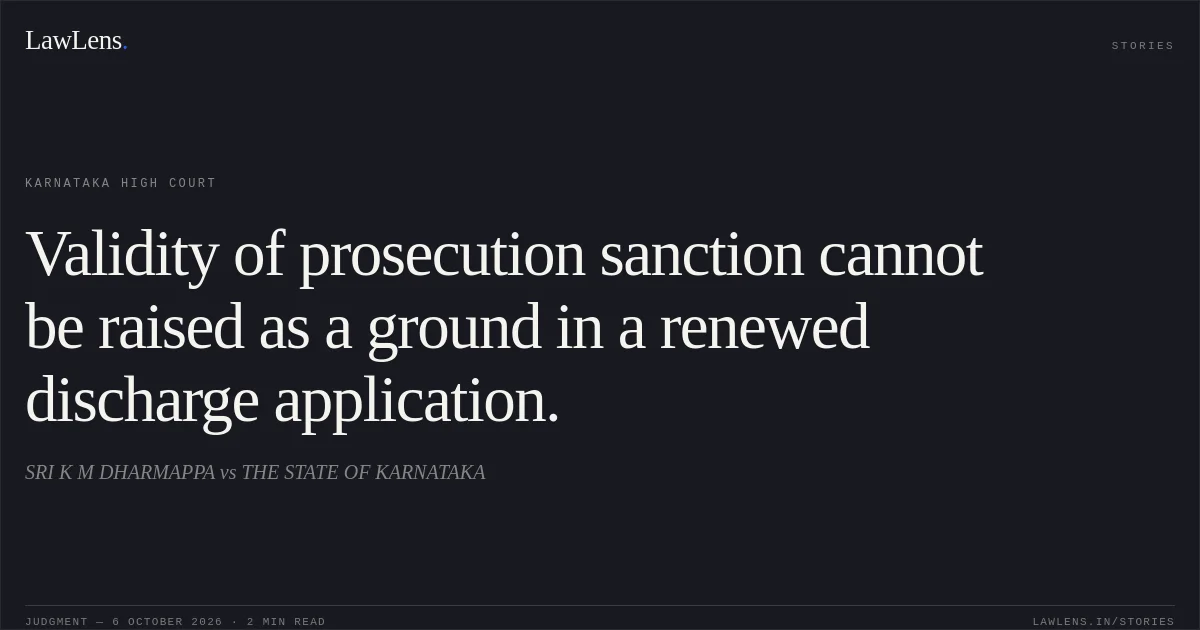
Source reference: paras. 3, 11, pp. 3, 6–7On sanction, the Court relied on State represented by Deputy Superintendent of Police, Vigilance and Anti-Corruption Chennai City-I Department v. G. Easwaran, 2025 SCC OnLine SC 643, for the principle that sanction validity may be examined during trial, and considered the submission based on State of Karnataka v. S. Subbegowda, (2023) 17 SCC 699, as quoted in Meenakshi Khare v. State of Madhya Pradesh, 2026 SCC OnLine MP 467, that a sanction objection should be raised at the earliest stage but may be considered at specified later stages, subject to Section 19(3) and (4) of the Prevention of Corruption Act. The Court concluded that sanction validity could not be pursued as a ground in the renewed discharge hearing.
Source reference: paras. 9–10, 15(v), pp. 4–6, 8Reasoning
The Court declined to quash the charge sheet on the sanction ground, holding that sanction validity was for consideration during trial and could, if appropriate, be addressed as a preliminary issue.
Source reference: paras. 12, 15(ii), pp. 7–8It separately found that the Trial Judge’s reasons concerning the ₹67,31,099 could not be sustained in law, having regard to the nature of the offence under Section 13(1)(e). It therefore set aside the order dismissing discharge and remitted the matter for fresh consideration, while excluding the sanction objection from that renewed discharge hearing.
Source reference: paras. 13–15, pp. 7–8Holding
The petition was allowed in part. The prayer to quash the charge sheet was rejected, but the order dismissing the discharge application was set aside and the matter remitted to the Special Judge for fresh disposal in accordance with law by 31 December 2026.
The petitioner could not raise sanction validity as a ground in the renewed discharge hearing.
Source reference: para. 15, pp. 7–8Acts & Sections Cited
3 provisions across 2 statutes referred to in this judgment. Each provision opens on LawLens.
Code of Criminal Procedure, 19731
Prevention of Corruption Act, 19882
Original Court PDF
SRI K M DHARMAPPAvsTHE STATE OF KARNATAKA
Click to open original judgment
Original judgment, available to read, download and summarize on LawLens.in