Facts
The wife sought divorce under Section 38 of the Special Marriage Act and pendente lite maintenance for herself and the parties’ minor son, together with educational expenses and litigation costs
Source reference: p. 4The Family Court awarded ₹50,000 per month for the wife and child from August 2025, when she was relieved from employment, and directed the husband to pay the child’s school fees directly
Source reference: pp. 7–8Both parties challenged that order: the husband disputed the amount, while the wife sought enhancement and maintenance from the date of her application
Source reference: pp. 3–4, 8–11The husband reported monthly net salary of about ₹3 lakh and argued that his expenses and obligations to dependants limited his capacity to pay
Source reference: pp. 5–6, 9The wife relied on his income-tax records, including stock-option proceeds, and produced medical records concerning glaucoma and an autoimmune disease
Source reference: pp. 10–14, 17Issues
1. Whether the Family Court’s award of ₹50,000 per month for the wife and minor child was inadequate or excessive in light of the parties’ circumstances and the husband’s financial capacity.
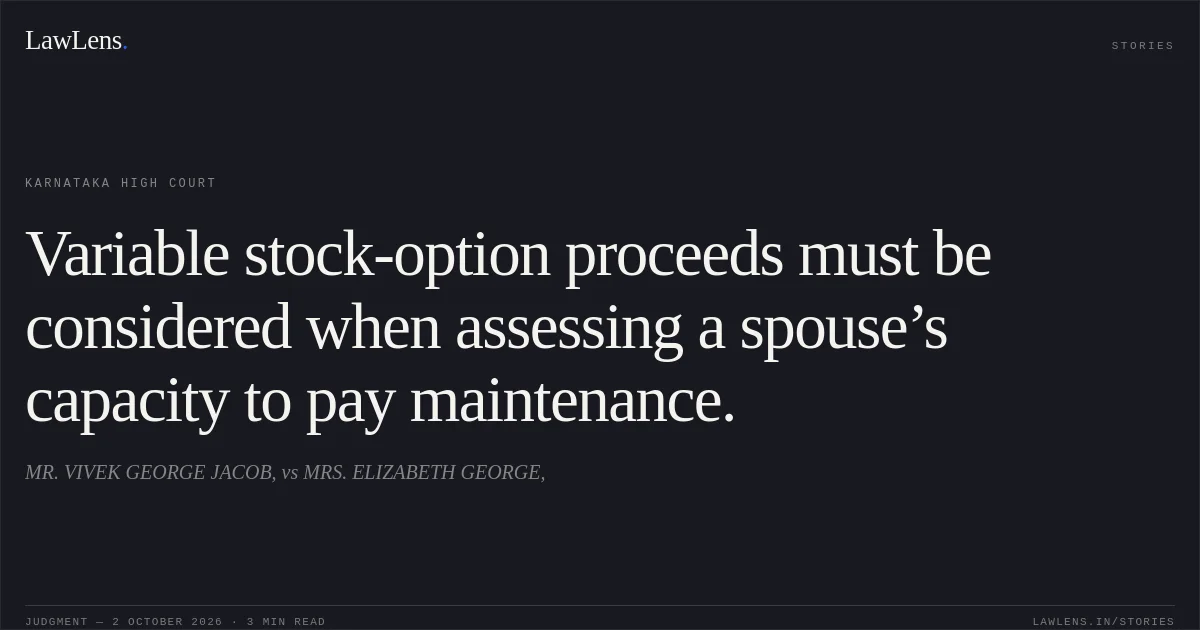
Source reference: pp. 8–11, 16–182. Whether the husband’s variable stock-option/share proceeds should be considered in assessing his financial capacity.
Source reference: pp. 11–163. Whether the wife was entitled to maintenance for a period before the Family Court’s award, including from the date of her application.
Source reference: pp. 10–11, 17–19Law Applied
The wife’s matrimonial proceeding was brought under Section 38 of the Special Marriage Act, and the petitions before the High Court invoked Articles 226 and 227 of the Constitution.
Source reference: pp. 2–3The Court relied on Nayanika Thukar Mehta v. Mohit Mehta to support the principle that variable ESOP benefits, although not regular salary, may be considered in assessing a spouse’s financial status and capacity.
Source reference: pp. 12–13, 16It also relied on Deepa Joshi v. Gaurav Joshi, 2026 INSC 370, for the principle that loan repayments which create or acquire assets are capital investments and should not take precedence over the legal obligation to maintain a spouse.
Source reference: pp. 14–15The Court treated the wife’s medical condition, the child’s needs, and the parties’ financial circumstances as relevant to determining maintenance.
Source reference: pp. 16–18Reasoning
The Court found that the husband’s annual share-sale proceeds of approximately ₹20–28 lakh were relevant to his financial capacity, notwithstanding their variable nature, and rejected the contention that the reported stock-option benefits could be excluded.
Source reference: p. 16It also declined to treat the stated expenses for the husband’s grandmother and sister as continuing obligations, noting that the grandmother had died and the sister was employed.
Source reference: p. 16On the wife’s side, it considered her medical records, inability to work in her health condition, and the need to meet her and the child’s expenses; it found the ₹50,000 award insufficient.
Source reference: pp. 17–18The Court further held that the wife’s financial needs existed before she lost her job and warranted an additional award for an earlier period.
Source reference: p. 17It did not, however, accept the wife’s full claimed monthly budget as the measure of maintenance.
Source reference: p. 17Holding
The wife’s petition was allowed and the husband’s petition dismissed.
Maintenance was enhanced from ₹50,000 to ₹1,20,000 per month, payable from the date of the Family Court’s order; the husband was also directed to continue bearing the child’s educational expenses and reimburse the wife for fees paid for the 2024–25 academic year upon receiving details.
Source reference: p. 18The Court separately awarded ₹30,000 from the date of application until 24 September 2024.
Source reference: pp. 18–19Arrears were to be paid within four weeks, and either party could seek modification if circumstances changed.
Source reference: p. 19Acts & Sections Cited
2 provisions across 2 statutes referred to in this judgment. Each provision opens on LawLens.
Special Marriage Act, 19541
Code of Civil Procedure, 19081
Original Court PDF
MR. VIVEK GEORGE JACOB,vsMRS. ELIZABETH GEORGE,
Click to open original judgment
Original judgment, available to read, download and summarize on LawLens.in