Facts
On 7 June 2017, Mintu was travelling from Gorakhpur to New Delhi by an express train on the basis of journey ticket No. 95389252.
Source reference: p. 2It was alleged that, due to heavy overcrowding, he was standing near the compartment door and fell from the moving train near Tundla Railway Station after a sudden jerk and the thrust of co-passengers.
Source reference: p. 2His dead body was subsequently found near the Down Starter Signal of Mitawali Station, specifically near Point No. 202 on the Down Loop Line.
Source reference: p. 6The appellant relied on the journey ticket, its verification by the Railway authorities, and a panchnama which, in one version, recorded recovery of the ticket from the deceased’s purse.
Source reference: p. 3–5The Railway relied on another version of the panchnama and the Investigating Officer’s final report, neither of which mentioned recovery of the ticket.
Source reference: pp. 3–5The Railway Claims Tribunal rejected the claim in O.A. No. OA(IIu)/203/2017 by judgment dated 23 January 2019, principally disbelieving the ticket and concluding that the location of the body was inconsistent with a fall from the train in question.
Source reference: pp. 2, 6The appellant challenged that decision under Section 23 of the Railway Claims Tribunal Act, 1987.
Source reference: no citationThe Court separately condoned the 210-day delay in filing the appeal.
Source reference: pp. 1–2Issues
Whether the deceased was a bona fide passenger for the purposes of a claim under the Railways Act, 1989, notwithstanding the discrepancy between the two versions of the panchnama and the omission of the ticket from the Investigating Officer’s final report?
Source reference: pp. 4–6; paras. 5–9Whether the deceased’s death resulted from an accidental fall from a passenger train, thereby constituting an “untoward incident” under Sections 123(c) and 124-A of the Railways Act, 1989?
Source reference: pp. 6–7; paras. 10–13Whether the appeal was liable to be entertained after condonation of the 210-day delay in filing it?
Source reference: pp. 1–2; paras. 1–7 of CM Appl. 50913/2019Law Applied
The Court applied Section 23 of the Railway Claims Tribunal Act, 1987 concerning appeals from Tribunal decisions, and Sections 123(c) and 124-A of the Railways Act, 1989 concerning “untoward incidents” and statutory compensation.
Source reference: no citationRelying on Union of India v. Rina Devi, (2019) 3 SCC 572, and Lata v. Union of India, 2026 SCC OnLine SC 1350, the Court held that the initial burden of proving bona fide passenger status lies on the claimant but may be discharged through relevant facts and circumstances.
Source reference: p. 4; para. 7Under Union of India v. Prabhakaran Vijaya Kumar, (2008) 9 SCC 527, Section 124-A embodies strict or no-fault liability, and negligence by the passenger does not defeat a claim where the occurrence otherwise falls within the statutory definition; the expression “accidental falling of a passenger from a train carrying passengers” must receive a liberal interpretation consistent with the beneficial object of the legislation.
Source reference: p. 7; para. 12The Court also applied the principle that delay may be condoned where sufficient cause is shown, particularly having regard to the beneficial nature of the legislation and the appellant’s economic circumstances.
Source reference: pp. 1–2; paras. 4–6 of CM Appl. 50913/2019Reasoning
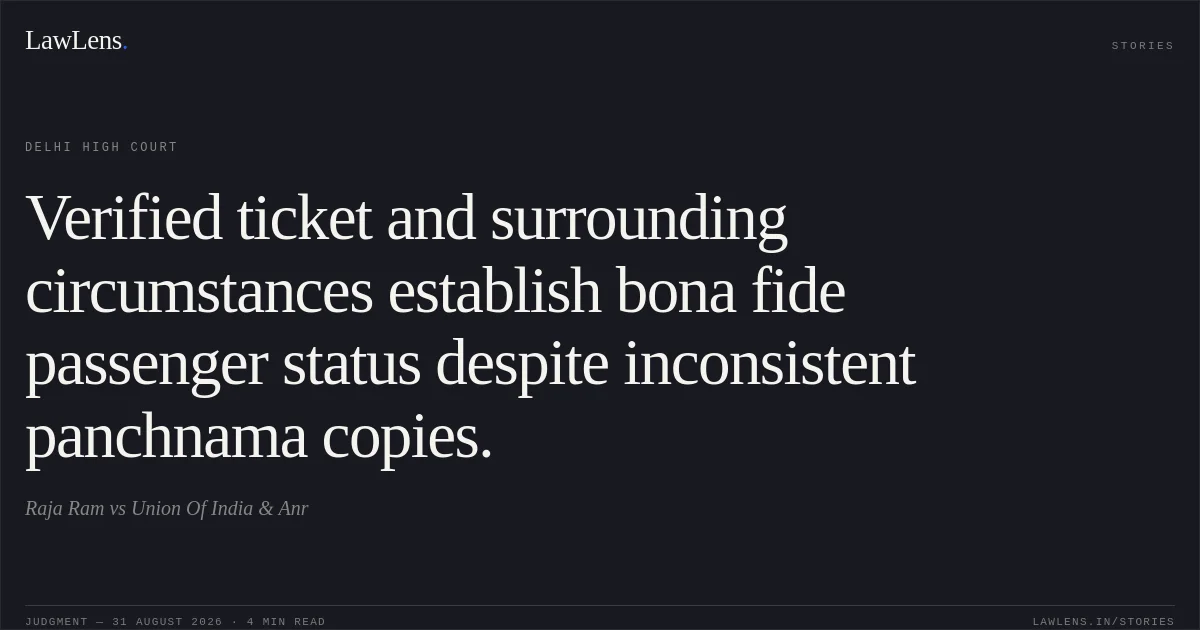
The Court held that the appellant had produced more than a bare assertion of ticket purchase: a journey ticket bearing a specific number had been produced, its particulars had been verified by the Railways, and one contemporaneous version of the panchnama recorded recovery of the ticket from the deceased.
Source reference: p. 5; para. 8Although the conflicting panchnama and the omission from the final report warranted scrutiny, they did not establish that the ticket was forged, fabricated, or unrelated to the deceased.
Source reference: pp. 5–6; paras. 8–9The Tribunal therefore erred in treating the discrepancy as conclusive instead of assessing it cumulatively with the verified ticket and other evidence.
Source reference: pp. 5–6; paras. 8–9As to the occurrence, the Tribunal relied principally on the fact that the body was found on the Down Loop Line whereas the train was travelling on the Up line.
Source reference: p. 6; para. 11However, there was no evidence establishing the precise trajectory of a person falling from a moving train or proving that the deceased could not have landed at the recorded location.
Source reference: p. 6; para. 11The finding in the DRM Report regarding negligence was insufficient to defeat the claim under the strict-liability scheme of Section 124-A, and there was no finding of suicide, self-inflicted injury, or any other statutory exception.
Source reference: pp. 6–7; para. 12In the cumulative circumstances—including the verified ticket, fatal ante-mortem injuries at railway premises, and absence of an established alternative cause—the Court found that the deceased was a bona fide passenger and that the incident was an accidental fall constituting an untoward incident.
Source reference: p. 7; para. 13Holding
The Court allowed the application for condonation of delay and condoned the 210-day delay in filing the appeal.
On merits, it set aside the Tribunal’s judgment dated 23 January 2019, held that the deceased was a bona fide passenger, and concluded that his death resulted from an untoward incident under Sections 123(c) and 124-A of the Railways Act, 1989.
Source reference: p. 7; paras. 13–15The matter was remanded to the Railway Claims Tribunal to assess the compensation payable in accordance with law and to direct disbursement within two months of receipt of the order.
Source reference: p. 7; para. 14The matter was directed to be listed before the Tribunal on 18 September 2026.
Source reference: p. 7; para. 14Acts & Sections Cited
2 provisions across 2 statutes referred to in this judgment. Each provision opens on LawLens.
Railway Claims Tribunal Act, 19871
Railways Act, 19891
Original Court PDF
Raja RamvsUnion Of India & Anr
Click to open original judgment
Original judgment, available to read, download and summarize on LawLens.in