Facts
The appellant, a Director of M/s Quest Laboratories Pvt. Ltd., was convicted under Section 27(d) of the Drugs and Cosmetics Act, 1940, by the Trial Court.
Source reference: para. 2On 30.03.2015, a Drug Inspector collected samples of "Paracetamol Oral Suspension" from Sadar Hospital, Jamtara.
Source reference: para. 3The Government Analyst reported the sample as "Not of Standard Quality" due to hard cake formation and solid lumps.
Source reference: para. 6, P.W.2During the trial, witnesses admitted to a lack of temperature control in the hospital store (reaching 44–45°C) and the absence of the manufacturer during sampling.
Source reference: para. 6The appellant challenged the conviction on the grounds that the company was not made an accused and that vicarious liability was improperly fastened.
Source reference: para. 8Issues
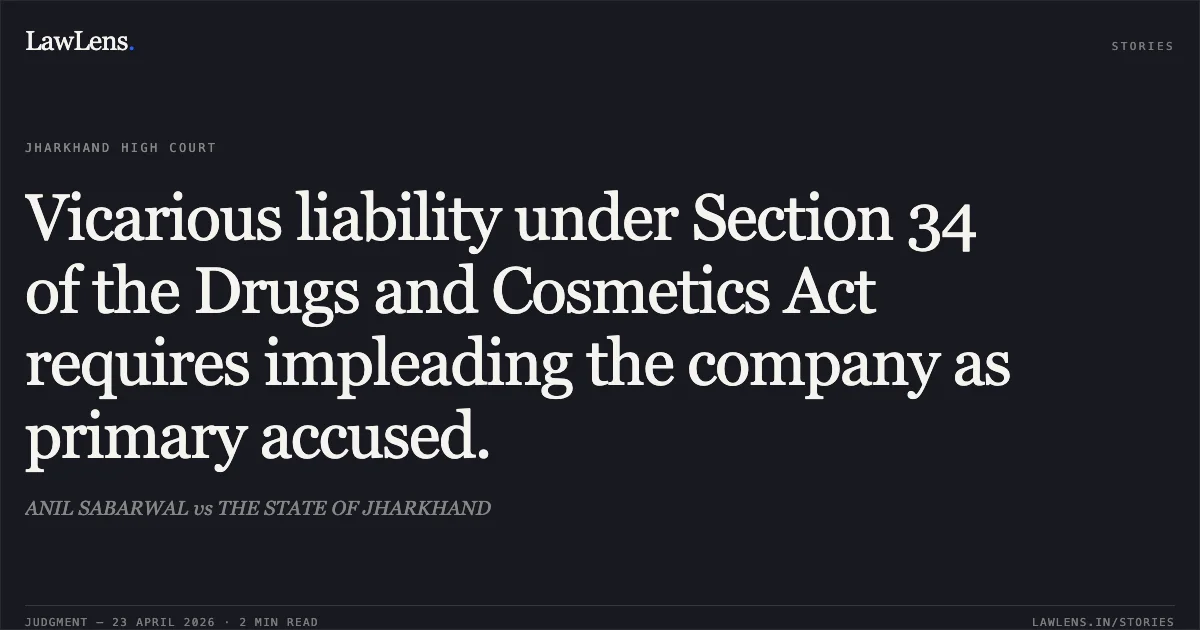
1. Whether a director can be held vicariously liable under the Drugs and Cosmetics Act without the company being joined as a principal accused.
Source reference: para. 82. Whether the lack of specific factual averments in the charges and the Section 313 Cr.P.C. examination vitiated the fairness of the trial.
Source reference: para. 8Law Applied
Section 34 of the Drugs and Cosmetics Act, 1940, which governs offences by companies and defines vicarious liability for directors/partners.
Source reference: para. 8The precedent set by the Hon’ble Supreme Court in Dilip Hariramani v. Bank of Baroda (2024) 15 SCC 443, which established that under deeming fictions (similar to Section 141 of the NI Act), a person cannot be convicted vicariously unless the company or firm—as the primary offender—has been prosecuted or committed the offence.
Source reference: para. 8, paras. 9–14 of cited textReasoning
The High Court found that the prosecution failed to implead the manufacturing company as a party to the proceedings, which is a sine qua non for fastening vicarious liability on its directors.
Source reference: para. 8Following the ratio in Dilip Hariramani, the Court reasoned that vicarious criminal liability is a legal fiction that presupposes the commission of an offence by the company as the principal accused.
Source reference: para. 8, para. 14 of cited textSince the company was not made an accused, the appellant could not be held liable solely by virtue of his position. Furthermore, the Court noted procedural infirmities, including vague charges and an inadequate statement recorded under Section 313 Cr.P.C., which undermined the requirement of a fair trial.
Source reference: para. 8, 10Holding
The Court answered the issues in favor of the appellant, holding that the conviction was unsustainable as it was "in the teeth" of established Supreme Court precedent regarding vicarious liability.
The High Court allowed the appeal, set aside the judgment of conviction and the order of punishment dated 29.01.2024, and discharged the appellant from his bail bonds.
Source reference: para. 11-12Acts & Sections Cited
5 provisions across 3 statutes referred to in this judgment. Each provision opens on LawLens.
Drugs and Cosmetics Act, 19403
Code of Criminal Procedure, 19731
Negotiable Instruments Act, 18811
Original Court PDF
ANIL SABARWALvsTHE STATE OF JHARKHAND
Click to open original judgment
Original judgment, available to read, download and summarize on LawLens.in