Facts
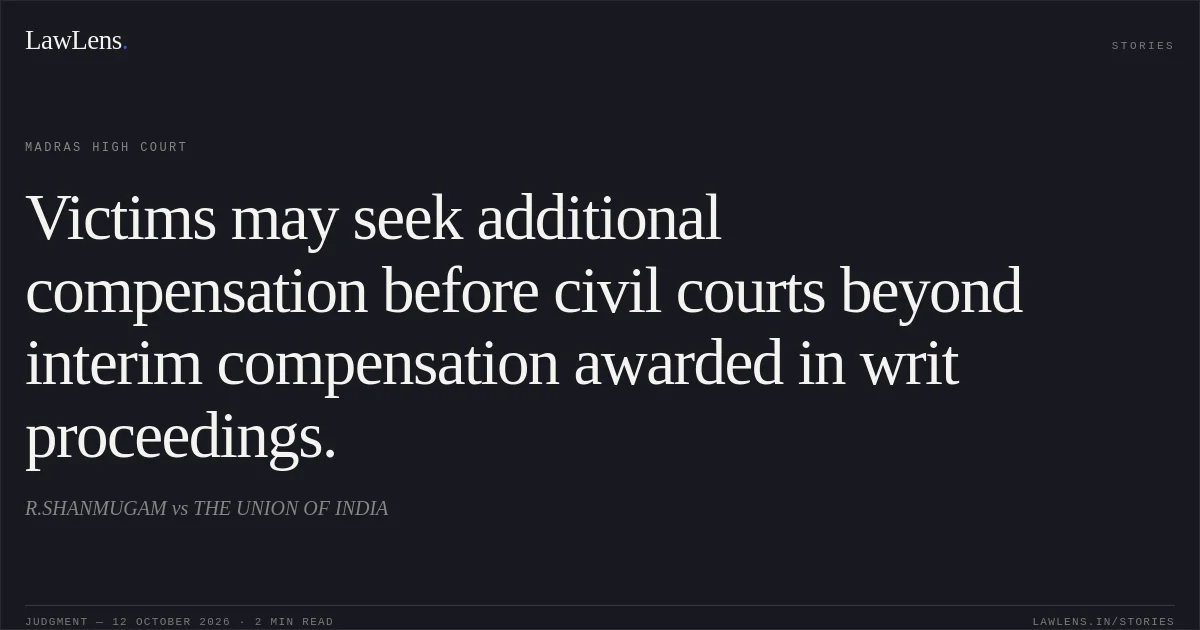
The petitioner sought review of the order dated 28 November 2016 in W.P.(MD) No. 8777 of 2014, which directed disbursement of the compensation amount already determined to the victims’ legal heirs and provided for disputes over entitlement to be resolved through the civil court if necessary.
Source reference: p.3He contended that the factory owner was liable because minors had been permitted to work, and relied on M.C. Mehta v. State of Tamil Nadu to argue that the Union Government should compensate for the employment of child labourers.
Source reference: p.4At a later hearing, the Court noted that the earlier amount was interim compensation and that any additional compensation would require civil-court consideration of evidence, including the victims’ ages, probable income, loss of income, and the cause of the explosion.
Source reference: pp.4–5Issues
1. Whether the petitioner established an error apparent on the face of the record warranting review of the order dated 28 November 2016.
Source reference: pp.3–42. Whether the petitioner could pursue additional compensation, beyond the interim amount already granted, before the civil court.
Source reference: pp.4–5Law Applied
The Court did not cite or apply a specific statute or expressly state the governing test for review.
Source reference: no citationIt proceeded on the basis that the compensation already directed was interim and that a claim for further compensation—where assessment depended on evidence concerning the victim’s age, probable income, loss of income, and the cause of the accident—should be pursued before the civil court.
Source reference: pp.4–5The petitioner’s reliance on M.C. Mehta v. State of Tamil Nadu was recorded as an argument, not as a rule adopted by the Court.
Source reference: p.4Reasoning
The Court had already directed disbursement of the amount determined in the writ proceedings and had contemplated recourse to the civil court where disputes or further claims required adjudication.
Source reference: p.3It considered that additional compensation depended on factual matters requiring evidence, which could be assessed by the civil court.
Source reference: p.4Rather than determining the factory owner’s or the Union Government’s liability in the review proceeding, the Court closed the review and preserved the petitioner’s ability to pursue that remedy in the appropriate forum.
Source reference: p.5Holding
The Court closed the review petition and granted the petitioner liberty to approach the civil court for further relief.
It directed that the period during which the review petition was pending be excluded for the purpose of limitation.
Source reference: p.5Original Court PDF
R.SHANMUGAMvsTHE UNION OF INDIA
Click to open original judgment
Original judgment, available to read, download and summarize on LawLens.in