Facts
The prosecution alleged that Apurba Kalita and Bijit Kalita took the 17-year-old victim on a motorcycle to an isolated location, where Bijit sexually assaulted her after she was allegedly given intoxicating chocolates; Apurba was alleged to have abetted the offence.
Source reference: p. 3, para. 5The Trial Court convicted Bijit under Section 4 of the Protection of Children from Sexual Offences Act, 2012 (“POCSO Act”) and sentenced him to 20 years’ rigorous imprisonment with fine, while convicting Apurba under Section 17 of the POCSO Act for abetment and imposing the same sentence.
Source reference: pp. 2–3, paras. 2–3On appeal, the High Court found material inconsistencies between the victim’s testimony and her statement under Section 164 Cr.P.C., particularly regarding whether the chocolates caused loss of consciousness and the circumstances in which Apurba left the victim and Bijit.
Source reference: pp. 6–7, paras. 12–14The medical evidence showed no recent sexual intercourse or injuries to the private parts, but recorded marks of violence on the victim’s body and assessed her age as above 16 and below 18 years.
Source reference: pp. 8–9, paras. 18–19No birth certificate, school admission register, or other primary age document had been proved.
Source reference: p. 9, para. 20Issues
1. Whether the evidence established that Apurba Kalita had abetted Bijit Kalita’s alleged penetrative sexual assault under Sections 16 and 17 of the POCSO Act.
Source reference: pp. 5–8, paras. 10–162. Whether the victim’s age was proved to be below 18 years so as to attract the POCSO Act.
Source reference: pp. 9–11, paras. 20–243. Whether, after excluding the applicability of the POCSO Act on account of the victim’s age, the matter could be proceeded with against Bijit Kalita under Section 376 IPC by alteration of charge under Section 216 Cr.P.C.
Source reference: pp. 11–12, paras. 24–28Law Applied
Sections 3 and 4 of the POCSO Act penalise penetrative sexual assault against a child, while Sections 16 and 17 require proof of abetment and prescribe punishment for abetment of a POCSO offence.
Source reference: pp. 3, 7–8, paras. 6, 15–16A statement under Section 164 Cr.P.C. may be used to corroborate or contradict the maker’s testimony, as recognised in R. Shaji v. State of Kerala, (2013) 14 SCC 266.
Source reference: p. 7, para. 14Absence of injuries or recent sexual-intercourse findings in medical evidence does not, by itself, discredit otherwise reliable testimony of sexual assault, as held in Lok Mal @ Loku v. State of Uttar Pradesh, (2025) 4 SCC 470.
Source reference: pp. 8–9, para. 19For age determination, where the documents specified under Section 94 of the Juvenile Justice (Care and Protection of Children) Act, 2015 are unavailable, reliance may be placed on an ossification test; however, the margin of error must be considered, and the benefit of doubt must favour the accused where two views are possible, in accordance with Yuvaprakash v. State of Tamil Nadu, (2024) 17 SCC 684.
Source reference: pp. 10–11, paras. 22–23A charge may be altered under Section 216 Cr.P.C., with the procedural safeguards under Section 217 Cr.P.C.
Source reference: pp. 11–12, paras. 26–27Reasoning
As to Apurba, the Court held that merely accompanying the victim and Bijit on the motorcycle up to Dampur Chowk did not establish intentional aid or participation in the subsequent assault.
Source reference: pp. 5–7, paras. 10–15The prosecution’s theory that the first chocolate was intoxicating and that Apurba thereby facilitated the assault was speculative, particularly because the victim did not testify that she lost consciousness and her Section 164 statement materially contradicted her trial testimony on this aspect.
Source reference: pp. 5–7, paras. 10–15The essential elements of abetment under Section 16 of the POCSO Act were therefore not proved beyond reasonable doubt.
Source reference: p. 8, para. 15As to Bijit, the Court considered the victim’s account of assault to be substantially consistent and found that the bodily marks noted by the doctor corroborated her allegation that she had been slapped.
Source reference: pp. 8–9, paras. 17–19The absence of genital injuries or evidence of recent intercourse was not decisive against the prosecution.
Source reference: pp. 8–9, paras. 17–19However, the prosecution failed to prove the victim’s age through reliable documentary evidence.
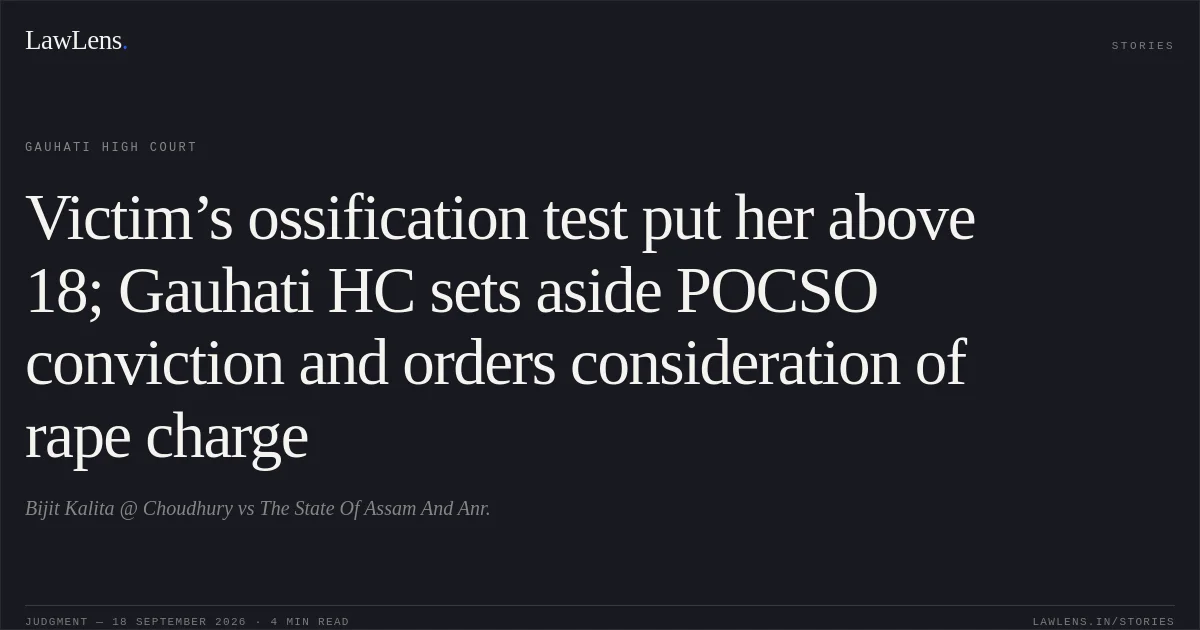
Source reference: pp. 9–11, paras. 20–24The ossification report placed her above 16 and below 18 years, and, applying the margin of error recognised in Yuvaprakash, the Court treated her age as above 18 years at the time of the incident.
Source reference: pp. 9–11, paras. 20–24Consequently, the POCSO Act could not apply, although the evidence disclosed a prima facie case of rape under Section 376 IPC.
Source reference: p. 11, paras. 24–26Holding
The conviction and sentence of Apurba Kalita under Section 17 of the POCSO Act were set aside, and his release from custody was directed unless required in another case.
The conviction and sentence of Bijit Kalita under Section 4 of the POCSO Act were also set aside because the victim’s age was not established as being below 18 years.
Source reference: pp. 11–12, paras. 24–28The matter was remanded to the Trial Court to consider alteration of the charge to Section 376 IPC under Section 216 Cr.P.C.; if such charge is framed, Section 217 Cr.P.C. must be followed.
Source reference: p. 12, para. 27The evidence already recorded would remain part of the record, subject to any further evidence or recall of witnesses deemed necessary by the Trial Court.
Source reference: p. 12, para. 27The question of Bijit’s bail was left to the discretion of the Trial Court.
Source reference: p. 12, para. 28Acts & Sections Cited
10 provisions across 4 statutes referred to in this judgment. Each provision opens on LawLens.
Protection of Children from Sexual Offences Act, 20124
Code of Criminal Procedure, 19734
Juvenile Justice (Care and Protection of Children) Act, 2015.1
Indian Penal Code, 18601
Original Court PDF
Bijit Kalita @ ChoudhuryvsThe State Of Assam And Anr.
Click to open original judgment
Original judgment, available to read, download and summarize on LawLens.in