01Facts
The respondent-workman was appointed as a Helper on probation for one year by appointment letter dated 21 December 1989, with the probation period being extendable subject to satisfactory performance.
p. 1 · ¶ 2–3His services were terminated on 13 April 1991 on the ground of unsatisfactory work and conduct, without a domestic inquiry, charge-sheet, or payment of retrenchment compensation.
p. 2 · ¶ 3 · p. 5 · ¶ 17The workman’s earlier writ petition was dismissed on 3 May 1995 on the ground that an alternative industrial remedy was available.
p. 2 · ¶ 4He thereafter raised an industrial dispute; the Labour Court held that the termination violated Section 25-F of the Industrial Disputes Act, 1947, and directed reinstatement with continuity of service and 50% back wages from July 1996.
p. 2 · ¶ 5–7During the pendency of the proceedings, the workman was reinstated pursuant to an order under Section 17-B of the Act and continued in service until superannuation on 15 August 2026.
p. 7 · ¶ 2002Issues
i.Whether the termination of a probationary workman who had completed 240 days of continuous service was illegal for non-compliance with Section 25-F of the Industrial Disputes Act, 1947?
p. 4 · ¶ 15 · p. 5 · ¶ 16–17ii.Whether non-compliance with Section 25-F automatically entitled the workman to reinstatement with back wages, or whether the relief could be modified to monetary compensation?
p. 6 · ¶ 18–19iii.Whether, in view of the workman’s reinstatement and subsequent superannuation, the Labour Court’s award required modification?
p. 7 · ¶ 2003Law Applied
Section 25-F of the Industrial Disputes Act, 1947 applies to a workman who has completed 240 days of continuous service in the preceding twelve months, irrespective of whether the workman is permanent, temporary, or probationary.
p. 4 · ¶ 15Termination without payment of the prescribed retrenchment compensation and compliance with the statutory conditions is illegal.
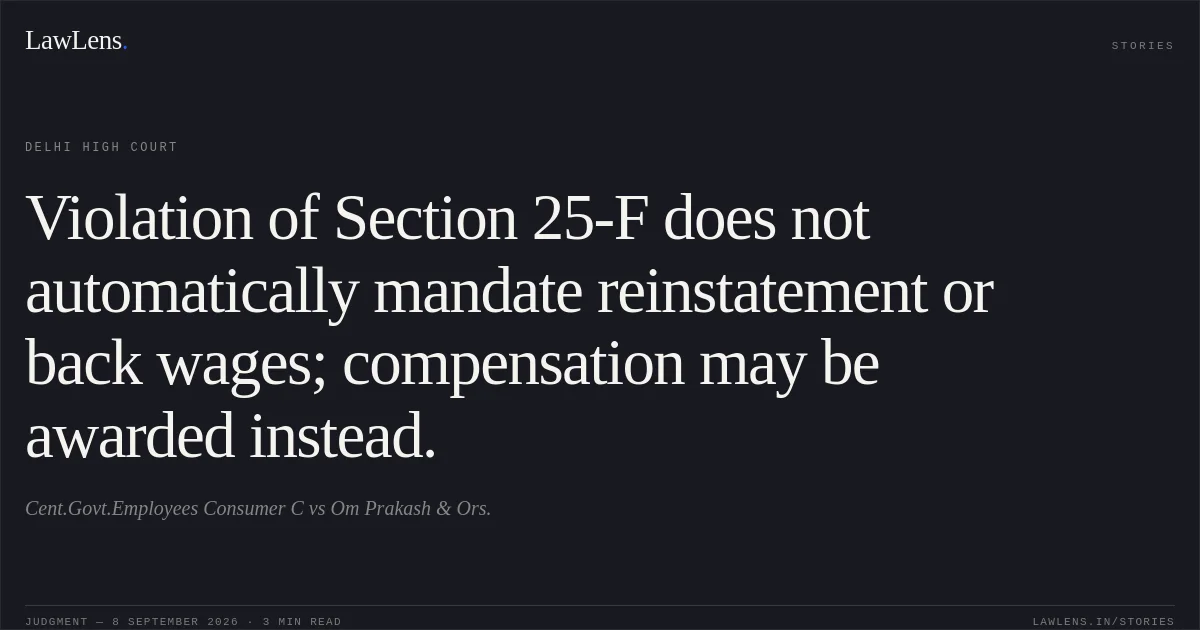
p. 5 · ¶ 16–17However, violation of Section 25-F does not automatically or mechanically require reinstatement with back wages; the relief must be moulded according to the nature of employment, length of service, and surrounding circumstances.
p. 6 · ¶ 18–19The Court relied on Delhi Cantonment Board v. Central Government Industrial Tribunal & Ors., 2006 (8) DRJ 75 (DB) on the applicability of Section 25-F to probationers.
p. 4 · ¶ 15The Court relied on Allahabad Bank v. Krishan Pal Singh, (2021) 19 SCC 227, for the principle that lump-sum compensation may be awarded instead of reinstatement and back wages where the circumstances so warrant.
p. 6 · ¶ 18Provisions in the judgment · 4
Industrial Disputes Act, 1947 Section 10Section 12Section 25FSection 17B
04Reasoning
The Court rejected the petitioner’s contention that the workman’s probationary status excluded the operation of Section 25-F.
p. 4 · ¶ 15Since the workman had completed 240 days of continuous service and no retrenchment compensation had been paid at the time of termination, the mandatory statutory requirements were not satisfied; the Labour Court therefore correctly held the termination illegal and unjustified.
p. 4 · ¶ 15 · p. 5 · ¶ 16–17Nevertheless, the Court held that reinstatement with back wages was not an automatic consequence of such illegality.
p. 6 · ¶ 18–19Considering that the termination occurred in 1991, nearly three decades had elapsed, and the workman had already been reinstated and had superannuated on 15 August 2026, the Court found it appropriate to preserve the reinstatement-related position but substitute the back-wage relief with a lump-sum monetary award.
p. 6 · ¶ 18–19 · p. 7 · ¶ 2005Holding
The Court upheld the Labour Court’s finding that the termination was illegal and unjustified because Section 25-F had not been complied with.
p. 7 · ¶ 20However, it modified the relief by awarding ₹1,00,000 as lump-sum compensation in lieu of back wages, payable by the petitioner within eight weeks from the date of the order.
p. 7 · ¶ 20–21The impugned award was modified accordingly, and the writ petition, along with the pending application, was disposed of.
p. 7 · ¶ 22–23Original Court PDF
Cent.Govt.Employees Consumer CvsOm Prakash & Ors.
Click to open original judgment
Original judgment, available to read, download and summarize on LawLens.in