Facts
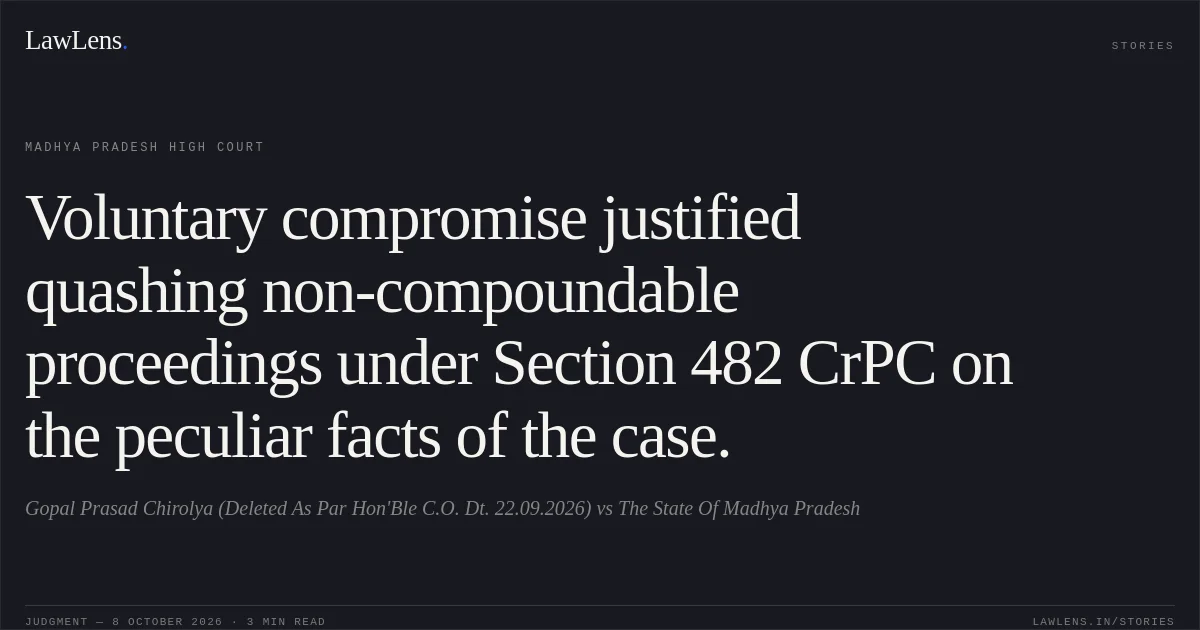
The applicants sought quashing under Section 482 CrPC of FIR No. 15/2018, arising from Crime No. 82/2017, registered for offences under Sections 354-A, 354-B, 354-C, 354-D, 420, 467, 468, 471, 494, 120-B, 109 and 506 IPC and Sections 66-E and 66-A of the Information Technology Act, 2000.
Source reference: para. 1Proceedings against the applicants had been stayed since 21 March 2018; co-accused Pankaj Kumar Chirolya had been acquitted on 15 April 2024.
Source reference: paras. 2, 15During the petition, the parties—who are closely related—entered into a compromise. The Registrar (J-II) verified that it was voluntary, and the complainant stated that she did not wish to pursue the prosecution.
Source reference: paras. 3–4, 13–14The State opposed quashing.
Source reference: para. 5Issues
Whether the High Court should exercise its inherent jurisdiction under Section 482 CrPC to quash the proceedings on the basis of the parties’ compromise.
Source reference: para. 7Whether, in view of the nature of the alleged offences and the circumstances of the case, continuation of the prosecution would serve the ends of justice.
Source reference: paras. 9–12, 16Law Applied
Section 482 CrPC preserves the High Court’s inherent power to quash criminal proceedings to secure the ends of justice or prevent abuse of process, including in appropriate cases involving non-compoundable offences. Under Gian Singh v. State of Punjab, (2012) 10 SCC 303, that power may be exercised where the dispute is essentially private and continuation would not serve justice.
Source reference: para. 8Narinder Singh v. State of Punjab, (2014) 6 SCC 466, identifies the nature and gravity of the offence, the accused’s antecedents, the parties’ conduct and the utility of continuing proceedings as relevant considerations.
Source reference: para. 9State of Madhya Pradesh v. Laxmi Narayan, (2019) 5 SCC 688, cautions against quashing serious offences with substantial societal impact merely because of a compromise.
Source reference: para. 10Ramgopal v. State of Madhya Pradesh, (2022) 14 SCC 531, confirms that Section 482 jurisdiction is distinct from statutory compounding under Section 320 CrPC and may extend to non-compoundable offences in an appropriate case, having regard to the offence’s nature and effect, the injury, the compromise’s voluntariness and the accused’s conduct.
Source reference: para. 11Reasoning
The Court considered the compromise alongside the particular circumstances: the parties’ close relationship, the Registrar’s verification that the settlement was voluntary, the complainant’s express wish not to prosecute, the substantial period for which proceedings had remained stayed, and the co-accused’s acquittal.
Source reference: paras. 13–15Although some alleged offences were non-compoundable and the compromise alone did not require quashing, the Court concluded that, in this case, continuing the proceedings would serve no useful purpose and would unnecessarily prolong criminal litigation.
Source reference: para. 16It therefore found the case appropriate for exercise of its inherent jurisdiction without expressing any view on the merits of the allegations.
Source reference: para. 17Holding
The petition was allowed, and the FIR and all consequential criminal proceedings were quashed insofar as they concerned the present applicants; the compromise filed with I.A. No. 21768/2025 was made part of the order.
The Court further directed that respondent No. 2/victim would not be entitled to compensation under the applicable Victim Compensation Scheme for this crime and that any compensation already paid would be recoverable in accordance with law.
Source reference: para. 20The order was confined to the case’s particular facts and was not an expression on the merits of the allegations.
Source reference: para. 21Acts & Sections Cited
9 provisions across 2 statutes referred to in this judgment. Each provision opens on LawLens.
Code of Criminal Procedure, 19732
Indian Penal Code, 18607
Original Court PDF
Gopal Prasad Chirolya (Deleted As Par Hon'Ble C.O. Dt. 22.09.2026)vsThe State Of Madhya Pradesh
Click to open original judgment
Original judgment, available to read, download and summarize on LawLens.in