Facts
Private respondents alleged that the appellant demolished their boundary wall while constructing a road.
Source reference: no citationIn an earlier writ proceeding, the Court directed a field enquiry and provided that, if the authority found the demolition to be unauthorised, the appellant would be directed to pay Rs. 10 lakh in compensation.
Source reference: no citationFollowing an enquiry and hearing, the authority found against the appellant, directed it to rebuild the wall and pay compensation.
Source reference: no citationThe appellant challenged that decision, alleging it had received neither prior notice of the enquiry nor a copy of the enquiry report.
Source reference: no citationThe Single Judge rejected the challenge.
Source reference: no citationIn the appeal, the appellant argued that it rebuilt the wall under threat of contempt; the Division Bench examined the relevant contempt orders and found no such threat or specific direction.
Source reference: para. 2–9, 14–24The Court also noted that the Rs. 10 lakh amount had been specified in an earlier order that the appellant had not challenged.
Source reference: para. 25–28Issues
1. Whether the appellant’s failure to receive prior notice of the field enquiry or a copy of its report invalidated the authority’s decision, despite the appellant not raising those objections before the authority.
Source reference: para. 7–9, 30–332. Whether the appellant’s reconstruction of the wall was compelled by a threat of contempt or amounted to acquiescence in its responsibility for the demolition.
Source reference: para. 14–243. Whether the appellant could challenge the Rs. 10 lakh compensation amount fixed in an earlier, unchallenged order.
Source reference: para. 25–28Law Applied
The Court applied the principles of natural justice, including the opportunity to receive notice and respond to material relied upon by a decision-maker.
Source reference: para. 25–33It also applied the procedural principle that an objection not raised before the competent authority, particularly where no contemporaneous protest is shown, may not be raised for the first time in a later writ challenge.
Source reference: para. 25–33The Court treated voluntary conduct as capable of amounting to acquiescence and applied the finality of an unchallenged judicial direction fixing compensation, which could not be reopened in the subsequent proceedings.
Source reference: para. 25–33Reasoning
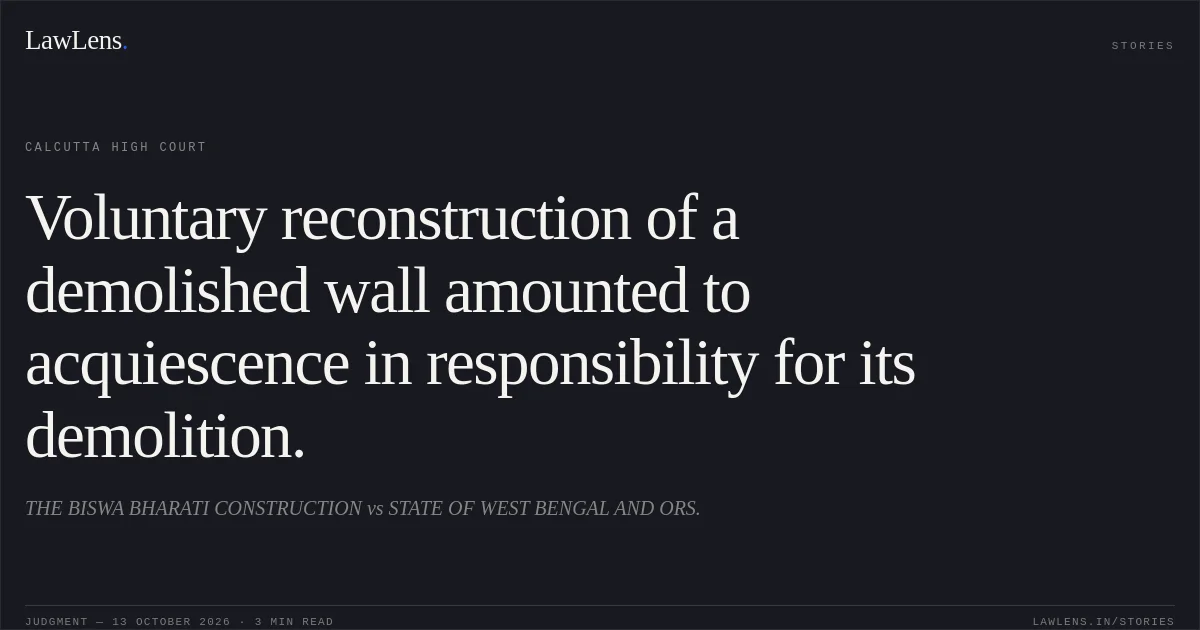
The Court found that the contempt orders did not compel the appellant to rebuild the wall: the first left reconstruction to the appellant’s discretion, and the second recorded counsel’s submission that reconstruction had begun but contained no specific judicial direction requiring it.
Source reference: para. 16–24The Court therefore rejected the claim that rebuilding occurred under threat of contempt and treated it as acquiescence in the appellant’s responsibility for the demolition.
Source reference: para. 16–24The compensation amount had been expressly fixed at Rs. 10 lakh in the earlier order and was not challenged; the appellant could not reopen that determination.
Source reference: para. 25–28Accordingly, the notice and report-service objections no longer affected the outcome; in any event, the appellant had raised neither objection before the authority and had made no contemporaneous communication about non-service.
Source reference: para. 29–33Holding
The appeal was dismissed on contest, and the Single Judge’s order was affirmed.
The appellant was directed to pay Rs. 10 lakh to the private respondents by the end of October 2026.
Source reference: para. 34–37After payment, the appellant may pursue recovery through due process from any authority that received the compensation, subject to that authority’s defences.
Source reference: para. 34–37CAN 1 of 2025 was disposed of, with no order as to costs.
Source reference: para. 36, 38Original Court PDF
THE BISWA BHARATI CONSTRUCTIONvsSTATE OF WEST BENGAL AND ORS.
Click to open original judgment
Original judgment, available to read, download and summarize on LawLens.in