01Facts
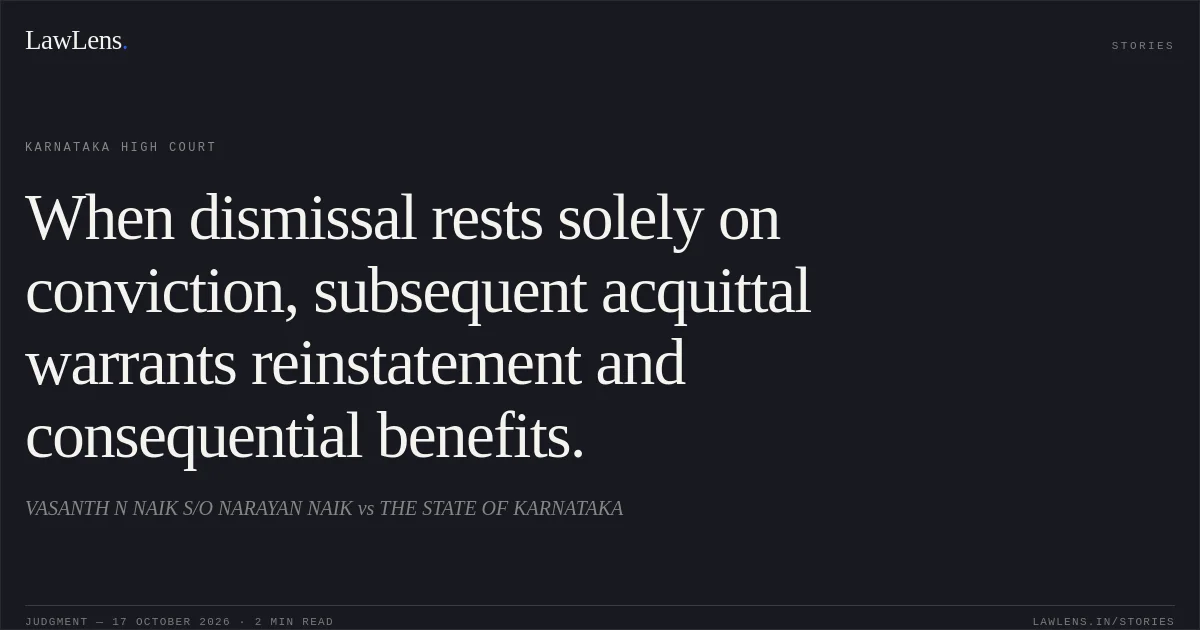
The petitioner, an Assistant Teacher, was dismissed from service by an order dated 17 August 2019 solely because he had been convicted under Sections 7 and 13(1)(d), read with Section 13(2), of the Prevention of Corruption Act, 1988; no separate departmental inquiry was held.
p. 3 · p. 8The Karnataka State Administrative Tribunal rejected his challenge to the dismissal.
p. 8Subsequently, in Criminal Appeal No. 2141/2017, the High Court set aside the conviction and acquitted him, holding that the prosecution had not established the alleged demand for a bribe.
pp. 3–7The petitioner then challenged the Tribunal’s order in this writ petition.
pp. 1–302Issues
i.Whether the Tribunal’s order rejecting the petitioner’s challenge to his dismissal should be set aside after the criminal conviction on which the dismissal was based had been set aside and the petitioner acquitted
p. 8, 12ii.Whether the dismissal order, imposed without a separate departmental inquiry and solely on the basis of the conviction, could remain in force after that conviction was set aside
pp. 8–903Law Applied
Article 311(2), second proviso (a), permits dismissal on the ground of conduct that has led to conviction on a criminal charge.
pp. 9–11Where dismissal is based solely on such a conviction, and the conviction is subsequently set aside on appeal, the basis for the dismissal is removed and reinstatement may follow.
pp. 9–11By contrast, acquittal in a criminal case does not by itself invalidate disciplinary action taken through an independent departmental inquiry, because the applicable standards of proof differ.
pp. 9–11The Court relied on Union of India v. Jaipal Singh, (2004) 1 SCC 121, which recognises reinstatement following acquittal where dismissal was based on conviction, while noting that back wages may be denied in appropriate circumstances;
pp. 9–10Karnataka SRTC v. M.G. Vittal Rao, (2012) 1 SCC 442, on the distinction between conviction-based dismissal and an independent departmental inquiry;
pp. 10–11and SBI v. Mohd. Abdul Rahim, (2013) 11 SCC 67, on the effect of appellate acquittal in removing the foundation for dismissal.
p. 11Provisions in the judgment · 2 · Linked ones open on LawLens
Prevention of Corruption Act, 1988 Section 7Section 13
04Reasoning
The Court found that the petitioner’s dismissal rested exclusively on the 2017 conviction and that no departmental inquiry had independently established misconduct.
p. 8The conviction was later set aside and the petitioner acquitted; accordingly, the foundation for the dismissal no longer subsisted.
pp. 7–9Applying the cited authorities, the Court concluded that the dismissal could not stand and that the Tribunal’s order, though appropriate when made, required setting aside in light of the subsequent acquittal and reinstatement.
pp. 11–1205Holding
The High Court allowed the writ petition and set aside the Tribunal’s order dated 27 August 2020.
pp. 12–13It also quashed the dismissal order and held that the petitioner was entitled to all consequential benefits flowing from the setting aside of those orders.
pp. 12–13Original Court PDF
VASANTH N NAIK S/O NARAYAN NAIKvsTHE STATE OF KARNATAKA
Click to open original judgment
Original judgment, available to read, download and summarize on LawLens.in