Facts
The petitioner filed a second writ petition under Article 226 after MCD officials seized his vending goods on 22 September 2026 and recovered ₹3,700, which he challenged as unauthorised and arbitrary.
Source reference: p. 1In an earlier writ petition, the Court had permitted him to vend subject to conditions, including maintaining cleanliness, keeping a dustbin, avoiding obstruction, and complying with the other conditions of his provisional Certificate of Vending (CoV).
Source reference: pp. 2–3MCD stated that the petitioner had refused to move during a cleanliness drive and had failed to maintain cleanliness; it seized his goods and released them on 24 September 2026 after imposing a fine.
Source reference: p. 3The petitioner argued that the fine had been imposed under the wrong category because he was a licensed vendor.
Source reference: p. 3Issues
Whether the seizure of the petitioner’s goods and recovery of ₹3,700 were unauthorised or illegal
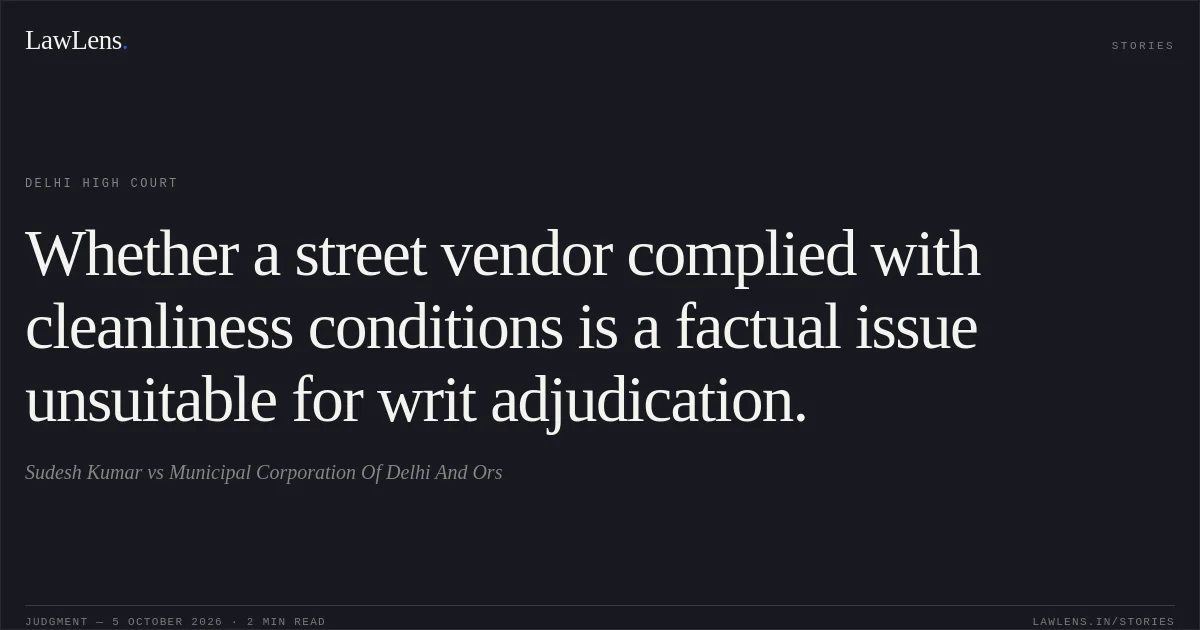
Source reference: pp. 1, 3Whether the Court could determine in this writ petition whether the petitioner had failed to maintain cleanliness and thereby breached the conditions governing his vending
Source reference: p. 4Law Applied
Article 226 of the Constitution provides for the High Court’s writ jurisdiction.
Source reference: no citationThe Street Vendors (Protection of Livelihood and Regulation of Street Vending) Act, 2014, including Section 21, was relevant insofar as the earlier directions were subject to any plan framed by the Town Vending Committee-II under that provision.
Source reference: p. 3The earlier order required the petitioner to comply with specified conditions, including maintaining cleanliness and avoiding obstruction, while permitting him to vend.
Source reference: pp. 2–3The Court also observed that vendors are expected to cooperate with MCD cleanliness and sanitation drives, and that disputes over whether cleanliness was maintained involve questions of fact.
Source reference: pp. 3–4Reasoning
The Court noted MCD’s account that the petitioner had refused to move during a cleanliness drive and had not maintained cleanliness, but did not determine whether those allegations were established.
Source reference: pp. 3–4It held that whether the petitioner had maintained cleanliness was a factual issue that could not be examined in this writ petition.
Source reference: pp. 3–4The Court also stressed that vendors should cooperate with sanitation drives, while MCD should work with vendors rather than harass or mistreat them.
Source reference: p. 3Holding
The Court disposed of the petition without adjudicating the merits of the alleged cleanliness breach or the petitioner’s challenge to the fine.
It left the petitioner free to institute a civil suit, if so advised, and pursue remedies in accordance with law.
Source reference: p. 4Acts & Sections Cited
1 provisions across 1 statute referred to in this judgment. Each provision opens on LawLens.
Street Vendors (Protection of Livelihood and Regulation of Street Vending) Act, 20141
Original Court PDF
Sudesh KumarvsMunicipal Corporation Of Delhi And Ors
Click to open original judgment
Original judgment, available to read, download and summarize on LawLens.in