01Facts
The petitioner joined Respondent No. 2, the Indian Institute of Public Administration (IIPA), an autonomous body, on 07.09.1981 and retired on 31.12.2019.
¶ 2He was a CGHS beneficiary during service, but CGHS benefits were not extended after retirement.
¶ 2His letter dated 21.05.2020 seeking continuation was rejected, with IIPA stating that only serving employees of autonomous bodies were eligible.
¶ 2An RTI response dated 22.06.2022 from the Ministry of Health and Family Welfare stated that CGHS extension to autonomous bodies was subject to consideration under OM dated 10.06.2014.
¶ 2The petitioner sought post-retirement CGHS benefits parity with Central Government employees, contending that withdrawal was arbitrary and discriminatory.
¶ 3–4He relied on President, CCRH Scientists Welfare Assn. v. Union of India (2011 SCC OnLine Del 1627) and the OM dated 10.06.2014.
¶ 5Respondents 1 and 3 stated that no proposal had been received from IIPA under the OM.
¶ 6IIPA stated that it had commissioned an actuarial study estimating a burden exceeding ₹20 crores over ten years and that it lacked the financial resources to meet it.
¶ 8, 19–2002Issues
i.1. Whether the petitioner, a retired employee of an autonomous body, has an enforceable right to continuation of CGHS benefits post-retirement in the absence of any binding rule or service regulation providing for it.
¶ 10–11ii.2. Whether paragraph 2 of OM dated 10.06.2014 mandates extension of CGHS to retirees of autonomous bodies, such that IIPA is obliged to forward a proposal under paragraph 4.
¶ 12–18iii.3. Whether the Court should interfere with the policy decision not to extend CGHS to the petitioner, having regard to financial implications and the precedents relied upon (CCRH, SPA Retired Employees).
¶ 19–2703Law Applied
The Supreme Court's decision in State of Maharashtra v. Bhagwan (2022) 4 SCC 193 holds that employees of autonomous bodies cannot claim service benefits at par with government employees merely because they are funded by the State, and that courts should refrain from interfering with policy decisions having financial implications.
¶ 10A long-standing beneficiary status during service does not create an enforceable right to post-retirement continuation absent a governing rule.
¶ 11OM dated 10.06.2014 makes extension to autonomous body retirees conditional on the body being "desirous," accepting prescribed conditions (including cost-to-cost funding), and forwarding a proposal.
¶ 13, 17–18J.K. Sawhney v. Punjab National Bank (2010 DHC) holds that courts should be circumspect in directing financial policy and that eligibility for welfare schemes is a matter of policy.
¶ 20, 23Union of India v. S. Srinivasa Rao (2011 DHC DB) and S.P. Mediratta v. Union of India (2024 DHC DB) hold that a policy declining CGHS extension on resource constraints is not arbitrary and warrants no judicial interference.
¶ 23–24, 26The decision in CCRH rested on Union of India v. SPA Retired Employees' Welfare Association and its specific facts.
¶ 21–22Under Article 226, the beneficial character of a scheme does not confer an automatic right, and comparison with other autonomous bodies does not establish a right.
¶ 25, 27–2804Reasoning
The petitioner's long service and CGHS coverage during employment did not create an enforceable post-retirement right, since no service regulation or binding rule was shown to provide for continuation.
¶ 11Paragraph 2 of the OM dated 10.06.2014 cannot be read in isolation from paragraphs 3 and 4. The words "desirous" and "may accept" were consciously chosen to build in financial safeguards, and reading the OM as mandatory would remove them.
¶ 16–18Coverage of serving employees is a necessary but not sufficient condition, and it creates no automatic right for individual retirees.
¶ 18CCRH was rendered substantially on SPA Retired Employees, which was confined to its peculiar facts, including a pre-/post-1992 classification, and did not consider J.K. Sawhney.
¶ 22–23IIPA placed financial material before the Court, including an actuarial report and deficit data, which the petitioner did not rebut. The financial burden is a matter for the executive, and the Court could not compel IIPA to assume it.
¶ 19–20Relying on S.P. Mediratta, the Court found the policy decision neither arbitrary nor warranting interference.
¶ 24, 26Reliance on other autonomous bodies did not establish comparable funding or service structures.
¶ 2705Holding
The petitioner has no enforceable right to post-retirement CGHS benefits. OM dated 10.06.2014 is a conditional enabling provision that does not mandate extension or compel IIPA to forward a proposal.
¶ 11, 16–18The Court declined to interfere with the financial policy decision in view of the resource constraints and the controlling precedents, and held that no ground for relief under Article 226 was made out.
¶ 20, 23–28The writ petition was dismissed, and pending applications were disposed of.
¶ 29–30Original Court PDF
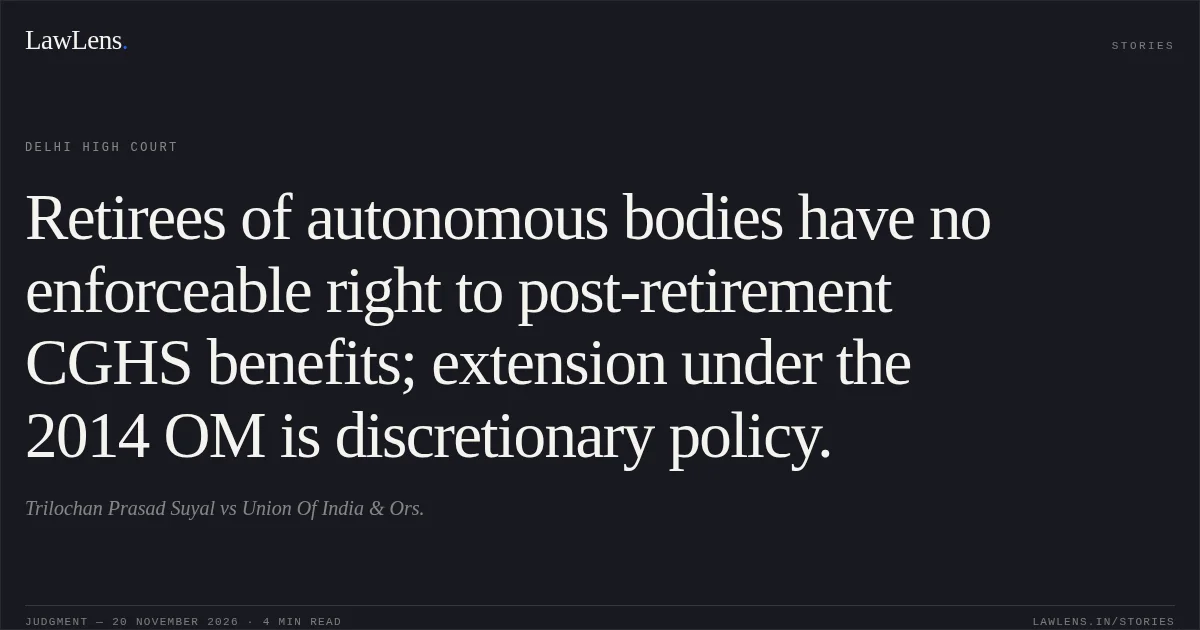
Trilochan Prasad SuyalvsUnion Of India & Ors.
Click to open original judgment
Original judgment, available to read, download and summarize on LawLens.in