Facts
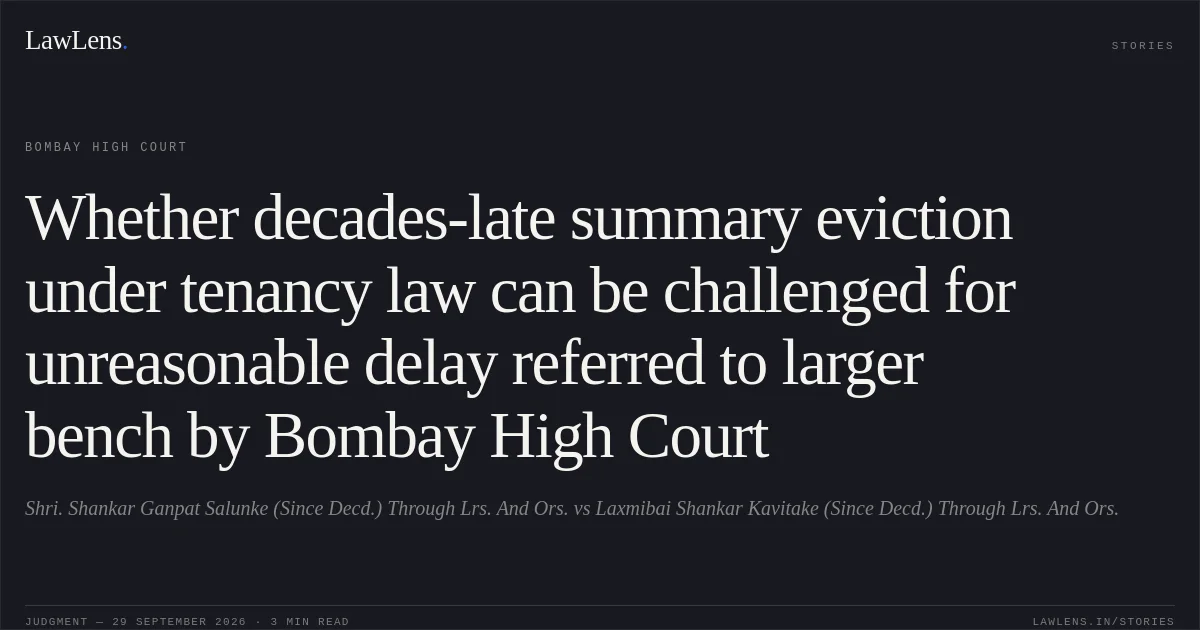
The dispute concerns land at Indapur. The petitioners’ predecessor, Shankar Salunkhe, was found to be in possession in earlier revenue proceedings; the High Court, in a 1981 proceeding concerning revenue entries, did not interfere with that finding and observed that the claimants could pursue a civil suit to establish title.
Source reference: pp. 3–4, paras. 3–4In 2013, the respondents applied under Section 84(c) of the Bombay Tenancy and Agricultural Lands Act, 1948, alleging that the petitioners were in unauthorised possession. The Sub-Divisional Officer rejected the application as time-barred, but the Maharashtra Revenue Tribunal allowed the respondents’ revision and directed delivery of possession.
Source reference: pp. 5–6, paras. 5–6The petitioners challenged the Tribunal’s order, relying on the delay, their possession, and the earlier proceedings.
Source reference: pp. 7–20, paras. 7–28Issues
1. Whether, despite the absence of an express limitation period in Section 84(c), the Collector must consider whether the power was exercised within a reasonable period, without importing a fixed limitation period.
Source reference: pp. 40–41, para. 66(ii)(a)2. Whether Ganesh and Another v. Khushalrao and Others excludes consideration of delay, laches, prejudice and settled rights when exercising the analogous power under Section 84(c), and whether any such proposition requires reconsideration.
Source reference: p. 41, para. 66(ii)(b)3. Whether Section 84(c) permits summary eviction merely because an occupant lacks established title, or requires the Collector first to examine any claimed statutory right under the Act and the availability of another statutory remedy.
Source reference: pp. 41–42, para. 66(ii)(c)4. Whether, after possession has continued for decades and earlier proceedings have taken note of it, the Collector may exercise Section 84(c) without considering the intervening proceedings, the parties’ conduct, delay, prejudice and finality in settled possession.
Source reference: p. 42, para. 66(ii)(d)Law Applied
Section 84 of the Bombay Tenancy and Agricultural Lands Act, 1948 authorises summary eviction in specified circumstances, including where a person is not entitled to use and occupy land under the Act and the Act provides no other eviction remedy; the Collector must therefore establish the statutory conditions before ordering eviction.
Source reference: pp. 23–24, paras. 35–36The Court distinguished a statutory limitation bar from scrutiny of delay: absence of a fixed limitation period does not permit the Court to insert one, but may leave open consideration of whether the statutory power was exercised unreasonably in the circumstances.
Source reference: pp. 24–27, paras. 37–44It referred to State of Punjab v. Bhatinda District Coop. Milk Producers Union Ltd., Ibrahimpatnam Taluk Vyavasaya Coolie Sangham v. K. Suresh Reddy, Situ Sahu v. State of Jharkhand and M/s North Eastern Chemicals Industries (P) Ltd. v. M/s Ashok Paper Mill (Assam) Ltd. on reasonable time, delay and prejudice where no limitation period is prescribed.
Source reference: pp. 24–27, paras. 38–44It also considered the Division Bench ruling in Ganesh and Another v. Khushalrao and Others, which held that no limitation period applies under Section 98 of the Hyderabad Tenancy and Agricultural Lands Act, 1950 and that a reasonable-time limitation cannot be read into that section.
Source reference: pp. 28–30, paras. 45–49The Court did not finally determine how those principles govern Section 84(c); it referred that question, together with the scope of the Collector’s jurisdiction, to a larger Bench.
Source reference: pp. 39–42, paras. 63–66Reasoning
The Court held that Section 84(c) contains jurisdictional conditions: the Collector must determine whether the occupant is unauthorised and whether the person has a right or protection under the Tenancy Act, or another statutory remedy applies.
Source reference: pp. 23–24, paras. 35–36; pp. 30–32, paras. 50–52It rejected both the proposition that a fixed three-year period could be imposed and the proposition that delay must invariably be ignored.
Source reference: pp. 34–40, paras. 55–64It reasoned that Ganesh was binding as to the impermissibility of importing a fixed limitation period, but its effect on consideration of unreasonable delay, prejudice and settled rights required authoritative clarification in light of the Supreme Court authorities discussed.
Source reference: pp. 34–40, paras. 55–64Because the case involved decades of possession and prior proceedings, the Court considered the issue substantial but left the merits—including the parties’ competing rights and the effect of the earlier High Court order—open.
Source reference: pp. 40–42, paras. 64–66Holding
The petition was not decided on its merits. The Court referred the four questions identified above to a larger Bench, directed the Registry to place the papers before the Chief Justice for appropriate orders, and kept all merits contentions open.
Acts & Sections Cited
10 provisions across 4 statutes referred to in this judgment. Each provision opens on LawLens.
Bombay Tenancy and Agricultural Lands Act-19485
Limitation Act, 19632
Code of Civil Procedure, 19082
Ajmer Tenancy and Land Records Act, 19501
Original Court PDF
Shri. Shankar Ganpat Salunke (Since Decd.) Through Lrs. And Ors.vsLaxmibai Shankar Kavitake (Since Decd.) Through Lrs. And Ors.
Click to open original judgment
Original judgment, available to read, download and summarize on LawLens.in