01Facts
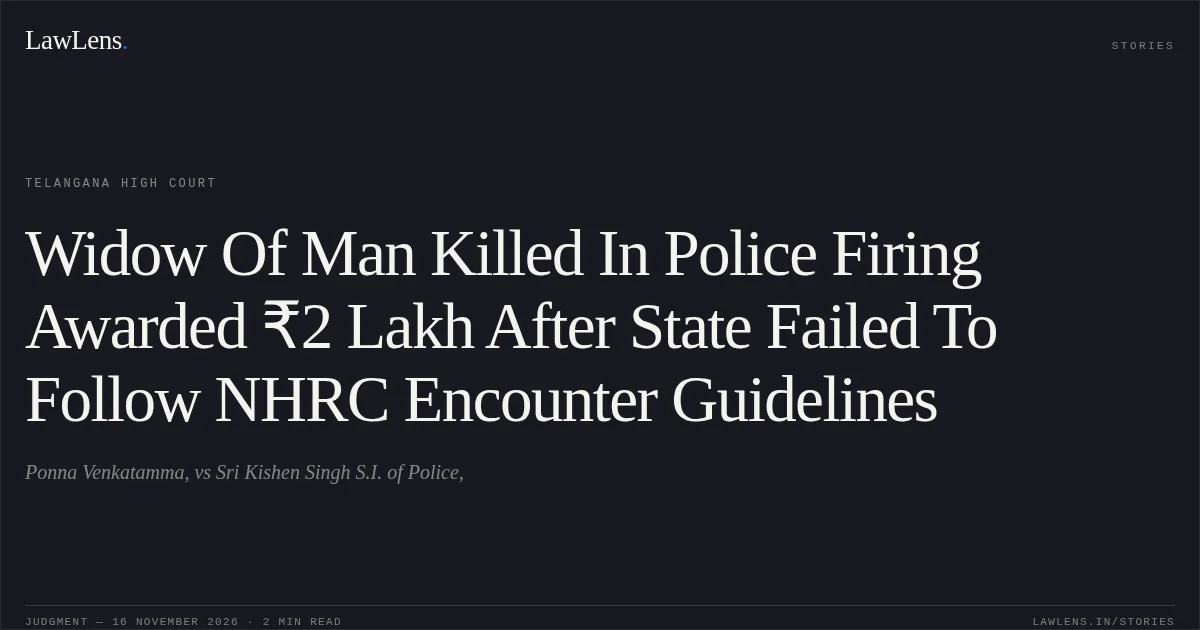
The petitioner alleged that her husband, B. Balanarsaiah, was shot dead by police on 11 December 2001 and that the police falsely portrayed the death as the result of an exchange of fire.
¶ 3–7, 14–17The police maintained that Balanarsaiah was a member of an outlawed PWG group and that they had fired in self-defence after the group opened fire.
¶ 3–7, 14–17The police registered Crime No. 129/2001 against the alleged extremists, including Balanarsaiah, but no case was registered against the police personnel.
¶ 3–7, 14–17Although the State said a magisterial inquiry had been ordered, it produced no inquiry report or other material showing that the inquiry had concluded.
¶ 3–7, 14–17The petitioner sought an independent investigation and Rs. 2,00,000 in compensation.
¶ 3–7, 14–1702Issues
i.1. Whether the State’s failure to register and independently investigate the police-related death, in accordance with the applicable NHRC guidelines, warranted a direction for further investigation.
¶ 14–18ii.2. Whether the State was liable to pay compensation under Article 21 where it relied on self-defence but failed to produce material substantiating that claim or showing compliance with the prescribed procedure.
¶ 17–1903Law Applied
Article 21 prohibits deprivation of life except in accordance with procedure established by law.
¶ 14–16The NHRC’s 1997 encounter-death guidelines required deaths to be recorded, treated as cognizable offences and investigated by an independent agency, such as the State CID, rather than officers of the same police station; the Court considered those guidelines binding on the State at the time of the incident.
¶ 14–16The Court also relied on the encounter-death directions in Extra Judicial Execution Victim Families Association v. Union of India, (2017) 8 SCC 417, People’s Union for Civil Liberties v. State of Maharashtra, (2014) 10 SCC 635, and the five-Judge Bench decision in W.P. No. 15419 of 2006 (6 February 2009), as well as the Article 21 compensation principle in Nilabati Behera v. State of Orissa, (1993) 2 SCC 746.
¶ 14–16Provisions in the judgment · 7 · Linked ones open on LawLens
Indian Penal Code, 1860 Section 147Section 148Section 307Section 149
Arms Act, 1959 Section 25Section 27
Code of Criminal Procedure, 1973 Section 174
04Reasoning
The State’s account that the police fired in self-defence did not, by itself, establish that the death was lawful.
¶ 17–19The State had neither shown that the encounter was investigated in accordance with the NHRC guidelines nor produced the outcome of the ordered magisterial inquiry or other cogent material supporting its account.
¶ 17–19The Court therefore found that the prescribed procedure had not been followed.
¶ 17–19It declined, however, to order a fresh FIR and independent investigation after the long lapse of time, reasoning that a belated investigation was unlikely to yield useful results.
¶ 17–19The failure to establish the circumstances of the death, together with the breach of the applicable procedure, justified public-law compensation under Article 21.
¶ 17–1905Holding
The Court partly allowed the writ petition.
¶ 18–20It declined to direct a fresh FIR or investigation but held the respondent police authorities and the State liable to compensate the petitioner for her husband’s death.
¶ 18–20The respondents were directed to pay her Rs. 2,00,000 within eight weeks from receipt of a copy of the order.
¶ 18–20No order was made as to costs.
¶ 18–20Original Court PDF
Ponna Venkatamma,vsSri Kishen Singh S.I. of Police,
Click to open original judgment
Original judgment, available to read, download and summarize on LawLens.in