01Facts
The appellant was convicted of murder and sentenced to life imprisonment in 2013.
¶ 3–10The High Court acquitted him on 20 January 2018; the State did not appeal, and the acquittal became final.
¶ 3–10However, the acquittal was not acted upon, and the appellant remained imprisoned until 19 May 2025.
¶ 3–10The State attributed the continued detention to failures in communication and verification between the prison and other authorities.
¶ 3–10On the appellant’s writ petition, the High Court found the detention unlawful and violative of Article 21 but awarded ₹2 lakh.
¶ 3–10He appealed seeking enhancement of compensation.
¶ 3–1002Issues
i.Whether the compensation of ₹2 lakh was adequate for the appellant’s unlawful detention for more than seven years after acquittal and the resulting violation of Article 21.
¶ 8, 11–12, 49–54ii.Whether directions should be issued to improve institutional safeguards against wrongful or continued detention after a court order requires release.
¶ 36–39, 55(xii)03Law Applied
Article 21 prohibits deprivation of life or personal liberty except according to procedure established by law.
¶ 12–24, 31–35, 39–46Under Articles 32 and 226, constitutional courts may award public-law compensation for an established infringement of fundamental rights; this remedy is founded on strict liability, is distinct from and additional to private-law damages, and is not subject to the defence of sovereign immunity (Nilabati Behera v. State of Orissa, drawing on Rudul Sah).
¶ 12–24, 31–35, 39–46The compensation is principally remedial and must be assessed in light of the circumstances of the case; it does not displace other available remedies (D.K. Basu v. State of W.B.).
¶ 12–24, 31–35, 39–46Article 9(5) of the ICCPR also recognises an enforceable right to compensation for unlawful arrest or detention.
¶ 12–24, 31–35, 39–46The Court noted that India had no statutory mechanism specifically governing compensation for wrongful incarceration.
¶ 12–24, 31–35, 39–46Provisions in the judgment · 6 · Linked ones open on LawLens
Indian Penal Code, 1860 Section 302
Code of Criminal Procedure, 1973 Section 437Section 436Section 357Section 358
Bharatiya Nagarik Suraksha Sanhita, 2023 Section 429
04Reasoning
The appellant’s acquittal was final, yet institutional failures allowed his detention to continue for over seven years, amounting to a clear infringement of Article 21.
¶ 9–12, 47–54The State’s explanation of communication and coordination gaps did not lessen its responsibility for the violation.
¶ 9–12, 47–54In assessing compensation, the Court considered not only the prolonged loss of liberty and the physical and mental hardships of incarceration, but also the appellant’s lost years in his prime, including loss of livelihood, earning capacity, education and advancement opportunities, and disruption of personal relationships.
¶ 9–12, 47–54It held that ₹2 lakh was inadequate to provide meaningful redress and that compensation should enable the appellant to rebuild his life and regain financial independence.
¶ 9–12, 47–5405Holding
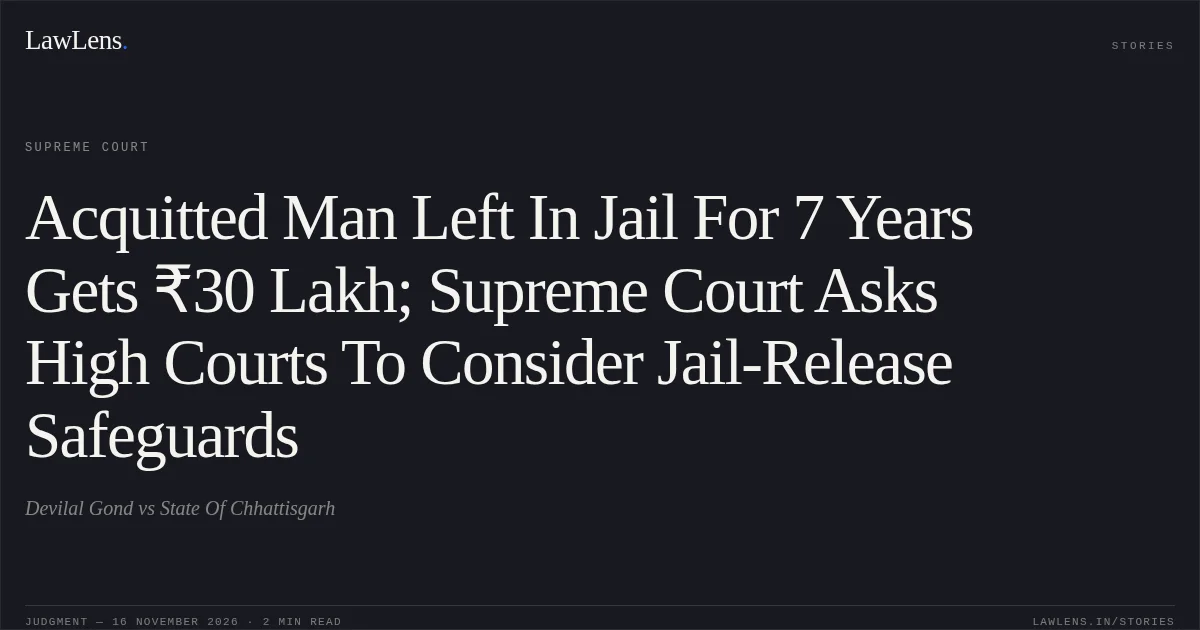
The appeal was allowed in part, and the High Court’s order was modified by enhancing compensation to ₹30 lakh, inclusive of pecuniary and non-pecuniary heads, payable by the State within four weeks, less any amount already paid.
¶ 55–56Of that sum, ₹5 lakh was to be transferred to the appellant’s savings account and the balance placed in an individual, auto-renewing fixed deposit, subject to the specified safeguards and supervision of the District Legal Services Authority.
¶ 55–56The Court also directed all High Courts to consider issuing safeguards similar to those adopted by the Madhya Pradesh High Court and to consider establishing an integrated criminal-justice information system.
¶ 55–56Original Court PDF
Devilal GondvsState Of Chhattisgarh
Click to open original judgment
Original judgment, available to read, download and summarize on LawLens.in