01Facts
The National Book Trust (NBT) was established pursuant to Government of India resolutions of 15 June 1957 and 28 September 1962 to promote the production and dissemination of literature and knowledge
¶ 11, 19A Full Bench of the Delhi High Court held that the Government exercised deep and pervasive control over NBT and that it was an instrumentality of the Government and therefore “State” under Article 12
¶ 2–4NBT appealed to the Supreme Court, disputing that classification
¶ 1, 1002Issues
i.Whether the National Book Trust is an “other authority” and therefore “State” within the meaning of Article 12 of the Constitution
¶ 103Law Applied
Article 12 extends to bodies that, despite their non-governmental legal form, are in substance instrumentalities or agencies of Government.
Under Ramana Dayaram Shetty v. International Airport Authority of India and Ajay Hasia v. Khalid Mujib Sehravardi, relevant indicia include governmental financial assistance, State-conferred monopoly, deep and pervasive control, public functions closely related to governmental functions, and transfer of a government department; no single factor is conclusive, and the body’s legal form is not determinative.
¶ 6–7Pradeep Kumar Biswas v. Indian Institute of Chemical Biology states the controlling inquiry: whether, on the cumulative facts, the body is financially, functionally and administratively dominated by or under the Government’s control, and whether that control is particular to the body and pervasive; ordinary regulatory control is insufficient.
¶ 8A public function, standing alone, does not establish State status under Article 12.
¶ 1804Reasoning
The Court assessed NBT’s creation, governance, administration, finances and functions cumulatively.
¶ 11–20The Government established NBT, appoints its Chairman—who holds office at its pleasure—and determines a substantial part of its governing and executive composition.
¶ 11–13Governmental involvement also extends to financial administration, audit, reporting and approval of specified changes to NBT’s rules and purposes.
¶ 14–15Although NBT earns revenue from publications and receives income from sources other than Government grants, that financial independence in one respect did not negate the wider control embedded in its governing framework.
¶ 16–17Its literary and educational functions were relevant not in isolation, but alongside its Government-directed creation and control.
¶ 18–20Taken together, these features showed particular and pervasive governmental control, not merely ordinary regulatory supervision.
¶ 23–2505Holding
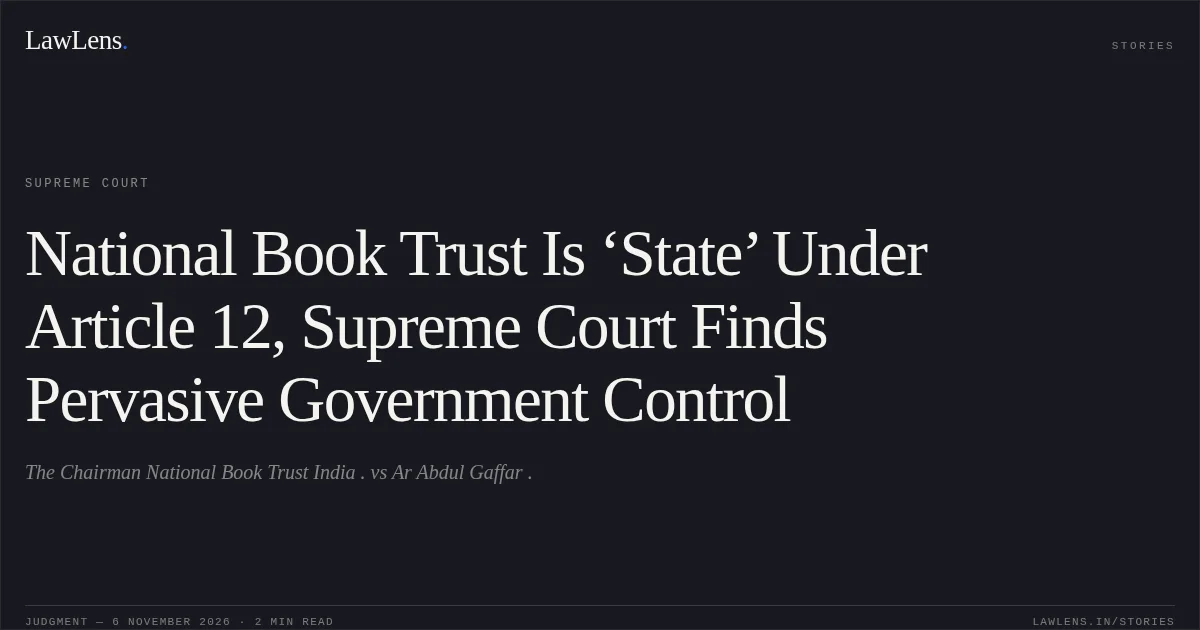
The Supreme Court held that NBT is financially, functionally and administratively dominated by or under the pervasive control of the Government and is therefore an “other authority” and “State” under Article 12.
¶ 25–26The Court clarified that this status does not make NBT a Government department or its employees civil servants.
¶ 22The appeal was dismissed, with no interference in the Full Bench’s judgment.
¶ 27Original Court PDF
The Chairman National Book Trust India .vsAr Abdul Gaffar .
Click to open original judgment
Original judgment, available to read, download and summarize on LawLens.in