Facts
The respondents alleged that the appellant, an alleged contemnor, had failed to comply with an order allowing their writ petition and directing consideration of their candidature for recruitment as Assistant Prosecution Officers.
Source reference: para. 3The appellant stated that he had considered and rejected their candidature and filed a compliance affidavit. In the pending contempt application, the Allahabad High Court’s Single Judge rejected that affidavit, directed further compliance and required the concerned officer to appear personally if the order remained uncomplied with.
Source reference: paras. 3–4Issues
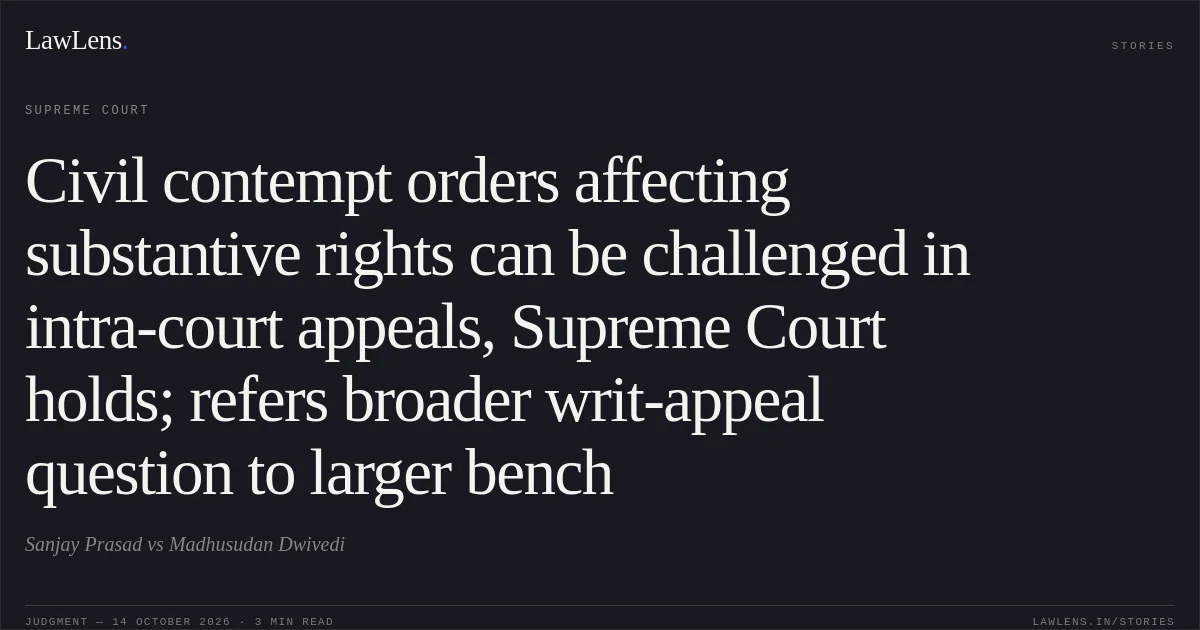
Whether a Special Appeal lies under Rule 5 against a Single Judge’s order in contempt proceedings where the order goes beyond deciding contempt and affects substantive rights or determines an issue on the merits.
Source reference: paras. 23–24, 33Whether such an appeal is barred because civil contempt proceedings are treated as an exercise of “criminal jurisdiction” under Rule 5.
Source reference: paras. 35–38Whether Ram Kishan Fauji v. State of Haryana correctly interprets “criminal jurisdiction” in the Letters Patent context, including its effect on intra-court appeals from writ proceedings.
Source reference: paras. 39–52Law Applied
Article 215 of the Constitution confers the High Courts’ sui generis power to punish for contempt; civil contempt is defined by Section 2(b) of the Contempt of Courts Act, 1971, and an appeal under Section 19(1) lies only against an order imposing punishment for contempt.
Source reference: paras. 18, 34Under Midnapore Peoples’ Coop. Bank Ltd. v. Chunilal Nanda, an order in contempt proceedings deciding the merits of the underlying dispute is not an exercise of the jurisdiction to punish for contempt; it may be challenged by intra-court appeal where the applicable rules permit, and an interlocutory order may qualify as a “judgment” if it finally decides an issue or collateral matter affecting vital rights.
Source reference: paras. 27–28Ajay Kumar Bhalla v. Prakash Kumar Dixit reaffirmed the distinction between a contempt finding and a direction affecting substantive rights.
Source reference: paras. 29–31The Court held that civil contempt proceedings are not resolved in the exercise of criminal jurisdiction and that their quasi-criminal character does not, by itself, bar a Special Appeal under Rule 5.
Source reference: paras. 37–38, 44–45The correctness of Ram Kishan Fauji on the interpretation of Letters Patent and Article 226 was referred for consideration by an appropriate Bench.
Source reference: paras. 49–52Reasoning
The impugned order did more than initiate or continue contempt proceedings: it rejected the appellant’s purported compliance and required further action, potentially affecting the parties’ substantive rights.
Source reference: paras. 3, 53Applying Chunilal Nanda, the Court held that an order of this kind may be appealable as a “judgment,” subject to the relevant High Court rules; Rule 5 did not exclude it merely because it arose in civil contempt proceedings. Section 19 was inapplicable because the Single Judge had not imposed punishment for contempt.
Source reference: paras. 33–38The Court left the merits—including whether the Single Judge exceeded the contempt jurisdiction—to the Special Appeal Bench. It separately referred the broader question concerning Ram Kishan Fauji for authoritative consideration.
Source reference: paras. 52–54Holding
The Supreme Court held that the appellant could present a Special Appeal against the impugned order and was not confined to seeking relief under Article 136.
It disposed of the appeal without deciding the merits, leaving those matters open for the appellate Bench; directed that any Special Appeal be presented within a fortnight; kept the reference concerning Ram Kishan Fauji pending; and stayed the contempt proceedings before the Single Judge for two months.
Source reference: paras. 54–57Acts & Sections Cited
9 provisions across 6 statutes referred to in this judgment. Each provision opens on LawLens.
Contempt of Courts Act, 19713
Indian Penal Code, 18601
Code of Civil Procedure, 19082
Specific Relief Act, 19631
Code of Criminal Procedure, 19731
Bharatiya Nagarik Suraksha Sanhita, 20231
Original Court PDF
Sanjay PrasadvsMadhusudan Dwivedi
Click to open original judgment
Original judgment, available to read, download and summarize on LawLens.in