Facts
The Respondent/plaintiff claimed ownership of the suit property and sought possession and mesne profits from his deceased son’s family, who had occupied it with his permission.
Source reference: para. 2–19The Appellant widow had lived there with her husband and daughters for over two decades, including after her husband’s death.
Source reference: para. 2–19The Trial Court decreed possession and awarded mesne profits of ₹10,000 per month.
Source reference: para. 2–19On appeal, the widow asserted an independent right of residence under the Protection of Women from Domestic Violence Act, 2005 (DV Act), and sought protection from eviction.
Source reference: para. 45–50, 76–78Issues
1. Whether the suit property was the Appellant’s “shared household” and she had an independent right of residence there under the DV Act, notwithstanding her husband’s death.
Source reference: para. 93, 106–182. Whether the owner could recover possession without first securing alternative accommodation for the widowed daughter-in-law, having regard to the parties’ rights and the maintenance provisions of the Hindu Adoptions and Maintenance Act, 1956 (HAMA).
Source reference: para. 124–463. Whether the award of mesne profits against the Appellants was sustainable.
Source reference: para. 147–48Law Applied
Section 2(s) of the DV Act defines “shared household” by reference to residence in a domestic relationship, and does not require the woman or her husband to hold a proprietary interest; Sections 17 and 19 recognise a right of residence and permit residence-related relief, while Section 17(2) allows eviction in accordance with law.
Source reference: para. 94–100, 118Under Satish Chander Ahuja v. Sneha Ahuja, (2021) 1 SCC 414, a suit for possession may constitute due process, but the woman’s statutory residence claim must be considered; Prabha Tyagi v. Kamlesh Devi, (2022) 8 SCC 90, establishes that the right is not extinguished merely by the husband’s death.
Source reference: para. 100–05, 118Sections 19 and 3(b) of HAMA provide, subject to statutory conditions, for maintenance of a widowed daughter-in-law by her father-in-law, with maintenance including residence; Sections 21 and 22 address dependants and maintenance from a deceased person’s estate.
Source reference: para. 127–37The rights of the property owner and the daughter-in-law must be balanced, and possession may be made conditional on suitable alternative accommodation.
Source reference: para. 141–43Reasoning
The Respondent’s pleadings and testimony established that the Appellant had lived with the family in the suit property after marriage and continued to reside there with her daughters; the property therefore qualified as her shared household, and her right did not depend on her husband having an interest in it.
Source reference: para. 106–18, 123The husband’s death did not extinguish that right.
Source reference: para. 106–18, 123The Court also considered the Appellant’s asserted financial hardship and the absence of evidence that she had income or property sufficient to maintain herself, and read her claim to residence alongside the father-in-law’s maintenance obligation under HAMA.
Source reference: para. 138–40Balancing that protection against the Respondent’s ownership, the Court upheld his entitlement to possession but required alternative accommodation or rent before eviction.
Source reference: para. 144–48The mesne-profits award was unsupported by evidence of comparable rents, and the Appellants could not be treated as unauthorised occupants while their residence remained protected.
Source reference: para. 144–48Holding
The appeal was partly allowed.
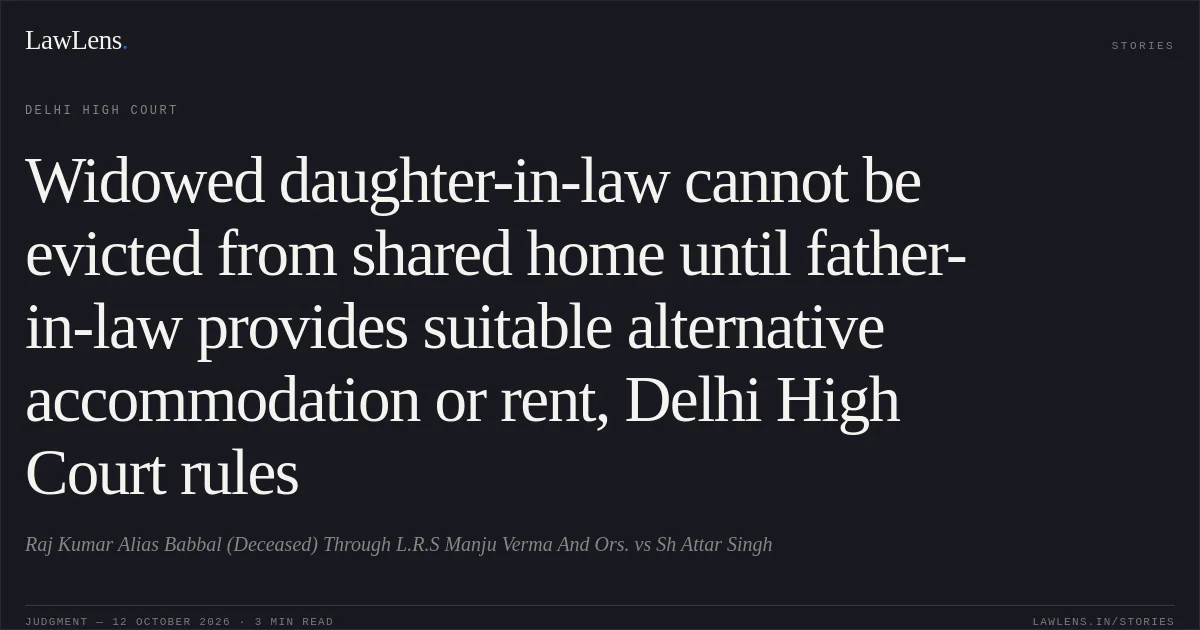
The decree for possession was upheld but made executable only after the Respondent secured suitable alternative accommodation for Appellant No. 1 in the same or a nearby locality, commensurate with her existing accommodation, or paid her ₹15,000 per month towards rent; the Executing Court must ensure compliance before giving effect to the decree.
Source reference: para. 149–52The award of damages/mesne profits against the Appellants was set aside.
Source reference: para. 149–52Acts & Sections Cited
15 provisions across 3 statutes referred to in this judgment. Each provision opens on LawLens.
Code of Civil Procedure, 19082
Protection of Women from Domestic Violence Act, 2005
Hindu Adoptions and Maintenance Act, 19564
Original Court PDF
Raj Kumar Alias Babbal (Deceased) Through L.R.S Manju Verma And Ors.vsSh Attar Singh
Click to open original judgment
Original judgment, available to read, download and summarize on LawLens.in