Facts
Gangaram died intestate in 1949, leaving behind his son Ganapati, born through his first wife, and his widow Kashibai, who had two daughters, including Defendant Nos. 1 and 2.
Source reference: paras. 1–3Ganapati claimed that, under the Mitakshara law applicable at the time, he alone succeeded to Gangaram’s properties, comprising house properties TMC Nos. 1074 and 1075, and sought declaration of title and a perpetual injunction.
Source reference: paras. 1–3After Kashibai’s death in 1986, Defendant No. 1 secured mutation of the properties in her name on the basis of Kashibai’s registered Will dated 13.10.1984.
Source reference: para. 3During the pendency of the suit, she sold TMC No. 1074 to Defendant No. 3 by a registered Sale Deed dated 03.08.1995.
Source reference: para. 3The defendants pleaded that an oral partition had allotted the suit properties to Kashibai and that she had acquired rights both as Gangaram’s widow and under the Hindu Women’s Rights to Property Act, 1937.
Source reference: paras. 4–5The Trial Court and First Appellate Court rejected the plea of oral partition and held that Kashibai had no disposable title; they decreed the suit in Ganapati’s favour and directed delivery of possession.
Source reference: paras. 4–5The High Court reversed those findings in Regular Second Appeal No. 551 of 2007, holding that Kashibai acquired rights under Section 3(2) of the 1937 Act, which matured into absolute ownership under Section 14(1) of the Hindu Succession Act, 1956.
Source reference: paras. 6–8Issues
Whether the Courts below were justified in ignoring the right allegedly vested in Kashibai under Section 3(2) of the Hindu Women’s Rights to Property Act, 1937, read with Section 14(1) of the Hindu Succession Act, 1956.
Source reference: para. 6Whether Kashibai’s right under the 1937 Act became an absolute and transferable interest under Section 14(1) of the 1956 Act, notwithstanding the absence of proof of an actual partition between her and Ganapati.
Source reference: paras. 13–15Whether the Will executed by Kashibai in favour of Defendant No. 1, and the subsequent sale of TMC No. 1074 to Defendant No. 3, were legally effective.
Source reference: paras. 3, 8, 15–17Law Applied
Section 3(1) and Section 3(2) of the Hindu Women’s Rights to Property Act, 1937 conferred on a Hindu widow, upon her husband’s intestate death, an interest in the husband’s property and the right to claim his interest, subject to the limitation under Section 3(3).
Source reference: no citationSection 14(1) of the Hindu Succession Act, 1956 enlarged a Hindu woman’s limited interest in property possessed by her into absolute ownership; Section 14(2) applies only where an instrument creates a new and independent title, and not where it recognises or confirms a pre-existing right.
Source reference: paras. 11, 14.1–14.2The Court relied on Potti Lakshmi Perumallu v. Potti Krishnavenamma, 1964 SCC OnLine SC 35, V. Tulasamma v. Sesha Reddy, (1977) 3 SCC 99, and Raghubar Singh v. Gulab Singh, (1998) 6 SCC 314, which recognise a widow’s pre-existing right to maintenance and property, give broad meaning to “possessed by,” and hold that such limited interests are enlarged into absolute ownership under Section 14(1).
Source reference: paras. 11, 14.1–14.2A prior partition is not a sine qua non for the widow’s statutory interest to subsist or become absolute.
Source reference: para. 15Reasoning
The Court held that Kashibai acquired a statutory interest in Gangaram’s property by operation of Section 3 of the 1937 Act when Gangaram died in 1949.
Source reference: paras. 13, 15That interest was not dependent upon the defendants proving the alleged oral partition.
Source reference: paras. 13, 15Although the Trial Court and First Appellate Court rejected the partition plea for want of specific pleadings and evidence, the absence of partition did not extinguish Kashibai’s underlying statutory right.
Source reference: paras. 13, 15Applying Section 14(1) of the 1956 Act and the principles in Tulasamma and Raghubar Singh, the Court treated the limitation attached to Kashibai’s interest under Section 3(2) of the 1937 Act as having been removed upon the commencement of the 1956 Act.
Source reference: paras. 13–15Her interest thereby became absolute, and the conversion did not require a prior physical division or separate possession of her share.
Source reference: paras. 13–15Consequently, Kashibai was competent to execute the Will in favour of Defendant No. 1, who could thereafter transfer TMC No. 1074 to Defendant No. 3.
Source reference: para. 8Holding
The Supreme Court answered the substantial question of law in favour of the respondents.
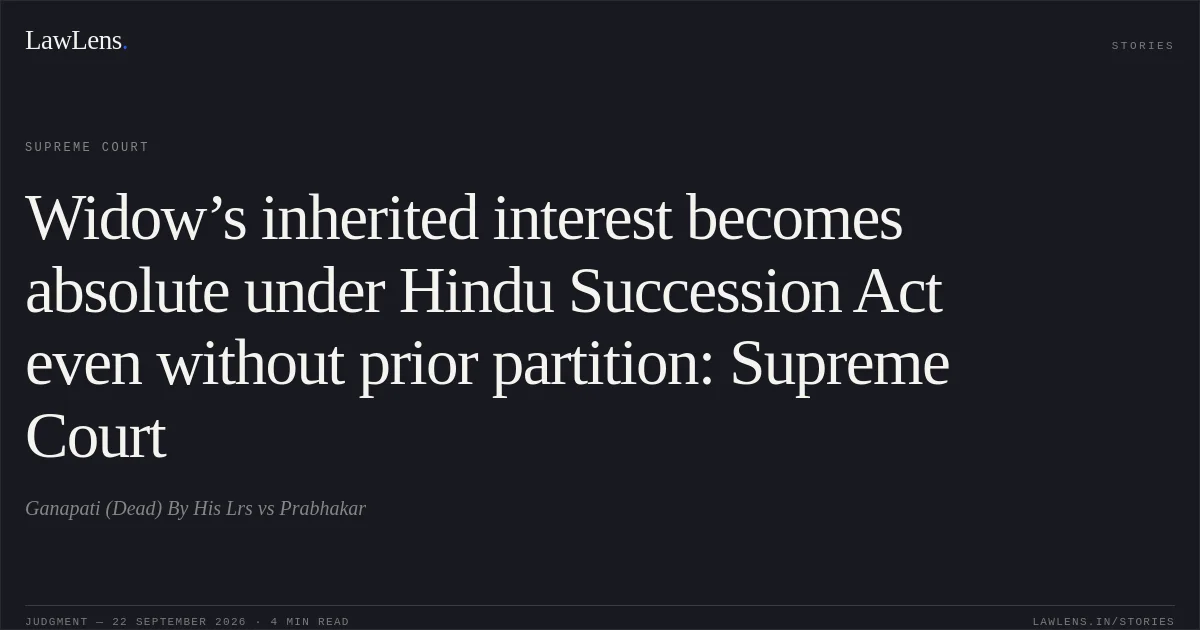
It affirmed that Kashibai acquired an interest in Gangaram’s property under Section 3(2) of the 1937 Act and that the interest matured into absolute ownership under Section 14(1) of the 1956 Act, irrespective of whether an oral partition had been proved.
Source reference: paras. 13–16The Will in favour of Defendant No. 1 and the subsequent sale to Defendant No. 3 were therefore legally sustainable.
Source reference: paras. 17–18The Civil Appeal was dismissed, with no order as to costs.
Source reference: paras. 17–18Acts & Sections Cited
2 provisions across 2 statutes referred to in this judgment. Each provision opens on LawLens.
Hindu Succession Act, 19561
Code of Civil Procedure, 19081
Original Court PDF
Ganapati (Dead) By His LrsvsPrabhakar
Click to open original judgment
Original judgment, available to read, download and summarize on LawLens.in