01Facts
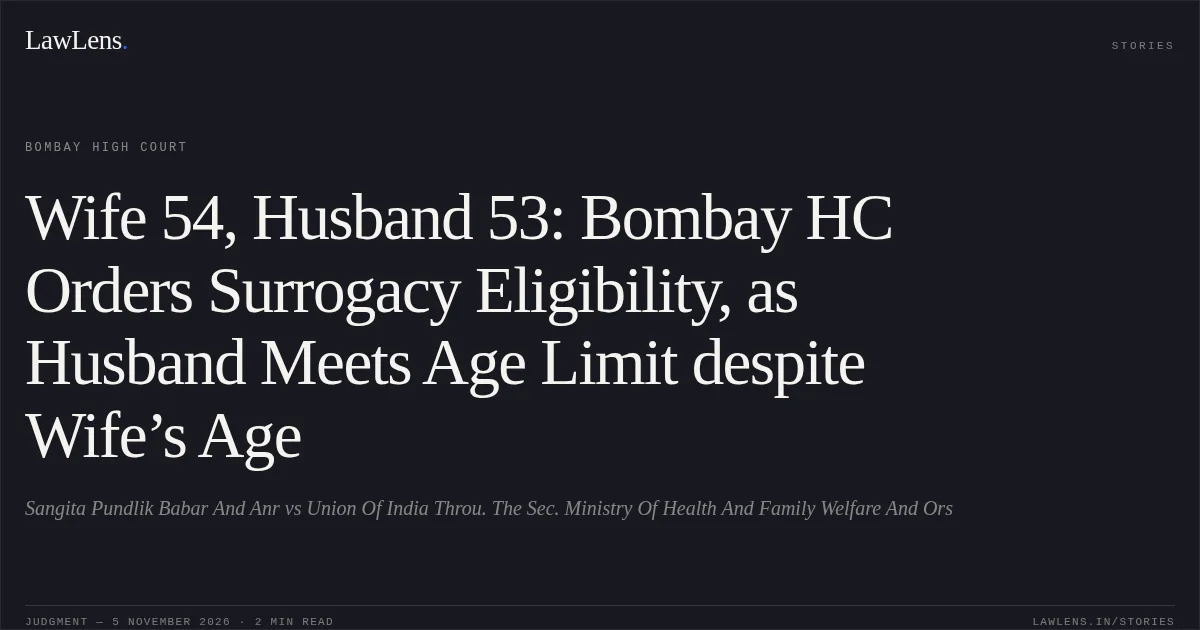
The petitioners, a legally married couple aged 54 and 53, sought gestational surrogacy after prolonged infertility and unsuccessful IVF treatment.
pp. 2–4, 26Their application for an eligibility certificate under Section 4(iii)(c) of the Surrogacy (Regulation) Act, 2021 was rejected because the wife had exceeded the statutory upper age limit of 50 years.
pp. 2–4, 26The husband remained below his prescribed limit of 55 years.
pp. 2–4, 26The petitioners challenged the rejection and sought reconsideration of their eligibility.
pp. 2–4, 2602Issues
i.Whether Section 4(iii)(c)(I) of the Surrogacy (Regulation) Act, 2021 makes an intending couple ineligible when one spouse exceeds the prescribed age limit but the other remains within it.
pp. 15–16, 26–27ii.Whether the age restriction should be interpreted in harmony with the Assisted Reproductive Technology (Regulation) Act, 2021, so that one spouse’s age-based ineligibility does not automatically disqualify the couple from surrogacy.
pp. 19–25, 39–4003Law Applied
Section 4(iii)(c)(I) of the Surrogacy (Regulation) Act, 2021 requires an intending couple to be married and prescribes age ranges of 23–50 years for the female and 26–55 years for the male on the date of certification.
p. 27The Court read that provision with Section 21(g) of the Assisted Reproductive Technology (Regulation) Act, 2021, which separately prescribes age limits for women and men receiving ART services.
p. 39Treating the two statutes as allied and cognate enactments forming a connected statutory framework, the Court applied the approach taken by High Courts under Section 21(g): where one member of a couple is within the prescribed age range, the other member’s age-based ineligibility need not bar the couple from accessing the procedure.
pp. 37–40, 42–47The Court also relied on the recognition of reproductive autonomy as an aspect of personal liberty under Article 21, including the principles in Suchita Srivastava v. Chandigarh Administration and K.S. Puttaswamy v. Union of India.
pp. 55–58It expressly did not determine the constitutional validity of the age limits.
p. 61Provisions in the judgment · 8 · Linked ones open on LawLens
Surrogacy (Regulation) Act, 2021 Section 2Section 4Section 17Section 36Section 50
Assisted Reproductive Technology (Regulation) Act, 2021 Section 2Section 21
Central Excise Act, 1944 Section 1
04Reasoning
The Court found that the petitioners’ eligibility was disputed only because the wife was over 50; their marital status, medical history, bona fides, and other statutory requirements were not contested.
p. 26Because surrogacy necessarily involves ART and the two Acts operate as a connected framework, the Court considered the reasoning of cases interpreting the ART Act’s individually framed age limits relevant to the Surrogacy Act.
pp. 37–40, 53It concluded that denying the petitioners access to surrogacy solely because one spouse exceeded the age limit would be inconsistent with that approach.
pp. 58–62The husband was within the statutory age range, and the Court therefore adopted a purposive interpretation allowing the couple to proceed, without invalidating the statutory age criteria.
pp. 58–6205Holding
The High Court allowed the petition, quashed the Appropriate Authority’s order rejecting the application, and directed it to issue an eligibility certificate to the petitioners.
pp. 62–63It held that the wife’s having crossed 50 years would not, by itself, bar the couple from undergoing surrogacy or, if required, ART.
pp. 62–63The District Medical Board was directed to issue a certificate of medical indication if the petitioners otherwise satisfied the prescribed medical requirements.
pp. 62–63The Court declined to stay its judgment.
p. 64Original Court PDF
Sangita Pundlik Babar And AnrvsUnion Of India Throu. The Sec. Ministry Of Health And Family Welfare And Ors
Click to open original judgment
Original judgment, available to read, download and summarize on LawLens.in