Facts
The petitioner-husband challenged the order dated 5 November 2025 passed by the I Additional Principal Judge, Family Court, Tumakuru, in Crl. Misc. No. 6 of 2025.
Source reference: p. 3; para. 4The wife and minor daughter had sought maintenance under Section 144(1) of the Bharatiya Nagarik Suraksha Sanhita, 2023 (“BNSS”), claiming ₹30,000 per month.
Source reference: p. 3; para. 4The Family Court awarded ₹5,000 per month to the wife and ₹4,000 per month to the minor daughter.
Source reference: p. 3; para. 4The husband contended that the wife had voluntarily left the matrimonial home, that he had neither neglected nor refused to maintain the respondents, and that he earned his livelihood through coolie work while also supporting his parents.
Source reference: p. 3–4; para. 5The wife alleged physical and mental cruelty, demands for additional money, and the husband’s addiction to gambling and alcohol; she nevertheless expressed willingness to resume matrimonial life.
Source reference: p. 4–5; para. 6The husband alleged that she failed to perform household duties, did not care for his parents, and left for her parental home without obtaining his or his parents’ permission.
Source reference: p. 5; para. 7The respondents did not contest the revision petition despite service of notice.
Source reference: p. 2; para. 1Issues
Whether the wife had sufficient cause to live separately from the husband and was therefore entitled to maintenance under Section 144 of the BNSS
Source reference: p. 6–7; paras. 8–10Whether the Family Court’s award of ₹5,000 per month to the wife and ₹4,000 per month to the minor daughter was excessive and required modification in revision
Source reference: p. 8–9; para. 14Whether the High Court should interfere with the Family Court’s order in exercise of its revisional jurisdiction under Section 19(4) of the Family Courts Act, 1984
Source reference: p. 2–3; paras. 2–4Law Applied
The Court applied Section 144(1) of the BNSS, 2023, which authorises an order of maintenance in favour of a wife and minor child unable to maintain themselves where the husband or father has sufficient means but neglects or refuses to maintain them.
Source reference: p. 3; para. 3The Court also considered the statutory limitation concerning a wife living separately without sufficient reason and held that the wife’s entitlement must be assessed in light of whether she had justifiable cause to reside apart.
Source reference: p. 6–7; paras. 8–10The revision was examined under Section 19(4) of the Family Courts Act, 1984.
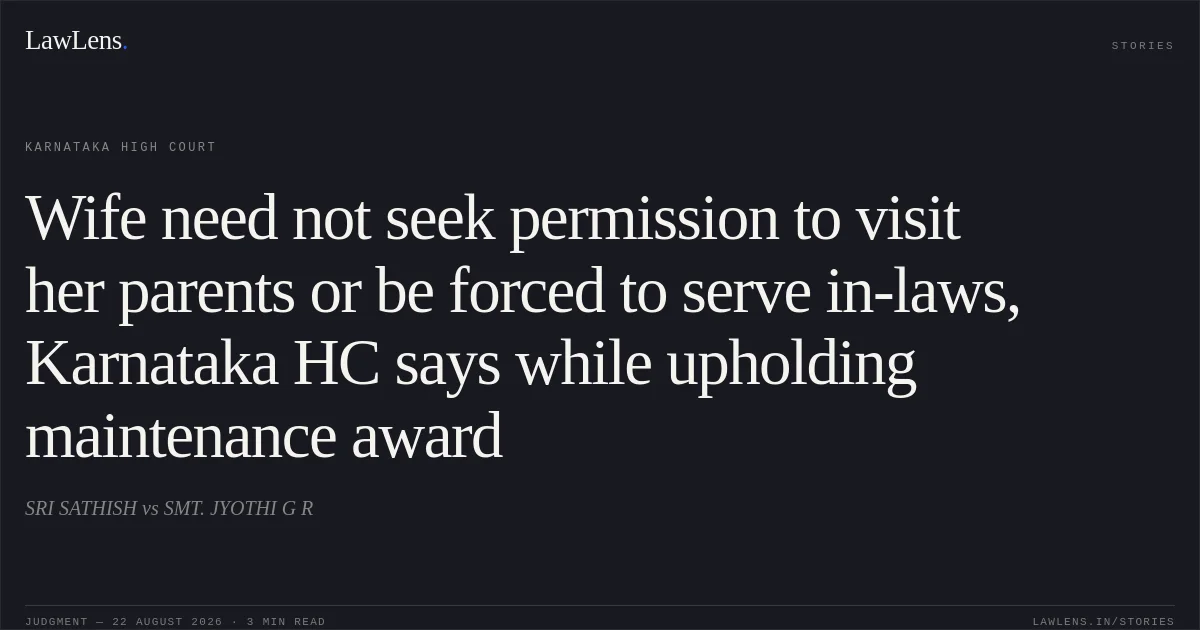
Source reference: p. 2As a matter of constitutional and matrimonial principle, the Court held that marriage does not authorise a husband to control, command, or restrict his wife’s autonomy; household work and care of in-laws cannot be imposed upon a daughter-in-law as a compulsory obligation, and such responsibilities must be voluntary.
Source reference: p. 6–8; paras. 8–13Reasoning
The High Court rejected the husband’s assertion that the wife’s departure from the matrimonial home was unjustified. In particular, the husband’s objection that she had visited her parental home without his and his parents’ permission, and his grievance that she had not performed household duties or cared for his parents, were viewed as reflecting an impermissible expectation that the wife was subordinate to the husband and his family.
Source reference: p. 5–7; paras. 7–9The Court held that a wife is not required to obtain permission to visit her parents and that caring for in-laws is not a compulsory legal duty of a daughter-in-law.
Source reference: p. 6–7; paras. 8–10In view of the wife’s allegations of abuse, assault, monetary demands, and the husband’s alleged alcohol and gambling habits, the Court found sufficient cause for her separate residence.
Source reference: p. 4–7; paras. 6–10On quantum, the Court noted that the total maintenance of ₹9,000 per month amounted to ₹300 per day for two persons, or ₹150 per person per day, which was not excessive considering contemporary prices and the cost of living.
Source reference: p. 8–9; para. 14Accordingly, the Court found no ground for revisional interference.
Source reference: p. 8–9; para. 14Holding
The High Court held that the wife had sufficient cause to reside separately and remained entitled to maintenance under Section 144 of the BNSS.
It further held that the Family Court’s award of ₹5,000 per month to the wife and ₹4,000 per month to the minor daughter was neither exorbitant nor liable to reduction.
Source reference: p. 7–9; paras. 10 and 14The revision petition was dismissed, and the Family Court’s order dated 5 November 2025 was affirmed.
Source reference: p. 9; para. 14Acts & Sections Cited
2 provisions across 2 statutes referred to in this judgment. Each provision opens on LawLens.
Family Courts Act, 19841
Bharatiya Nagarik Suraksha Sanhita, 20231
Original Court PDF
SRI SATHISHvsSMT. JYOTHI G R
Click to open original judgment
Original judgment, available to read, download and summarize on LawLens.in