01Facts
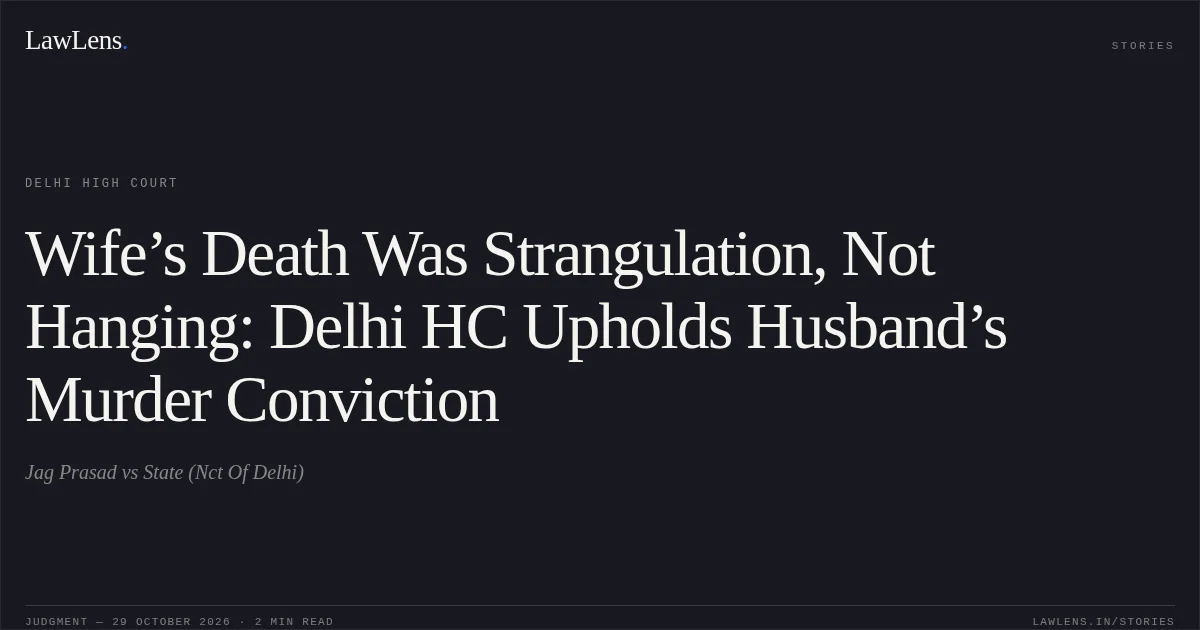
On 2 October 2016, the appellant’s wife was found dead at their home. The appellant said he had found her hanging from a ceiling fan, cut the saree and brought her down. The post-mortem, however, attributed death to ligature strangulation. The prosecution also relied on injuries to the deceased’s head, the appellant’s account of the circumstances, and the absence of signs consistent with the asserted hanging.
pp. 2–4, 8–9The appellant was charged under Section 302 IPC and convicted by the Trial Court; he appealed, maintaining that the death was suicide.
pp. 2–4, 8–9The deceased’s family had initially described the marriage as happy and made no allegation of dowry demand; the High Court treated later allegations of dowry demand as improvements.
pp. 2, 17–1802Issues
i.1. Whether the medical and circumstantial evidence established that the deceased died by homicidal strangulation rather than suicide by hanging.
pp. 9–15ii.2. Whether the circumstances, including the appellant’s account of finding the deceased and his failure to explain them consistently, were sufficient to sustain his conviction under Section 302 IPC.
pp. 14–1703Law Applied
Section 302 IPC applies where the prosecution proves murder beyond reasonable doubt.
pp. 14–15Under Section 106 of the Evidence Act, facts especially within an accused’s knowledge may call for an explanation, but the provision does not displace the prosecution’s burden to establish the relevant circumstances.
pp. 14–15In a circumstantial-evidence case, motive is relevant but its absence is not, by itself, fatal; the court must scrutinise the evidence carefully to ensure that suspicion does not replace proof, as stated in *Amitava Banerjee v. State of W.B.*, (2011) 12 SCC 554, and *Tarsem Kumar v. Delhi Administration*, 1995 Cri LJ 470.
pp. 14–15, 17–18The Court also relied on the medical distinctions between hanging and strangulation discussed in Modi’s *Medical Jurisprudence and Toxicology* and referred to *Javed Abdul Rajjaq Shaikh v. State of Maharashtra*, (2019) 10 SCC 778.
pp. 9–10, 13–14Provisions in the judgment · 4 · Linked ones open on LawLens
Indian Penal Code, 1860 Section 302
Code of Criminal Procedure, 1973 Section 428Section 313
Bharatiya Nagarik Suraksha Sanhita, 2023 Section 351
04Reasoning
The Court found the post-mortem findings—particularly a complete, horizontal ligature mark low on the neck, congestion and internal neck bruising—to be consistent with strangulation and inconsistent with the appellant’s account of hanging; the medical opinion on cause of death had not been challenged in cross-examination.
pp. 9–13It also considered the head injuries, the intact fan and the undisturbed stool and drum, alongside the absence of evidence that anyone other than the appellant had seen the deceased hanging.
pp. 14–16The Court treated the appellant’s explanation as false and inconsistent with the medical and scene evidence, and held that the circumstances called for an explanation under Section 106.
pp. 14–16It considered the disclosure statement about striking the deceased’s head as an additional circumstance, noting that the reported head injuries were consistent with that account, although no rope was recovered.
pp. 15–16The lack of a proved motive did not outweigh the circumstances accepted by the Court.
pp. 17–1805Holding
The High Court held that the Trial Court’s finding of murder was supported by the evidence and disclosed no infirmity.
p. 19It dismissed the appeal and upheld the appellant’s conviction under Section 302 IPC and the sentence of life imprisonment and fine.
p. 19Original Court PDF
Jag PrasadvsState (Nct Of Delhi)
Click to open original judgment
Original judgment, available to read, download and summarize on LawLens.in