01Facts
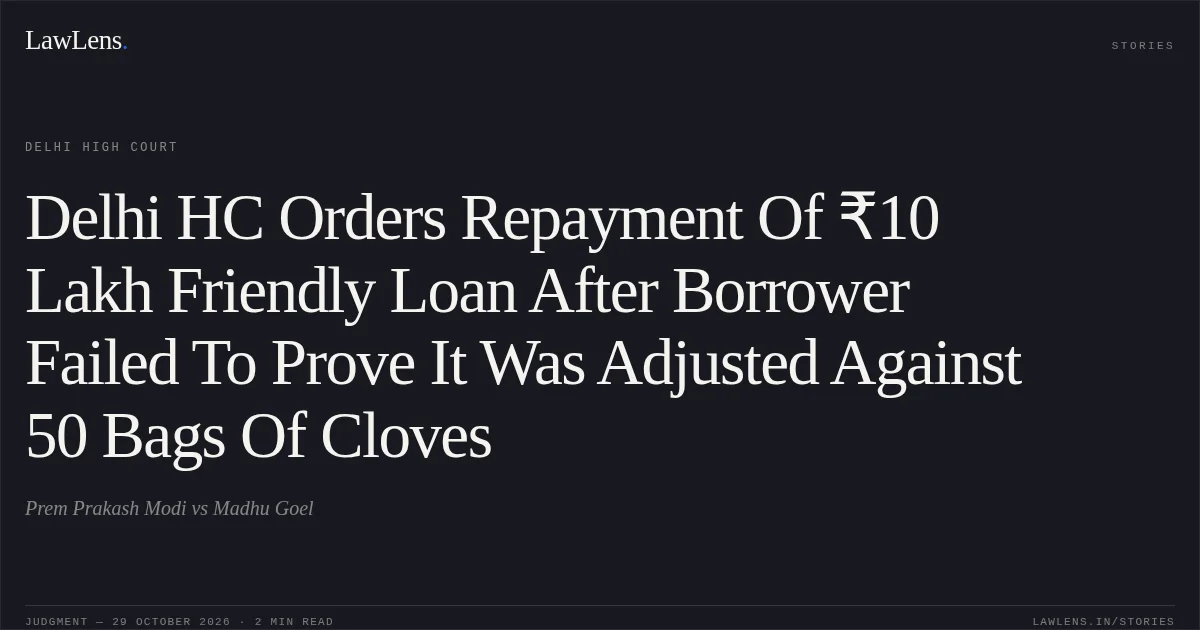
The appellant sued to recover ₹10,00,000, alleging that he had advanced the amount to the respondent as a friendly loan and that it remained unpaid.
¶ 3–12, 23–29The respondent denied the loan characterization and pleaded that the amount related to a business transaction and had been adjusted under a 2013 settlement.
¶ 3–12, 23–29The respondent stopped appearing after filing her written statement, did not cross-examine the appellant, and led no evidence.
¶ 3–12, 23–29The Trial Court dismissed the suit, finding the loan insufficiently proved and declining to rely on the bank statement and Form 16A.
¶ 3–12, 23–29The appellant appealed under Section 96 CPC.
¶ 1–202Issues
i.Whether the appellant proved that ₹10,00,000 was advanced to the respondent and remained repayable, despite the Trial Court’s decision to disregard the bank statement.
¶ 25–31, 38ii.Whether the respondent’s pleaded defence that the amount was adjusted against another transaction could defeat the claim in the absence of evidence supporting that defence.
¶ 36–38iii.Whether the Trial Court’s dismissal of the recovery suit should be set aside.
¶ 39–4003Law Applied
The appeal was brought under Section 96 of the Code of Civil Procedure, 1908, which provides for a first appeal from an original decree.
¶ 1The Court’s reasoning applied the evidentiary principle that a party asserting an affirmative defence—here, adjustment of the amount under a settlement—must support that defence with evidence; an unchallenged and unrebutted account of the transaction may be relied upon when the opposing party neither cross-examines the witness nor leads evidence.
¶ 24, 28, 37–38Although the Trial Court had considered Section 65B of the Indian Evidence Act, 1872, in assessing the computer-generated bank statement, the High Court held that proof of that statement was unnecessary in the circumstances.
¶ 12, 29–31Provisions in the judgment · 2 · Linked ones open on LawLens
Code of Civil Procedure, 1908 Section 96Section 151
04Reasoning
The appellant’s testimony that he advanced the loan remained unrebutted, and the respondent did not cross-examine him.
¶ 24–25, 28The Court considered that the written statement did not deny receipt of ₹10,00,000, but instead pleaded that the amount had been adjusted against another transaction.
¶ 31It therefore concluded that the bank statement’s formal proof was not decisive to establishing receipt of the sum.
¶ 29–31The Court also considered Form 16A, which identified Madhu Goel as the deductor, alongside the appellant’s unchallenged evidence.
¶ 27, 32–33Since the respondent neither testified nor produced evidence of the alleged adjustment, the Court held that her defence could not displace the appellant’s evidence.
¶ 36–3805Holding
The High Court held that the appellant had proved that ₹10,00,000 was advanced and remained unpaid, while the respondent had failed to establish the pleaded adjustment.
¶ 38It set aside the Trial Court’s judgment and decree and decreed the suit for ₹10,00,000 with interest at 6% per annum from the date of filing until realization.
¶ 39–41Original Court PDF
Prem Prakash ModivsMadhu Goel
Click to open original judgment
Original judgment, available to read, download and summarize on LawLens.in