01Facts
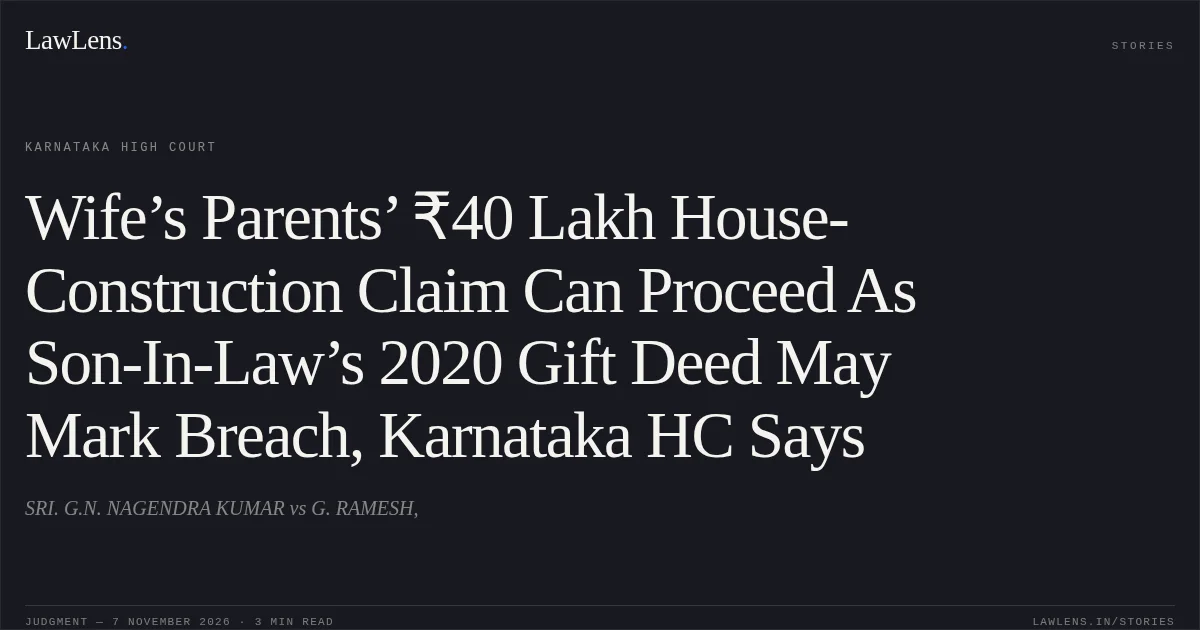
The plaintiffs alleged that they spent approximately ₹40 lakh constructing and furnishing a house on land owned by defendant No. 1, their son-in-law, after relying on oral assurances that they could reside there for life and that the property would ultimately benefit their daughter and grandson.
pp. 3–12, paras 2–7Construction was completed and the housewarming ceremony held in November 2012. Defendant No. 1 later executed a gift deed concerning the property in favour of defendant No. 2 on 20 December 2020.
pp. 3–12, paras 2–7After demands for repayment were refused, the plaintiffs filed a money-recovery suit on 10 March 2023. The defendants sought rejection of the plaint under Order VII Rule 11(a) and (d) CPC, contending that no cause of action was disclosed and that the claim was time-barred because the expenditure was incurred in 2012. The Trial Court rejected the application, and the defendants challenged that order in revision.
pp. 3–12, paras 2–702Issues
i.1. Whether the plaintiffs’ right to recover the construction expenditure accrued when the expenditure was incurred in 2012, or whether the alleged breach of the oral arrangement through the 2020 gift deed could give rise to a cause of action within limitation.
p. 14, para 10ii.2. Whether, on the plaint averments, the suit was liable to be rejected under Order VII Rule 11(a) or (d) CPC for failure to disclose a cause of action or for being barred by limitation.
pp. 11–14, paras 7–1003Law Applied
Under Order VII Rule 11 CPC, the court examines the plaint as a whole, accepts its material factual averments as true, and does not consider the defendant’s defence; however, it must reject a plaint where the absence of a cause of action or a legal bar, including limitation, is apparent from the plaint itself.
p. 14, para 11Limitation may be a mixed question of law and fact where its determination depends on the nature and timing of the pleaded obligation.
pp. 17–18, para 12The Court considered Articles 23 and 55 of the Limitation Act, 1963, as potentially relevant depending on whether the claim was for money paid under a contractual obligation or arose upon breach of the alleged arrangement.
pp. 17–18, para 12Provisions in the judgment · 5 · Linked ones open on LawLens
Code of Civil Procedure, 1908 Section 115Section 7Section 151
Limitation Act, 1963 Section 22Section 23
04Reasoning
The plaint alleged more than a simple advance of money in 2012: it described an oral family arrangement involving repayment, continued residence, and the future benefit of the property to the plaintiffs’ daughter. On that pleaded case, the 2020 gift deed was alleged to have defeated the arrangement and could potentially mark the breach giving rise to the claim.
pp. 15–20, paras 12–13As the suit was filed within three years of that deed, the Court held that limitation could not be determined solely by reference to the date construction was completed.
pp. 15–20, paras 12–13Whether the promise to repay was unconditional, when it became enforceable, and whether reimbursement was legally available depended on the nature of the alleged arrangement and required adjudication. Those matters could not be conclusively decided under Order VII Rule 11 on the plaint as pleaded.
pp. 15–20, paras 12–1305Holding
The High Court dismissed the civil revision petition and declined to interfere with the Trial Court’s refusal to reject the plaint.
pp. 20–21, para 13 and orderIt left open the parties’ rights and the merits of the plaintiffs’ claim, directing that the Trial Court proceed uninfluenced by the High Court’s observations, which were made only for deciding the application.
pp. 20–21, para 13 and orderOriginal Court PDF
SRI. G.N. NAGENDRA KUMARvsG. RAMESH,
Click to open original judgment
Original judgment, available to read, download and summarize on LawLens.in