Facts
The respondent, Celagenex Research (India) Pvt. Ltd., was the proprietor of the registered Class 5 trademark “NUREWIRE”, used for nutraceutical products.
Source reference: paras. 3–5Appellant No. 2, a founding director and shareholder of the respondent, resigned in October 2024.
Source reference: paras. 3–6Appellant No. 1 was incorporated in December 2024 and subsequently adopted the mark “RewireX”, for which it filed a trademark application on a proposed-to-be-used basis on 6 March 2025; products bearing that mark were launched in March 2026.
Source reference: paras. 3–6The respondent issued a cease-and-desist notice dated 29 October 2025 after becoming aware of the appellants’ trademark application and later filed objections before the Registrar of Trade Marks on 27 January 2026.
Source reference: paras. 7, 15–16However, the plaint stated that the respondent first learnt of the appellants’ mark and allegedly infringing sales only in May 2026, without pleading the prior notice or objections.
Source reference: paras. 17–18, 23–30The learned Single Judge granted an ex parte ad-interim injunction on 20 May 2026 and appointed a Local Commissioner.
Source reference: para. 8The appellants challenged that order under Section 13(1A) of the Commercial Courts Act, 2015 read with Order XLIII Rule 1(r) CPC, contending that the respondent had suppressed material facts and that the requirements of Order XXXIX Rule 3 CPC had not been satisfied.
Source reference: paras. 1, 10.1–10.3Issues
1. Whether the respondent’s failure to disclose the cease-and-desist notice dated 29 October 2025 and objections dated 27 January 2026 amounted to wilful suppression of material facts, affecting the ex parte injunction.
Source reference: paras. 19–332. Whether the learned Single Judge could grant an ex parte ad-interim injunction without recording reasons under Order XXXIX Rule 3 CPC and without providing the appellants an opportunity of being heard.
Source reference: paras. 34–373. Whether the respondent, having approached the Court without full candour and having obtained discretionary relief on the basis of suppressed facts, was entitled to retain the interim injunction.
Source reference: paras. 39–43, 54–564. Whether the injunction application itself was liable to be dismissed, and what consequential reliefs and costs should follow.
Source reference: paras. 43, 55–58Law Applied
The Court applied Section 13(1A) of the Commercial Courts Act, 2015 read with Order XLIII Rule 1(r) CPC in examining the appeal against the injunction order.
Source reference: para. 1Under Order XXXIX Rule 3 CPC, notice must ordinarily precede an injunction, unless the Court is satisfied that delay would defeat the object of granting relief; in such a case, reasons for dispensing with notice must be recorded. Order XXXIX Rule 3A requires an expeditious returnable hearing where an ex parte injunction is granted.
Source reference: para. 10.3The Court relied on the commercial-litigation obligation of complete disclosure under the Statement of Truth, including disclosure of all material facts and documents.
Source reference: paras. 22, 56It applied the clean-hands and uberrima fides principles recognised in R v. Kensington Income Tax Commissioner, Oswal Fats and Oils Ltd. v. Additional Commissioner, and Amar Singh v. Union of India: a litigant seeking ex parte equitable relief must disclose all material facts, and suppression that misleads the Court ordinarily warrants vacation of the order and dismissal of the interim application.
Source reference: paras. 39–42The Court also relied on Dabur India Ltd. v. Emami Ltd. and Wander Ltd. v. Antox India (P) Ltd. for the principle that where the defendant has already commenced commercial activity, the Court should consider issuing short notice before granting an injunction.
Source reference: para. 35The Court further referred to Lakshmikant V. Patel v. Chetanbhai Shah on the power to grant ex parte relief in appropriate counterfeit or passing-off cases, while emphasising that such discretion must be exercised on the basis of full disclosure.
Source reference: para. 37Section 12A of the Commercial Courts Act, 2015 concerning pre-institution mediation was also considered, although the exemption granted by the Single Judge was not interfered with.
Source reference: para. 38Reasoning
The Court held that the respondent’s prior notice and objections were material because they established that it knew of the appellants’ adoption of “RewireX” at least by October 2025, contrary to the plaint’s assertion that knowledge arose only in May 2026.
Source reference: paras. 23–30Merely including the objections and notice within a bundled document under an obscure index description did not satisfy the obligation of disclosure under the Statement of Truth, particularly when the documents were not separately identified or pleaded.
Source reference: paras. 31–33The omission was found to be wilful, not inadvertent, especially in light of the pattern of similar non-disclosures by the same filing counsel in other suits.
Source reference: paras. 45–53This suppression created a misleading impression of a fresh and urgent cause of action and materially influenced the Single Judge’s decision to dispense with advance service and grant ex parte relief.
Source reference: paras. 34–37Had the prior notice and objections been disclosed, the Court could have issued short notice and heard the appellants before deciding the injunction.
Source reference: paras. 34–37Further, the impugned order did not record the reasons required under Order XXXIX Rule 3 for proceeding without notice.
Source reference: para. 37Although the respondent relied on the likelihood of confusion between “NUREWIRE” and “RewireX”, the Division Bench held that the merits could not cure the respondent’s misconduct in obtaining equitable relief through non-disclosure.
Source reference: paras. 43, 54The absence of any prima facie indication that the appellants’ regulated products were substandard or dangerous also meant that no overriding public-interest consideration justified preserving the injunction.
Source reference: para. 55Holding
The appeal was allowed.
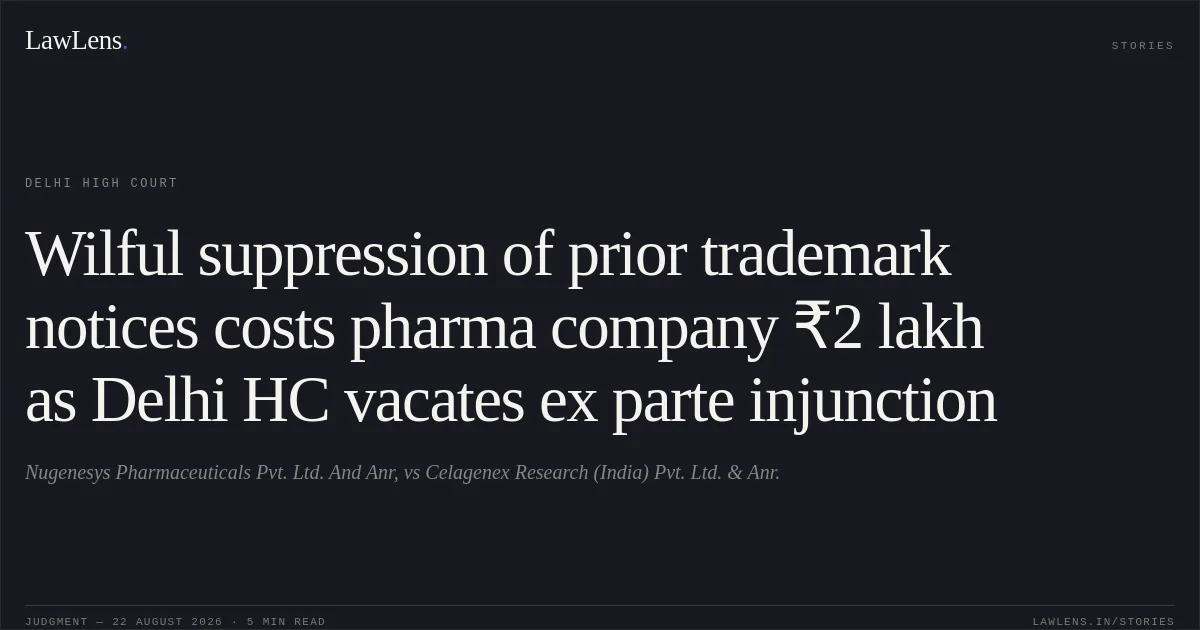
The Court held that the respondent had wilfully suppressed material facts and documents and had obtained the ex parte injunction by presenting a misleading account of the date of knowledge and urgency.
Source reference: paras. 30, 43, 56The ex parte ad-interim order dated 20 May 2026 was vacated, and the respondent’s interim injunction application, I.A. No. 14201/2026, was dismissed.
Source reference: paras. 56–57The products seized from the appellants were directed to be released from superdari, and the appellants were permitted to dispose of them.
Source reference: para. 57The respondent was directed to pay ₹2,00,000 as costs to the Delhi High Court Legal Services Committee within two weeks.
Source reference: para. 56The Court did not interfere with the exemption from pre-institution mediation, and all pending applications in the appeal were disposed of.
Source reference: paras. 38, 58Acts & Sections Cited
3 provisions across 2 statutes referred to in this judgment. Linked provisions open on LawLens.
Commercial Courts Act, 20152
Code of Civil Procedure, 19081
Original Court PDF
Nugenesys Pharmaceuticals Pvt. Ltd. And Anr,vsCelagenex Research (India) Pvt. Ltd. & Anr.
Click to open original judgment
Original judgment, available to read, download and summarize on LawLens.in