Facts
The petitioners were Class I officers of the Kolkata Port Trust, now Syama Prasad Mookerjee Port, who claimed that successive wage revisions of Class III and Class IV workmen had resulted in their subordinates receiving higher pay than them.
Source reference: para. 1–2An Anomaly Committee constituted in 2014 recommended merger of 50% Dearness Allowance with the officers’ basic pay from 1 January 2012.
Source reference: para. 3Subsequently, the Ministry of Finance approved a 17.5% Special Pay for affected Class I and Class II officers, subject to a monthly ceiling of ₹6,890, by order dated 10 July 2017.
Source reference: para. 7The Special Pay was implemented from July 2017 and paid until 5 February 2020.
Source reference: para. 9–10A pay revision was implemented with effect from 1 January 2017 by order dated 5 February 2020.
Source reference: para. 11Clause 2.3 of that order stated that the 17.5% Special Pay was to be “subsumed” in the pay revision, but directed that it be ignored while calculating the 15% fitment benefit.
Source reference: para. 11, 42The petitioners contended that this effectively withdrew the Special Pay, thereby reviving the pay anomaly, particularly after further workmen wage revisions in 2017 and 2022.
Source reference: para. 15–18, 32(iv)–(v)They sought quashing of the withdrawal, restoration and merger of the Special Pay with basic pay, refixation of pay, and payment of arrears.
Source reference: para. 21–22Issues
1. Whether Clause 2.3 of the Pay Revision Order dated 5 February 2020, which required the 17.5% Special Pay to be ignored for calculating fitment benefit, unlawfully withdrew or excluded a benefit previously approved by the Ministry of Finance?
Source reference: para. 32(iii), 37–422. Whether the withdrawal or exclusion of the Special Pay was arbitrary, unreasonable, and contrary to the purpose for which the benefit had been granted—namely, to remove the pay disparity between Class I and Class III/IV employees?
Source reference: para. 12–15, 32(iv)–(v)3. Whether such withdrawal could be effected without the concurrence or approval of the Ministry of Finance or the Department of Expenditure, particularly in view of its financial implications?
Source reference: para. 19(d), 38–42Law Applied
The Court applied the principle that administrative and executive decisions affecting pay and service conditions must be rational, non-arbitrary, and consistent with the purpose for which a benefit was granted.
Source reference: para. 19(b)–(c)It relied on Paritosh Paruk & Ors. v. State of West Bengal & Ors., 87 C.W.N. 747, for the principle that a pay structure should not ordinarily result in subordinates receiving higher pay than their superiors.
Source reference: para. 19(a), 23(i)The Court also referred to Lalit Mohan Deb & Ors. v. Union of India & Ors., (1973) 3 SCC 862.
Source reference: para. 23(ii)Under the Government of India (Transaction of Business) Rules, 1961, matters concerning the pay or allowances of Government servants or other service conditions having financial implications require inter-departmental consultation and the requisite concurrence of the Ministry of Finance.
Source reference: para. 19(d), 39–40Although those Rules do not directly govern statutory bodies, the Court held that the administrative Ministries overseeing such bodies remain bound by the applicable financial and approval procedures; the Delegation of Financial Powers Rules and General Financial Rules were treated as the governing financial framework.
Source reference: para. 39–41The Court further construed “subsumed” as meaning absorbed or incorporated, not excluded from the pay-fixation exercise.
Source reference: para. 19(e), 20, 37Reasoning
The Court found that the 17.5% Special Pay had been consciously approved by the Ministry of Finance to address the admitted pay anomaly between Class I officers and Class III/IV employees.
Source reference: para. 32(i)–(ii), 33–36Although Clause 2.3 described the Special Pay as “subsumed,” it simultaneously directed that the component be ignored while determining fitment benefit. In the Court’s view, this operated as a withdrawal rather than an absorption of the benefit.
Source reference: para. 32(iii), 37The withdrawal defeated the original object of the Special Pay because subsequent workmen wage revisions again resulted in Class III and Class IV employees receiving higher pay than Class I officers.
Source reference: para. 32(iv)–(v), 36The Court also noted that the Department of Expenditure had itself observed that withdrawal would restore the anomaly.
Source reference: para. 8, 33, 35Since the Special Pay had financial implications and had originally been approved by the Ministry of Finance, its withdrawal without corresponding approval or concurrence lacked authority.
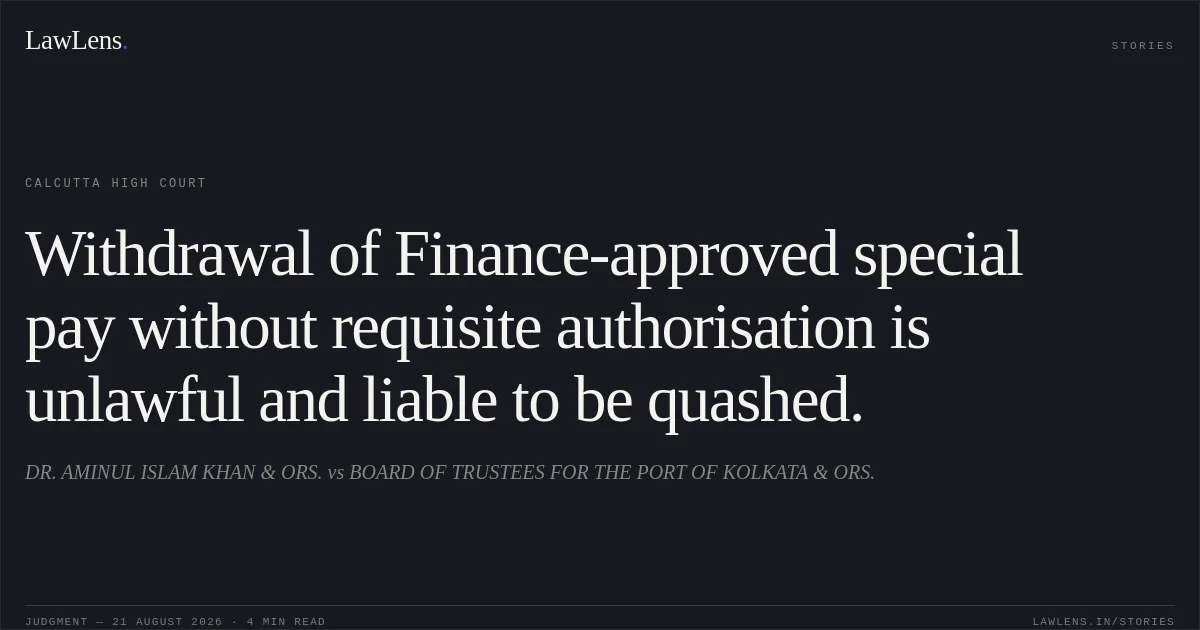
Source reference: para. 38–42Accordingly, Clause 2.3 was held to be arbitrary and legally unsustainable.
Source reference: para. 42Holding
The writ petition was allowed.
Clause 2.3 of the Pay Revision Order dated 5 February 2020, insofar as it required the 17.5% Special Pay to be ignored for pay fixation, was quashed and set aside.
Source reference: para. 42–43The Ministry of Finance’s approval of the Special Pay dated 10 July 2017, effective from January 2012, was directed to continue in force.
Source reference: para. 44The respondent authorities were directed to refix the petitioners’ pay by adding the Special Pay from the date of its withdrawal, and to disburse arrears and consequential benefits within three months from the date of the judgment.
Source reference: para. 44Connected applications were disposed of and any interim order was vacated.
Source reference: para. 45–46Original Court PDF
DR. AMINUL ISLAM KHAN & ORS.vsBOARD OF TRUSTEES FOR THE PORT OF KOLKATA & ORS.
Click to open original judgment
Original judgment, available to read, download and summarize on LawLens.in