Facts
The petitioner, initially appointed as a Constable and subsequently promoted as Head Constable, was posted at Police Station Bahodapur, District Gwalior.
Source reference: no citationOn 25 November 2022, he was directed to inquire into Merg Case No. 89/2022.
Source reference: no citationFollowing allegations concerning delay in registration of the case against the accused, a fact-finding inquiry was conducted by the CSP, Gwalior.
Source reference: no citationThe petitioner contended that neither the fact-finding inquiry report nor a show-cause notice was supplied to him, and that no opportunity to submit an explanation was granted before the Superintendent of Police imposed the penalty of withholding one annual increment without cumulative effect by order dated 2 November 2023.
Source reference: para. 2His departmental appeal was rejected on 9 February 2024.
Source reference: para. 2The State defended the orders on the ground that the punishment was imposed after consideration of the fact-finding inquiry report.
Source reference: para. 3Issues
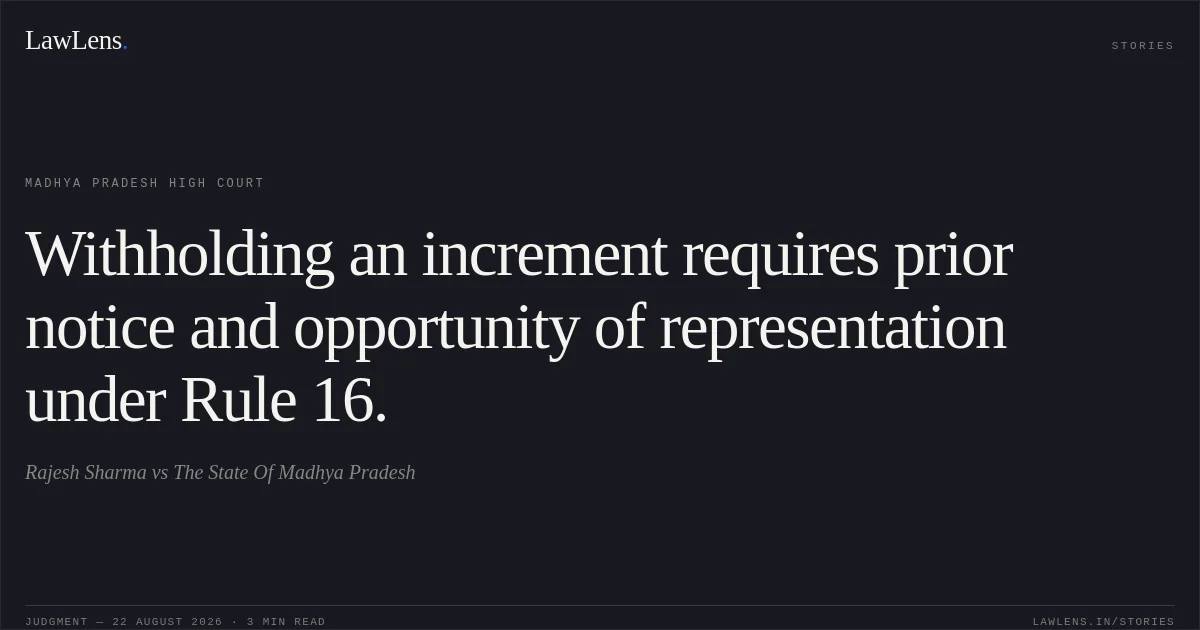
Whether the disciplinary authority could impose the minor penalty of withholding one annual increment without cumulative effect without furnishing the inquiry material and giving the petitioner a reasonable opportunity to submit a representation under Rule 16 of the M.P. Civil Services (Classification, Control and Appeal) Rules, 1966.
Source reference: paras. 2, 5Whether the punishment order and the appellate order were liable to be quashed for violation of the principles of natural justice and the procedure prescribed under Rule 16.
Source reference: paras. 5–6Law Applied
The Court applied Rule 16(1) of the M.P. Civil Services (Classification, Control and Appeal) Rules, 1966, which prohibits imposition of specified minor penalties unless the government servant is informed in writing of the proposed action and the imputations of misconduct and is given a reasonable opportunity to make a representation.
Source reference: para. 5The disciplinary authority must consider the representation and any inquiry record, record findings on each imputation, and comply with the prescribed procedural safeguards.
Source reference: para. 5Rule 16(2) further requires the disciplinary record to include the proposal, statement of imputations, representation, evidence, findings, and reasoned orders.
Source reference: para. 5Where the penalty involves withholding increments in circumstances covered by Rule 16(1-a), a formal inquiry under Rule 14 is mandatory.
Source reference: para. 5These requirements embody the principles of natural justice and fair disciplinary procedure.
Source reference: paras. 2, 5Reasoning
The Court found that the punishment order was based on the fact-finding/merg inquiry report, but did not indicate that the report had been supplied to the petitioner or that any show-cause notice had been issued.
Source reference: para. 5The petitioner was therefore denied an opportunity to know the imputations and respond to the material relied upon by the disciplinary authority.
Source reference: para. 5The direct imposition of the penalty, without seeking the petitioner’s explanation or recording findings in accordance with Rule 16, was contrary to the mandatory procedure under the 1966 Rules and violated natural justice.
Source reference: paras. 2, 5The appellate authority’s failure to correct this procedural defect rendered the appellate order unsustainable as well.
Source reference: para. 6Holding
The Court held that the punishment order dated 2 November 2023 and the appellate order dated 9 February 2024 were procedurally invalid and quashed both orders.
The respondents were directed to grant the petitioner all consequential benefits.
Source reference: para. 6The Court, however, granted liberty to the respondents to take fresh action against the petitioner in accordance with law, if so advised.
Source reference: para. 6The writ petition was accordingly allowed and disposed of.
Source reference: para. 7Original Court PDF
Rajesh SharmavsThe State Of Madhya Pradesh
Click to open original judgment
Original judgment, available to read, download and summarize on LawLens.in